
Playing Catch-Up: White Girl (dir by Elizabeth Wood)


white_girl_film_poster

Ever since it premiered at the Sundance Film Festival, I’ve read the White Girl was the most “shocking” film of 2016.  You can take a look at the poster above and see that, according to The Hollywood Reporter, White Girl is “SHOCKING … AND SEXY AS HELL!”

Well, I finally got a chance to watch White Girl on Netflix and the only thing shocking about it is that so many (male) critics were apparently convinced that it was the most shocking movie ever made.  I certainly wouldn’t call it shocking.  (And considering that White Girl features two graphic rapes, I’d love to know why the critic thought “sexy as Hell” would be an appropriate description.)  A better description of White Girl would be “honest.”  Then again, considering the way that the movies usually present the experience of being young, female, and in the city, perhaps the fact that White Girl is an honest film is the most shocking thing of all.

Morgan Saylor plays Leah, a college student who, along with her friend, Katie (India Meneuz), moves into a New York apartment.  The apartment is located in a largely Spanish neighborhood, one that has yet to surrender to gentrification.  While Katie and Leah’s hipster friends are immediately suspicious of everyone else in the neighborhood, the Oklahoma-born Leah is far more adventurous (or perhaps reckless).  She approaches Blue (Brian Marc) on a street corner and asks him if he has any weed.

Blue has weed and a lot more.  He’s the neighborhood drug dealer and soon, he’s also Leah’s boyfriend.  When Leah isn’t getting high and having sex with Blue, she’s working as an intern at a magazine where, early on in the film, she’s sexually assaulted by her boss, Kelly (Justin Bartha, playing a predator who, for many, will seem disturbingly familiar).  Leah invites Blue to a party given by the magazine and Blue is able to make a lot of money selling cocaine to Leah’s wealthy co-workers.

For Blue, drugs are a business and he refuses to do hard drugs himself.  To Leah, it’s an adventure, one that she believes doesn’t have any real consequences.  Or, at least, that’s the way she sees it until Blue is arrested.  With Blue, a repeat offender, facing a life sentence, Leah manages to find a lawyer (Chris Noth, who will make you skin crawl) but she needs to raise the money to pay him.  Fortunately, Leah has a stash of cocaine that Blue was supposed to sell.  Blue tells Leah that she needs to return the cocaine to his dealer but instead, Leah decides to sell the cocaine herself.  Or, at the very least, she’s going to sell whatever cocaine she doesn’t end up snorting herself…

White Girl has been called shocking because of its open and nonjudgmental portrayal of both drugs and sex but, honestly, there’s nothing shocking about it.  It may be a generational thing but, to me, Leah’s story was a familiar one.  I’ve known a lot of Leahs and, personally, there were moments in White Girl that left me cringing just because I could relate to one of Leah’s naive notions or I could remember what it was like to feel like, no matter what I did, there would never be any consequences.  Leah may not always be a likable character but it’s not because she has sex or experiments with drugs.  Instead, it’s because she spends most of the film blissfully unaware of her own privilege.  Leah thinks that she understands the realities of Blue’s world but, as she learns by the end of the film, she’s really just a tourist.  And, unlike Blue and the rest of her neighbors, Leah can always leave whenever she wants.

So, White Girl was not a shocking film to me.  Instead, it was a very honest film.  It can currently be viewed on Netflix.
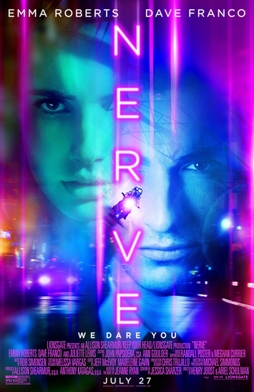
Back to School Part II #52: Nerve (dir by Henry Joost and Ariel Schulman)


For the past three weeks, Lisa Marie has been in the process of reviewing 56 back to school films!  She’s promised the rest of the TSL staff that this project will finally wrap up by the end of today, so that she can devote her time to helping to prepare the site for its annual October horrorthon!  Will she make it or will she fail, lose her administrator privileges, and end up writing listicles for Buzzfeed?  Keep reading the site to find out!)

nerve_2016_poster

Recently, I came across someone on twitter wondering if Emma Roberts is ever actually going to play an adult role.  Personally, I think the question is a bit unfair (just because you’re playing a teenager, that doesn’t mean that you’re not dealing with “adult” issues) but I understand the logic behind it.  Emma Roberts is a Hollywood veteran who made her film debut 15 years ago.  She’s currently 25 years old but, more often that not, she’s still cast as a high school student.  (At the most, she might occasionally get to be a college student.)  Going solely by her film and television roles, Emma Roberts has been a high school student for 12 years now.

But you know what?

I say more power to Emma Roberts.  Being a teenager is a lot more fun than being an adult and she should stay in high school for as long as she can pull it off!

Anyway, this year’s Emma-Roberts-In-High-School film was a thriller called Nerve.  Actually, very little of the film takes place in high school though a running theme through the film is the desire of a senior named Vee (short for Venus and played by Roberts) to attend the California Institute of the Arts after she graduates.  Unfortunately, it costs money to go to a good school and Vee’s mother (Juliette Lewis) doesn’t have any.  As well, both Vee and her mother are still struggling to accept the recent death of Vee’s brother.

However, there may be a way for Vee to raise the money.  Vee learns that her friend, Sydney (Emily Meade), has become an online star by playing Nerve.  Nerve is a game where you can either volunteer to be a player or you can pay to be a viewer.  (There’s a third role that you can play in Nerve but it’s not a good role and we don’t learn about it until later in the film.)  The watchers dare the players to do something.  If the players do it, they win money.  If the players fail … well, there are consequences for everything.

Though initially reluctant, Vee agrees to be a player.  At first, it’s a lot of fun.  The normally cautious Vee gets to experience the exhilaration of taking a risk.  She even meets another Nerve player, Ian (Dave Franco) and soon the two of them are a team, partners and perhaps something more.  But, as the game progresses, the dares become more dangerous and the stakes get higher.  And, of course, Ian has a secret of his own..

The great thing about Nerve is that it tells a story about what’s is pretty much happening right now.  It’s easy to imagine a real-life version of Nerve going on right now.  As I watched Vee and Ian play Nerve, I was actually reminded of how much fun twitter used to be.  And then, just as happens in Nerve, more and more people got involved and things quickly went downhill.  The more popular both twitter and Nerve became, the less pleasant the experience.  The same is true for just about everything that’s ever happened online.  It always starts out as fun until the trolls arrive.  (And trolls, of course, have the magic ability to use their mere presence to transform former non-trolls into trolls as well.)  Nerve answers the age-old question of why we can’t have nice things.

Beyond that, it’s an entertaining film.  Emma Roberts and Dave Franco make for an exceptionally likable couple, the film is quickly paced, and Michael Simmonds’s cinematography gives the film an appealing and slickly flamboyant look.  Nerve didn’t really get as much attention as it deserved when it was originally released but I have a feeling that it is a film that will be rediscovered and appreciated by viewers in the future.