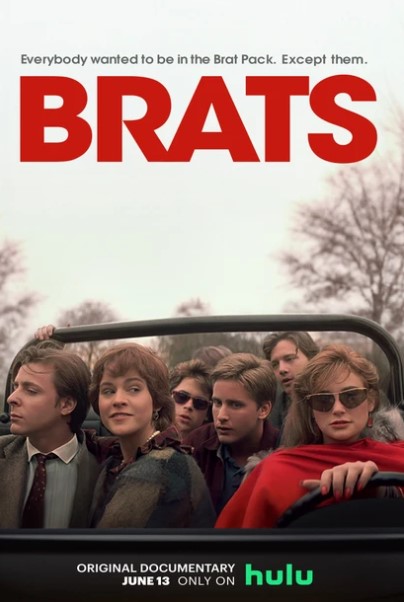
The documentary Brats opens with actor and travel writer Andrew McCarthy in New York City.
He’s obsessing over his film career, which featured him starring in several classic 80s films, like Pretty In Pink, Class, and Less Than Zero. If you love those films as much as I do, you’ll be happy to know that, physically, McCarthy has aged well. If he was adorably cute during his teen idol days, Andrew McCarthy now looks like a distinguished and handsome creative writing teacher. McCarthy talks about how he was briefly a star and now, he has a busy career as a writer. To be honest, it seems like everything should be going pretty well for Andrew McCarthy.
The only problem is that Andrew McCarthy has spent the last 30 years obsessed with an article that he feels led to him being labeled as one of the “Brat Pack,” along with Emilio Estevez, Rob Lowe, Judd Nelson, Molly Ringwald, Demi Moore, and Ally Sheedy. Interestingly enough, McCarthy is only mentioned once in the article, when Nelson dismissively describes him as playing every role “with the same intensity.” Still, McCarthy feels that the article led to him being unfairly labeled “a brat,” and it also led to his film career fizzling.
Over the course of the documentary, McCarthy travels to California and tracks down some of his co-stars (with both Ringwald and Nelson being notable for their absence) and he also talks to the author of the article. He talks about what it means to be identified with the Brat Pack and how the label still haunts him.
Seriously, this is one of the most depressing documentaries I’ve ever seen.
It’s not just that McCarthy, who really does seem like he should be enjoying his second act as a successful and respected travel writer, is still obsessed with an article that came out 30 years ago. It’s also the fact that, judging from the scenes in which he drops in on Estevez, Lowe, Moore, and Sheedy, it doesn’t appear that anyone has wanted to talk to McCarthy since they all did St. Elmo’s Fire. Emilio Estevez, especially, seems to be uncomfortable with having McCarthy in his kitchen. As for the others, Ally Sheedy is polite, Demi Moore comes across as if she’s visiting from another planet, and Rob Lowe is once again the most likable and laid back person in the room. Everyone that McCarthy interviews has dealt with the Brat Pack legacy in their own different way. The thing they all have in common is that they’ve all dealt with it better than McCarthy.
The saddest part of the film is that Molly Ringwald never returns Andrew McCarthy’s call. Seriously, the main reason I watched this documentary was because I wanted to see Andie and Blane reunited. Instead, I had to settle for Blane and Duckie having an awkward conversation. It’s nice to see that McCarthy and Jon Cryer are apparently now on friendly terms (which apparently they weren’t during the filming of Pretty in Pink), but seriously, Molly is the one that most viewers will probably want to see reunited with Andrew. That it doesn’t happen is kind of heart-breaking.
I hope someone gives Andrew McCarthy a good hug and tells him that we’re all Team Blane. He deserves it.


 Through the Shattered Lens