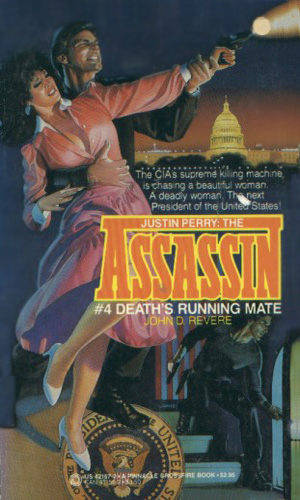
Book Review: Death’s Running Mate by John D. Revere


Having previously taken on mutant chickens and barnyard sex, the fourth Justin Perry novel takes on the American political system!

First published in 1985, Death’s Running Mate is all over the place.  Author John D. Revere plays with time in Death’s Running Mate, which means that the book opens minutes before the climax of oversexed super assassin Justin Perry’s latest mission and then flashes back to how Perry and the readers arrived at that moment but the flashbacks themselves contain their own flashbacks and even the occasional flash forward.  It leaves the plot so jumbled that it would probably require keeping extensive notes to really understand everything that happens and jotting down notes is a bit more effort than a Justin Perry novel deserves.  The previous three Justin Perry novels were surreal but the fourth one plays out like an extended fever dream.  And yet, because it’s so strange, it’s also probably the most compelling of all of the Perry novels.  You keep turning page after page, just to see how much stranger it can get.

The book deals with politics.  A 36 year-old woman named Andrea McKay has come out of nowhere and is running for President as the candidate of the Federalist-Liberal Party.  She’s running on a platform to “throw the rats out” and she proves her sincerity by eating rat meat at her campaign events.  Those who have read the previous volumes of the Justin Perry series will not be a surprised to learn that Andrea McKay is actually being backed by SADIF, an evil conspiracy that previously infiltrated the Vatican and developed mutant chickens.  And since a major theme of these books is that Justin Perry is somehow at the center of everything that happens on the planet, most readers will not be surprised to learn that Andrea’s political platform was developed by SADIF abducting Justin during an orgy, holding him captive in a mental hospital for several months, and then interviewing him about his thoughts on politics.  Justin is not only an expert killer who literally can’t leave the house with getting laid.  He’s also so in touch with the American people that his vague political opinions can serve as the basis of a successful third party presidential campaign.  Interestingly enough, it turns out that Andrea McKay is being as manipulated by SADIF as Justin is by The Old Man, his boss at the CIA.  The suggestion, of course, is that Andrea, Justin, and the voters are all in the same situation.  They’re all being manipulated and used like pawns on a chessboard.

As strange as the Andrea McKay presidential campaign is, it’s not the strangest part of the book.  This is a novel that starts with Justin bragging about how he’s going to kill the population of an entire town in Illinois and then flashes back to Justin disguising himself as a psychologist so that he can prevent SADIF from breaking into a mental hospital and releasing all of the patients.  (It turns out that the mental hospital uses sex therapy and, of course, Justin has to be carefully examined before he’s allowed to work there.)  Among other events, Justin gets attacked by a woman driving a pumpkin truck and then later, he discovers the truth of his parentage.  And I’m not even getting into the scenes of teenage Justin learning how to make love with a girl named Thelma who later turns out to be a spy herself.  Did Justin Perry ever know anyone who didn’t turn out to be a spy?

To be honest, I’m probably not communicating just how weird this book is.  I haven’t even gotten to the stuff about Illinois or the author’s apparent belief that a presidential vacancy is filled by a special election.  (I laugh out loud at that part of the book, if just because it reminded me of Sally Kohn’s theory that impeaching Trump and Pence would lead to a special election between Paul Ryan and Hillary Clinton.  “Straight forward from here,” as Sally put it.)  Earlier, I described the book as being a fever dream but it’s really like several hundred fever dreams, all crammed together to form one big epic.  Not a bit of it makes sense but the total lack of coherence is undeniably fascinating.  Justin’s as much of a sex-crazed misogynist as he was in the previous books but, at least in this case, it nearly leads to collapse of the United States (which, I might add, leads me to suspect that these books were meant to be satirical).  Will Justin learn a lesson from this?  I’ve read the final book in the series and no.  He does not.

Speaking of that fifth book, I’ll be reviewing that one on Saturday!  And then, we’ll be done with Justin Perry.

Two Looks at the Office: The Office: The Untold Story of the Greatest Sitcom of the 2000s: An Oral History by Andy Greene and Welcome to Dunder Mifflin: The Ultimate Oral History of The Office by Brian Baumgartner and Ben Silverman


The American version of The Office was so good that it has led to not one but two oral histories!  And I’m such a fan that I’ve got both of them.

The first oral history that I read was Andy Greene’s The Office: The Untold Story of the Greatest Sitcom of the 2000s.  First published in 2020, Greene’s book was full of interesting facts and anecdotes, though a careful reading revealed that a lot of the “oral” part of the oral history was lifted from old interviews, DVD commentaries, and an article that Greene had previously written.  The book was notable for 1) establishing that Steve Carell is one of the nicest guys in show business, 2) putting the blame squarely on Jeff Zuker for Carell not returning after Season 7, and 3) getting some of the behind-the-scenes people to talk about why seasons 8 and, to a lesser extent, season 9 were so uneven.

The other oral history, which was published earlier this year, was Welcome to Dunder Mifflin.  It was written by Brian Baumgartner (who played Kevin Malone on the show) and Ben Silverman, one of the show’s producers.  Probably because Baumgartner and Silverman were both involved in the show, they apparently were able to get a lot more people to talk to them personally.  Unlike Greene’s book, which relied heavily on previously published interviews, Welcome to Dunder Mifflin features recent interviews with people like Steve Carell, Jenna Fischer, John Krasinski, Rainn Wilson, Angela Kinsey, Craig Robinson, Ed Helms, Amy Ryan and many others.  In fact, nearly the entire cast seems to have been interviewed for Welcome to Dunder Mifflin.  Presumably because their schedules wouldn’t allow it, neither BJ Novak or Mindy Kaling are interviewed and their absence is definitely felt.  Also not interviewed is James Spader but that’s not really a surprise.  (Spader played Robert California during the season of The Office that everyone seems to agree was the worst, Season 8.)  While everyone in both of the oral histories is quick to compliment Spader as an actor and a person, there’s a general agreement that the show never figured out what to do with the Robert California character and that Spader’s vibe didn’t quite meld with the show.  One gets the feeling that his time on The Office is something that Spader is more than happy to put behind him.

(Personally, of all the celebrities who were brought in to “interview” for the management position after Steve Carell left the show, I thought Ray Romano was the one who seemed like he would best fit in with the show’s ensemble.  Then again, I always felt that the best solution would have been to cast some total unknown for as Michael’s replacement and then keep him off-screen as much as possible.  But I’m getting distracted.  Someday, I’ll post my big ‘What the Office Should Have Done’ screed.  Of course, it’ll be like 20 years too late but whatever….)

The books are both full of love for The Office but they each take a somewhat different approach.  The Untold Story takes a very structured and very chronological look at the show and focuses a lot on what went on behind the scenes, both on set and with the network.  (If you didn’t already dislike Jeff Zucker, you will after reading Greene’s book.)  Welcome to Dunder Mifflin takes a far looser approach to the material and focuses more on what it was like to be a part of television’s funniest ensemble.  Welcome to Dunder Mifflin is full of interviews of people gushing about how much they loved working together and how proud they were to work on The Office and what’s interesting is that, even though you’re just reading their words on the printed page, you never doubt that they’re totally telling the truth.  Perhaps because it was Baumgartner who was doing the interview, the cast seems to let down their guard in a way that you really don’t see very often when it comes to performers talking about their time on a classic show.

Welcome to Dunder Mifflin focuses on the positive aspects of being on the show.  Whereas The Untold Story spends a lot of times on Seasons 8 and 9 and on the difficulty of integrating James Spader and Catherine Tate into the main cast, Welcome to Dunder Mifflin devotes only a few pages to those seasons and instead focuses on the Carell years.  One thing that both of these oral histories have in common is that Steve Carell comes across as being the nicest guy who ever lived.  How nice is Steve Carell?  I’d rather live next door to him than Tom Hanks.  Actually, I take that back.  I would want Carell next door and Tom Hanks living across the street.  It’s a big neighborhood.

Both of these oral histories nicely compliment each other.  If you want a chronological history of the show, Greene’s book is for you.  If you want a book that focuses on what it felt like to be a member of The Office crew, Welcome to Dunder Mifflin has you covered.  I would recommend buying both and getting the full Office experience.

And remember, there’s no party like a Scranton party.

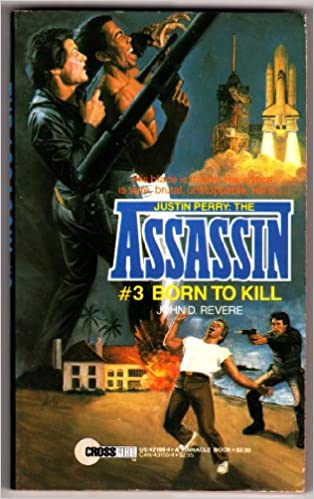
Book Review: Born to Kill by John D. Revere


Published in 1984, Born to Kill is the third volume in the Justin Perry saga.

This time, the CIA’s most sex-obsessed assassin is on assignment in Jamaica.  There have been a series of mysterious chicken attacks in both Jamaica and Florida and Justin’s boss, the Old Man, is sure that it is somehow connected to the upcoming launching of a space shuttle in Cape Canaveral.  However, it’s not only chickens that have been making trouble.  Someone has been beheading government officials across Europe.  Justin’s assignment is to solve the mystery behind the chicken attacks and make sure that SADIF doesn’t interfere with the shuttle launch.  The Old Man has decide that he doesn’t want any SADIF operatives taken alive so, naturally, Justin Perry is the man to send.

Of course, Justin is more concerned with his latest girlfriend but she’s apparently blown up while driving to the airport.  Now, Justin not only has to solve the mystery of the killer chickens but he also has to get vengeance for his latest murdered lover.  But, before he does that, he has to spend a few days at the local brothel with another CIA agent because he’s Justin Perry.

Anyway, Born to Kill moves along at a decent enough pace, up until we get a flashback to the time that an 8 year-old Justin Perry had sex with a chicken and was then traumatized when his grandparents possibly served him the same chicken for dinner and then …. wait, what?  Justin Perry did what?  Yes, you read that correctly.  The action in the book stops so that Justin Perry can remember the time that he had sex with a chicken.  First off, ew.  Secondly, does this guy even have any good childhood memories?  Third, why is this even in the book?  It certainly doesn’t make Justin Perry into a sympathetic character.  Later on, when Perry was attacked by several mutant chickens, I was rooting for the chickens.

When I read the first two books, I assumed that they were meant to be a satiric and that Justin Perry was meant to be a parody of the heroes who appeared in other pulp paperbacks.  But I have to say that the book treats the chicken incident very seriously and, just as Perry spent Vatican Kill debating the existence of God, he spends a good deal of this book thinking about the decline of morality in society.  (He blames the sexual magnetism of John F. Kennedy.)  What I’m saying is that I’m getting the feeling that the author may have meant these books to be taken seriously.  If so, agck!

Anyway, to be honest with you, the whole chicken thing was really gross and I nearly stopped reading at that point.  Because I’m a completist, I did continue with the book but I have to admit that it was more skimming than in-depth reading as I was kind of worried to find out what other barnyard animals Justin Perry may have had sexual relations with.  And really, I think that might be the best way to read these books.  Skim over it all as quickly as possible and don’t make the mistake of thinking about what any of it means.  Justin Perry saves the day and kills a lot of people and, at one point, watches as a woman he’s just had sex with gets eaten by a shark.  He’s fascinated by the fact that the shark is eating a bit of him along with her.  The main theme of the series seems to be that Justin Perry really needed to get help.  Let’s just put it like that.

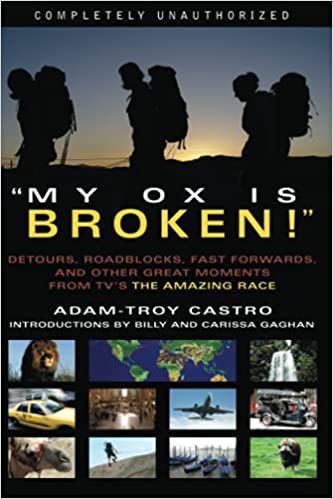
Book Review: “My Ox is Broken!” Roadblocks, Detours, Fast Forwards and Other Great Moments from Tv’s ‘the Amazing Race’ by Adam-Troy Castro


I will be the first to admit that I probably watch too much reality television.

Of course, I will also defend myself by saying that I don’t watch as much as I used to.  I limit myself now.  The Bachelor, the Bachelorette, and Bachelor In Paradise are the only dating shows that I still watch and I have to admit that I find them less and less interesting with each passing season.  (Some of that, to be honest, is because I cringe whenever I see people talking about the “Bachelor Nation.”  Just because I watch the same show as you doesn’t mean that I want to come over to your house and watch you get drunk on box wine.)  I still watch Survivor but I have yet to watch any episodes of the Hulu Kardashian show.  The only reason that I recently watched Selling Sunset was because I was checking out the shows that had been submitted to the Emmys.  I haven’t really been emotionally involved with Big Brother for a while now, though I do still write about it because I love my readers.

That said, I still absolutely love The Amazing Race and I make no apologies for that.

The premise behind The Amazing Race has always been a simple one.  Teams of two are sent on a race around the world.  During each leg of the race, they have to complete tasks before they can continue on their journey.  At the end of each leg is a pit stop.  Finish first and you’ll get a prize.  Finish last and you’ll probably be eliminated from the race.  Each season has featured little tweaks to the formula but the basics have always remained the same, which is one reason why The Amazing Race‘s fans have remained loyal to it for over 22 years.

What is the appeal of The Amazing Race?  It’s more than just seeing who wins and who loses.  It’s seeing how the teams, who always start out very confident, handle being outside of their comfort zone.  I’ve lost track of how many athletic, cocky teams were eliminated from the race because they failed to properly communicate with their taxi driver.  How many teams have gone from being in first place to being dead last just because their flight was delayed?  The most recent season of the Amazing Race was actually put on hold due to COVID quarantines.  Filming stopped in 2020 and then resumed over a year later, with the remaining teams returning to their last pit stop.  The Amazing Race is unpredictable and it takes exactly the right mix of athleticism, intelligence, confidence, and luck to survive it.  The Amazing Race is about skill and communicating and seeing the world and I absolutely love it.  A good deal of the Race’s popularity is also due to host Phil Keoghan, who actually seems to be sincerely invested in the racers and their journey.  That’s quiet a contrast to most reality competition hosts.  Just as snarky Jeff Probst was the perfect host for Survivor (or, at least, he was before he decided to get all weepy and sincere these past few seasons), Phil Keoghan is the perfect host for The Amazing Race.

My Ox is Broken! is a perfect companion to The Amazing Race.  Admittedly, the book was published in 2006 and, as a result, it only covers the first 9 seasons of the Race.  But those were some truly great seasons and reading the book today is a wonderful way to relive the excitement of Rob and Amber going from dominating Survivor to nearly winning The Amazing Race, Colin and Christie narrowly losing the fifth season, and the dysfunctional couples who made up the sixth season.  Author Adam-Troy Castro takes a look at everything that made those first 9 seasons so much fun and he’s also honest about the show’s occasional missteps.  Full of recaps, interviews, and lists (you know how much I love lists!), this book is an essential for anyone who loves the Race.

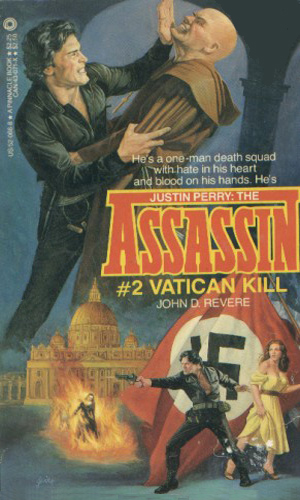
Book Review: Vatican Kill by John D. Revere


Justin Perry, the assassin, is back!

And he’s just as screwed up as usual.

Continuing the theme of the first Justin Perry novel, 1983’s Vatican Kill finds the CIA still battling the evil plans of SADIF.  A Nazi sympathizer named Carl Werner is working as a gardener at the Vatican and masterminding SADIF’s European operations.  Justin Perry’s boss, the enigmatic Old Man, not only wants Werner to die, he wants it to be such a cruel and sadistic death that it will send a message to all of America’s enemies.  Among Werner’s many crimes is developing a nuclear warhead that SADIF is planning to fire at Venus in an attempt to wow the world.  Unfortunately, as a scientist helpfully explains at the start of the book, blowing up Venus will also destroy the universe so the stakes are pretty high!

The reader might assume that, with the future of the universe at stake, Justin Perry might actually focus on his job for once.  The reader would be wrong.  The world’s greatest assassin is just as easily distracted in this book as he was in the second.  When I reviewed the first book, I mentioned my theory that the series was meant to be a satiric.  Justin Perry was just too weird and sex-obsessed to be viewed as anything other than a parody of the traditional, hypermasculine pulp hero.  There are definitely elements of satire in Vatican Kill but, oddly enough, there are also several passages in which Perry sincerely contemplates why he cannot accept the idea of a benevolent God, passages that suggest that the author was trying to make some sort of larger point about the mysteries of existence.  Of course, there are also several overheated flashbacks to a childhood trip to India, during which Perry both lost his virginity and he witnessed a train crash rather than run over a cow.  Just as in the first book, it turns out that everything that happened in his past is connected to what’s happening in the present….

It’s a weird book.  To be honest, I haven’t even begun to scratch the surface of some of the weird things that happen in Vatican Kill.  Justin Perry is as obsessed with sex and violence as ever while the villains of SADIF continue to come up with with elaborate tortures.  (This book didn’t do much to help me with my fear of dogs.)  I haven’t even gotten into Werner’s demand that Justin Perry assassinate the King and Queen of Spain for …. reasons, I guess.  Just as with the first book, describing the plot of Vatican Kill probably makes it sound more interesting than it actually is.  As over the top as all of the action and the scheming is, the prose describing it is fairly mundane and the author continually gets lost in Perry’s ruminations about God and the past.  I have to admit that I read the book very quickly, first because it was called Vatican Kill and I can only imagine what my Spanish and Italian grandmothers would have thought about that and secondly, because Justin Perry was such a creepy character that I really didn’t want to spend too much time with him.  The book ended on a note so grotesque that I washed my hands afterwards.  Seriously, Justin Perry was one messed up dude!

Book Review: Mafia: The Government’s Secret File On Organized Crime


If you are a writer and you’re currently working on a novel or a script about the Mafia in the late 50 or early 60s, you simply must include a character based on Usche Gelb.  Gelb was born in Austria in 1897 and apparently came to New York City when he was just a teenager.  Between 1913 and the 60s, he was arrested multiple times and charged with everything from disorderly conduct to felonious assault to perjury to federal narcotics conspiracy.  According to the FBI, despite not being Italian, he was a powerful figure in the Mafia and served as a liaison with various international drug cartels.  He also worked as a machinery salesman and as a florist.  He and his wife Ethel lived on West End Avenue and spent their summers at Tenaha Lake.  His nickname was King Gelb.

You might also want to include a character based on Joey Caesar (real name: Joseph Divarco), who owned a glassware distribution but who was secretly one of the top men in the Chicago Outfit.  Or maybe Sam Giacana, who took over Capone’s organization and eventually ended up getting murdered in his own kitchen.  Don’t forget Luigi Fratto, the crime boss of Des Moines, Iowa who was so confident in his position that he flashed a big grin for his mugshot.  And certainly, be sure to remember Joe Civello, who ran the Dallas mob and who had the look of a weary accountant whose only client was being audited.

All of these people (and more) are profiled in Mafia, a fascinating book that contains the over 800 organized crime dossiers that the Treasury Department put together in the late 50s and 60s.  Some of the gangsters profiled have familiar names.  Meyer Lansky, Mickey Cohen, Lucky Luciano, Johnny Rosselli, Carlos Marcello, Vito Genovese, and Joseph Valachi are all included.  Even more interesting to me, though, are the less well-known gangsters.  All of them were prominent within their organization but most of them managed to hide in the shadows of history.

For history nerds and true crime buffs, it makes for interesting reading.  Almost all of the men profiled in the book came from blue collar backgrounds.  Many of them were immigrants.  The great majority were from Italy but Germany, France, Austria, and the United Kingdom are all represented as well.  When they weren’t committing crimes, many of them worked as salesmen.  Some were truck drivers.  Many of them were union reps.  A large number either worked at or owned small taverns.  Many of them had been arrested for violent crimes but most of them also had families and vacation homes and everything else that was held up as being a part of the American dream in the 50s and 60s.  Most people probably wouldn’t give these men a second look but, secretly, they were among the most powerful people in their city and state.

It’s hard not to become fascinated with the people in this book.  Enough details are provided in the government’s sparse reports that you get a clue for who they were but enough is left vague to reward those of us with an active imagination.  Why, for instance, was John Daneillo nicknamed “Baldy” when his mugshot shows that he had a full of head of hair?  Who nicknamed him Baldy and did it have anything to do with his day job as a construction worker?  And why did Lucky Luciano give Patsey Matranga, an olive oil salesman who was a known narcotics smuggler despite having never been arrested once in his life, an old Oldsmobile?  Was it a sign of friendship or something else?  Maybe Luciano was just sick of looking at the car.  These are the type of questions that are raised by reading the dossiers within Mafia.  They’re just waiting for creative reader to answer them.

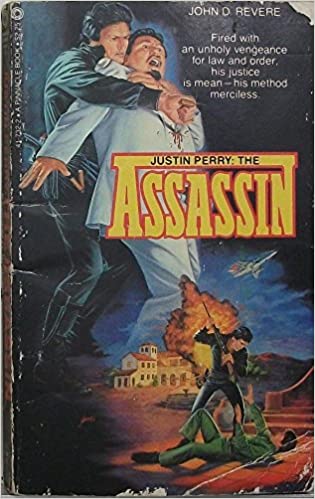
Book Review: Justin Perry: The Assassin by John D. Revere


About a month ago, as I continued to make my way through the paperbacks that I inherited from my aunt, I read five short paperbacks about a character known as Justin Perry, the assassin.

Who is Justin Perry?  As was explained in the first book in the series, 1982’s Justin Perry: The Assassin, Justin’s name used to be Roger Johnson.  He was raised in a world of wealth and privilege, the son of a general and a socialite.  Like his father, Roger enlisted in the army.  He ended up in Vietnam and, when he saw a friend of his get blown up the Viet Cong, Roger discovered that he had it in him to be a very savage and efficient killer.  Back in the States, Roger was hailed as a hero.  He married the beautiful Bambi and they had a son named Roger, Jr.  But then, Bambi was murdered by a commie spy and Roger went mad.  A mysterious figure known as the Old Man recruited Roger to work as an assassin as the CIA.  Now known as Justin Perry, the assassin lives to kill the nation’s enemies and to have sex with every woman he meets.  Seriously, that’s all he does.

The book not only gives us Justin’s origin story but also presents us with a rather sordid adventure in which Justin Perry tracks down a Nazi collaborator in Europe.  It’s while on that assignment that Justin discovers the existence of SADIF, a secret organization that we know is evil because its acronym sounds a lot like SADIST.  His pursuit of SADIF leads to several over-the-top torture sequences and also the discovery of a huge conspiracy, one that involves almost everyone that Justin has ever known.  We also discover that SADIF has infiltrated the Church and that Josef Mengele is now working as a gardener at the Vatican.  (As an Irish-Italian-Spanish Catholic, I would be offended it wasn’t all so stupid.)  None of it makes much sense but, to be honest, I’m not totally convinced that the Justin Perry books weren’t meant to a parody of sex-obsessed pulp fiction.

When I say that Justin Perry is sex-obsessed, that is literally all that he seems to think about.  He gets an erection when he kills a man.  Every woman that he wants automatically wants him (and, apparently, they’re all into S&M to boot).  One sexual encounter is ruined by an attack by an assassin, which leads to not only Justin’s masochistic lover killing herself with a knife (and getting off on the process) but also Justin obsessing over the fact that some of his sperm ended up on a hotel room floor.  Justin, in fact, is so hypersexual and so obsessed with proving himself sexually that it’s hard not to wonder if maybe he’s killing people because he’s trying to kill something about himself that he doesn’t want to accept.  I haven’t even gotten into the weird torture sequence where Justin and his friend, Bob Dante, are threatened with being sexed to death by a group of SADIF nymphomaniacs and a feet-licking chauffeur.

Actually, I have a feeling (or maybe it’s a fear) that I’m making this book sound more interesting than it is.  Despite all of the insane things that happen, the prose itself is actually fairly dull.  If one takes the book seriously, it’s a celebration of a sociopath.  If one takes the book as being satirical, it’s still just one joke repeated over and over again.  What is interesting is that the next four books in the series were even stranger and I’ll be reviewing those over the days to come.  For now, let’s just be happy that Justin Perry: The Assassin never made it to the big screen.

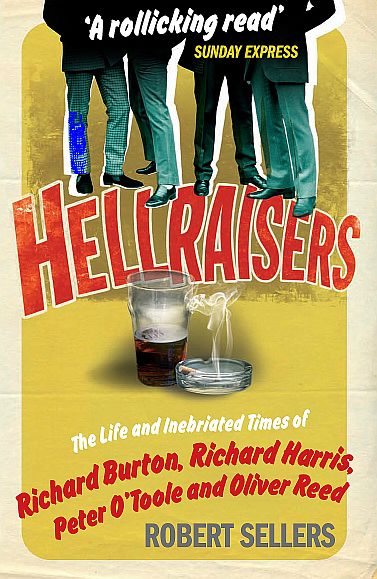
Book Review: Hellraisers: The Life and Inebriated Times of Richard Burton, Richard Harris, Peter O’Toole, and Oliver Reed by Robert Sellers


First published in 2009, Hellraisers is a fast-paced look at the life and times of four men, Richard Burton, Richard Harris, Peter O’Toole, and Oliver Reed, and an examination of what they all had in common.

First off, they were all talented actors who were at the height of their careers in the 60s and the 70s.

They all first came to prominence in the UK.  Peter O’Toole and Oliver Reed were English.  Richard Burton was Welsh.  Richard Harris was born in Ireland.

With the exception of Oliver Reed, all of them were multiple Oscar nominees but none of them actually won the award.

All four of them could boast filmographies that included some of the best and some of the worst films of all time.

And, of course, all four of them were infamous for their drinking.  They were all, if I may borrow the book’s title, famous for raising Hell.

Hellraisers is a frequently entertaining look at their careers and their legendary off-screen exploits.  All four of them come across as being very different drinkers.  Richard Burton was a depressing drunk, one who drank because he was aware that he was wasting his talents in mediocre films.  O’Toole was a drunk who alternated between being charming and being dangerous, someone who was capable of coming across as being a bon vivant even at his lowest moments.  Richard Harris was the angry drunk but he was also the one who seemed to have the both the best understanding of why he drank and why, at a certain age, it was necessary for him to cut back.  And, finally, Oliver Reed was the showman, the one who viewed drinking a beer the way that others viewed having a cup of tea and who would rather damage his career than allow anyone else to tell him how to live.  He knew that he had a reputation and he was determined to live up to it, even at the risk of his own health.

Perhaps not surprisingly, it’s Oliver Reed who dominates the book.  There was very little that Reed wouldn’t do while drunk and he was drunk quite a lot of the time.  He was also perhaps the most unpredictable of all of the actors profiled in the book, a raw mountain of energy who kept audiences off-balance.  Personally, I would not have wanted to have been along in a room with a drunk Oliver Reed.  The book has too many stories of Reed dropping his trousers and asking everyone to look at what he called his “mighty mallet,” for the reader to feel totally safe with Reed.  At the same time, anyone who has seen a good Oliver Reed performance knows that he deserved better roles than he was often given.  (Then again, the book is also honest about the fact that a lot of filmmakers would not work with Reed because they had justifiable reasons to be terrified of him and his erratic nature.)  Over the course of the book, Reed comes across as hyperactive, easily bored, and also far more intelligent than most gave him credit for.  In many ways, he was a prisoner of his own reputation.  He was outrageous because he knew that was what was expected of him.  As shocking as some of his behavior seems today, he felt that he was giving the people what they wanted and Hellraisers suggests that he may have been right.

Personally, I don’t drink and I find most heavy drinkers to be tedious company at best.  That said, Hellraisers is an interesting book.  Burton, Harris, O’Toole, and Reed are all fascinating talents and the book takes a look at how their hellraising reputations both hurt and, in some cases, helped their careers.  However, the book is more than just a biography of four actors who drank a lot.  It’s also an examination of a different era, of a time when performers were expected to raise Hell and when one could get away with being a contrarian just for the fun of it.  One can only imagine what the moral scolds of social media would have to say if Oliver Reed were around today!  As a result, this is a book that can be enjoyed by both film lovers and history nerds, like you and me.

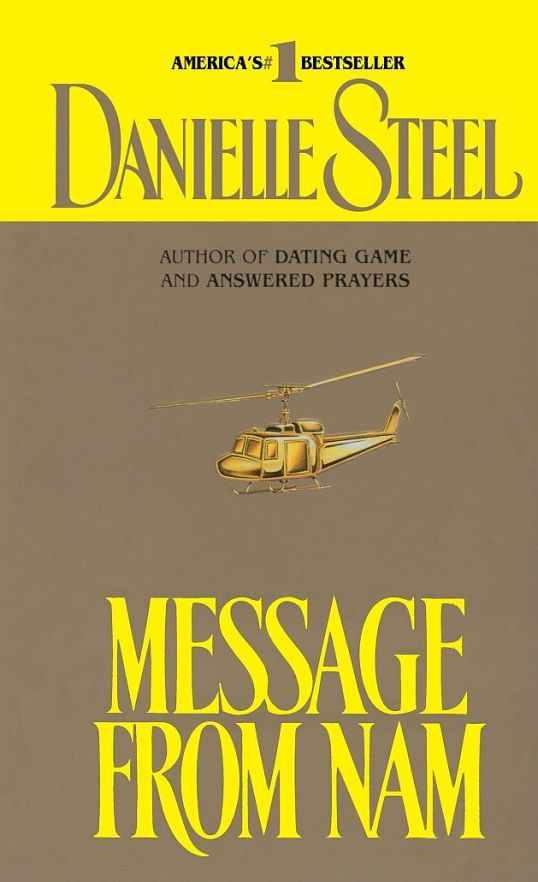
Book Review: Message From Nam By Danielle Steel


This is a review of another novel from my aunt’s big collection of paperbacks.

First published in 1991, Message From Nam follows Paxton Andrews as she grows up in the 1960s.  She goes from being an idealistic, Kennedy-inspired teenager in Savannah, Georgia to being a hardened and brave war correspondent in Vietnam.  Along the way, she defies the wishes of her wealthy family, who would rather that she live in a conventional life in Georgia.  She goes to college, she protests the war, and she eventually even gets to write a weekly column about the war and how it is effecting both the combatants and the folks back home.  She also falls in love with several different men, the majority of whom end up dying in Vietnam.  I guess that’s one of the dangers that you run into when you’re a war correspondent.  Eventually, the great love of her life also disappears in Vietnam.  Is he dead or is he just waiting for Paxton to come and find him?

So, I don’t know about you but when I think of an American author who could deftly capture the intricacies of American foreign policy and the turmoil of the late 60s and the early 70s, Danielle Steel is not necessarily the first name that comes to mind.  Steel fills the book with historical detail but it all feels a bit rudimentary.  Naturally, the book opens on the day of the assassination of John F. Kennedy and, of course, there are references to all of the other big events of the 60s but the book’s examination of those events don’t go much deeper than acknowledging that they happened and that Paxton was upset about some of them.  Even when Paxton goes to Vietnam, it’s an experience that’s pretty much interchangeable with what the reader might expect to see if they were watching a movie about Vietnam as opposed to reading a book about it.  There are no details that make the reader pause and think, “I bet that’s what it was really like.”  Throughout the copy of the book that I read, Steel continually referred to Vietnam as being “Viet Nam.”  Admittedly, I usually make the same mistake before autocorrect jumps in to help me out but, then again, I’ve also never written a novel about being a war correspondent in Vietnam.

I suppose Message From Nam was Steel’s attempt to show that she could write a novel that didn’t take place in a world of glamorous and glitzy rich people but the fact of the matter is that Paxton still comes from a rich family and nearly every man that she meets falls in love with her so this really isn’t that much different from a typical Danielle Steel novel.  Indeed, the novel could use a little glamour and glitz.  To be honest, the book works best when Steel stop trying to make history come to life in all of its gritty reality and instead, just embraces the melodrama.  When the book focuses on people declaring their undying love right before tragedy ensues, it works just fine.  Seriously, there’s nothing wrong with being a good romance novelist.

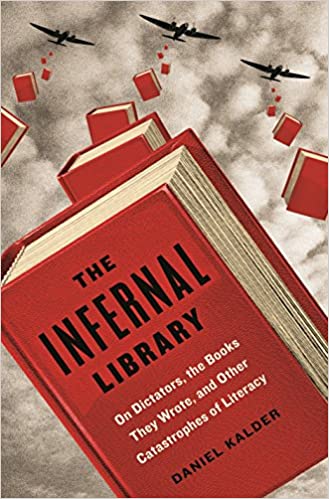
Book Review: The Infernal Library: On Dictators, The Books They Wrote, And Other Catastrophes Of Literary by Daniel Kalder


The history of dictatorship is littered with failed writers.

That’s one of the lessons that I learned from reading Daniel Kalder’s 2018 book, The Infernal Library.  The Infernal Library takes a look at the literary output of some of the worst people who have ever lived.  Some of the dictators and the books examined are to be expected.  Everyone knows that Hitler wrote Mein Kampf while in prison and everyone knows that it’s a terrible book, from both a literary and a moral perspective.  Many people also know that Chairman Mao was credited as authoring several books, many of which were treated as holy texts by radicals in the west who read and quoted from them while, in Mao’s own country, intellectuals were being murdered during the Cultural Revolution.  And, of course, the works of Lenin and Stalin have recently found renewed popularity amongst the heirs of Walter Duranty.

But did you know that Benito Mussolini, long before he took over Italy, wrote florid novels that attacked the power of the Church?  Did you know that Saddam Hussein was not only Iraq’s feared leader but also it’s most popular novelist?  Did you know that Saparmurat Niyazov Turkmenbashi, leader of the nation of Turkmenistan, not only wrote his own hybrid historical-religious text but that he also sent into space so that it can be discovered and read by any intergalactic travelers who came across it?

What is up with dictators and their literary pretensions?  I suppose it does make a strange sort of sense.  The typical psychological profile of a writer is that they’re cynical, they’re comfortable working alone for long periods of time, they often feel alienated from mainstream and/or conventional society, and they feel that they not only have something to say but that they are the only ones who can say it.  If someone who fits that profile also has talent and imagination, they’re capable of creating powerful works of art.  If someone who fits that profile doesn’t have talent or imagination, then they can take over a country and force their subjects to not only read their books but to also talk about how well-written they are.  As well, a literary output allows a dictator to fashion themselves as being something more than a thug.  Being a published writer brings with it an aura of respectability.  The more gullible assume that you must have something worth saying because otherwise, why would someone have published it?

In The Infernal Library, Daniel Kalder writes that he read these book so “you wouldn’t have to” and for that, we should perhaps be thankful.  Along with often being second-rate minds, dictators are also often second-rate writers and Kalder examines their work with both a razor-sharp wit and a knowledge that the books themselves reveal much about the men who wrote them.  Hitler’s paranoia, resentment, and conspiracy-fueled world-view are present on every page of Mein Kampf and, indeed, while the rest of Europe’s leaders were trying to negotiate with and contain him, they could have just read his book and discovered that their efforts would be for naught.  The mix of ruthlessness and prejudice that led to Stalin starving his own citizens can be found in his own words while Saddam Hussein’s novels reveal a mind that was obsessed with a mix of preserving tradition and punishing those who have somehow failed.  While some of the dictators spend more time on their ideology than others, all of them share an obsession with exposing their perceived enemies, justifying their own actions, and demanding to be respected by a world that they feel has treated them unfairly.  Almost every dictator that Kadler profiles strives (often a bit too hard) to prove their literary worth while ultimately revealing the true darkness at the heart of their worldview.  Indeed, only a youngish Mussolini appears to have had even the hint of any real ability as a writer, authoring sordid novels with a satirical subtext.  But whatever literary talent he may have had disappeared once he gave his life over to fascism.  Authoritarianism and imagination do not go well together.  Indeed, imagination is perhaps the biggest enemy that the authoritarian has.  The great irony is that so many dictators demanded to known as men of imagination when imagination and freedom of thought was often the first thing that they tired to stamp out upon coming to power.

The Infernal Library is an interesting and important book.  Read it so you don’t have to read any of the people profiled within.