My music series this year fell victim to a game of forum mafia that’s eaten up every ounce of my free time (and a little more I couldn’t really afford to lose <_<) but I wanted to share one last song here before we lay the Halloween season to rest. Dissection are one of the more notorious black metal bands of the 90s, embroiled in murder and occult suicide and all sorts of trouble. Generally, bands in that ballpark produced the more deranged, off-kilter songs that granted 90s black metal such a strong air of the sincerely sinister. But Dissection was a bit different. For all of Jon Nödtveidt's faults, he was a really brilliant songwriter in a surprisingly traditional sense. The band's most famous song–"Where Dead Angels Lie", off Storm of the Light’s Bane (1995)–is a masterful six minute progression of beautiful melodies that would not be out of place on an early In Flames album. (Is it a mere coincidence that the band’s home town of Strömstad is not terribly far north of the melodic death metal capital of the world: Gothenburg, Sweden?) It is sinister in a theatrical sort of way, quite different from the traditional roots of the genre and quite better than the few ‘mainstream’ bm bands, who are generally more willing to take this approach.
The short-lived, Yaroslavl-based band Векша (Veksha) offer a look at that strange world of ultra-nationalistic, rabidly pagan Slavic metal that began to emerge shortly after the fall of the Soviet Union. I love the awkward juxtaposition (by 1998 standards) of black metal and this anonymous woman’s clean, almost childish singing in the environment of absolutely rock-bottom recording quality. The aesthetic consequence is spooky–a sort of half-formed ghost of a demo tape that dares you to shut off your speakers and see if it continues to play.
But the appeal that keeps me listening to На пороге ночи (Na Poroge Nochi) might not have been the band’s intent. Believe it or not they actually had a website, on which they greet all Aryan brothers with pastel flowers and rotating heart gifs.
umm…
But creepy by accident is always more effective than creepy by intent, right? The bizarrely pervasive fixation on race throughout a lot of early Slavic pagan metal bands probably has an interesting historical explanation that is well beyond the scope of my knowledge, and the explicitly sinister intent of a few prominent bad apples in that bunch might cast the rest a little out of context, but at any rate it’s another off-kilter factor in rendering Veksha’s lone release just a wee bit disturbing for reasons the band probably never intended. They’ve definitely earned a spot in my Halloween playlist.
If there is one artist I have consistently returned to every October for the 15 or so years that I’ve had a clue what I’m talking about, it’s Vratyas Vakyas. I first discovered Falkenbach via Audiogalaxy–a long forgotten site that stood out back in the Napster days for a design which allowed users to easily explore non-mainstream genres. I had never heard anything remotely similar to Falkenbach at the time, and I fell in love with the plodding hymns that seemed to turn black metal on its head and generate a spirit of reverence rather than darkness.
Of course, in hindsight Falkenbach fits into a broader historical progression, but his sound is still entirely unmistakable. Vratyas Vakyas was one of the earliest artists to really latch on to the ‘viking metal’ ideal that Bathory began in the late 80s, before too many stylistic norms were standardized, and the sound he landed on has never ceased to captivate me. “Heathen Foray” is the opening track to his fourth studio album, Heralding – The Fireblade (2005), and it also makes an appearance in somewhat grimmer form on his second album, …Magni blandinn ok megintiri… (1998). How far back the basic idea of the song dates is hard to say; there is a ton of earlier demo material available going as far back as 1989. I could have chosen any of dozens of stand-out songs to showcase here without any reservations, but this one has been speaking to me lately. Enjoy!
Part of the ‘appeal’ of the second wave of black metal as it manifested in Norway is the feeling that you are listening to a product of truly deranged minds. Granted most of the artists in the scene were fairly normal kids who matured and went on to enjoy long-term musical success, the genre’s focus on the occult, Satanism, and all things traditionally “evil” brought a few real wackos into the fold. Most of them wound up dead and behind bars. Gorgoroth pressed on.
This is a band that continues to project itself as dead-serious Satan-worshiping masochists long after their peers evolved away from the genre’s early image or else dropped sufficient hints to be recast as a sort of warm cuddly metal-spiked parody. Does their sound reflect this? I like to believe it does. “Procreating Satan” is the opening track to Twilight of the Idols, the band’s sixth studio album, released in 2003. It features the most notorious of the many vocalists the band has had over the years: Gaahl.
Well, I started out this series featuring a couple of songs I’ve been enjoying for the better part of two decades. Here is one I discovered less than a week ago. It’s not too often that music successfully creeps me out these days, but I suppose I should have known I was in for a treat when Veilburner were described to me as a bad acid trip.
“Scorched Earth Exorcism” is a great example of this band’s unique, psychedelic mix of death and black metal. It’s some seriously twisted stuff, and nothing on the album better captures the deranged spirit of the season than the melody that takes over this song around the 4 minute mark. I’ve been watching AMC’s The Walking Dead marathon over the past few days, and I seriously had a dream about hunting zombies with this screwed up tune playing in the background. It was disturbing and awesome.
The dream has to end somewhere. Science fiction seems to agree on that. Futuristic technology produces what biology could not: logic-based systems so functional and adept at survival that humanity becomes obsolete. Whether we assimilate into a borg colony or a zerg hive mind, imagination is pretty screwed. Our best bet might be something like The Matrix. Perhaps some utility will compel our robot overlords to spare the sheep who spawned them. Yay!
I cannot say what it must feel like to be enslaved by a post-human species, but I fancy it would sound a lot like the 777 trilogy by Blut Aus Nord. Between 2011 and 2012, these French black metal legends offered up a journey through a world that was beyond dystopian. Discordant melodies and unorthodox rhythms taken to the extreme are usually a recipe for disaster–the tools of technically proficient but creatively deprived math rock and avant-garde musicians I would only listen to under duress. Blut Aus Nord masterfully avoided that pitfall by envisioning a coherent aesthetic framework and driving the music forward as a consistent conceptual progression across 18 tracks. Radical experimentation joins forces with dark industrial grooves to place the listener in a futuristic, post-human world where mechanical gods rule apathetic over mortals bred in gestation crates.
The trilogy does not actually offer any textual insight into what its world is supposed to be. The minimal lyrics are highly esoteric, and Blut Aus Nord ultimately leave it to the instrumentation to tell their tale. You might not experience it as a futuristic world at all, but rather as some bleak corner of hell from which a lost soul digs through the madness and witnesses his overlord. But as far as it speaks to me, the 777 trilogy is the vision of a feckless human slave awakening from his dream into terrifying, incomprehensible world. He slowly comes to understand his master and, perhaps, ultimately assimilates into the hive mind. The final track, “Epitome XVIII”, is a grim, cold trance in which a soulless machine reigns on triumphant.
A part of me feels totally out of my comfort zone reviewing Marduk, but I keep coming back to the band over the years in spite of it. The classic Swedish style of black metal, as popularized by bands like Dark Funeral, Naglfar, and of course Marduk, never managed to appeal to me much. It was all about this relentless brutality–an aesthetic not far removed from death metal–when I was turning to black metal for its occult appeal. It was Satan as a cold-hearted masochist, but I wanted to legitimize Catholic blood libel. Live dissection vs goat sodomy. That’s pretty clear, no?
But, aside from the fact that they were just better at it than everyone else, Marduk initially stood out to me for their song titles and lyrics. “Christraping Black Metal”, “Fistfucking God’s Planet”, “Jesus Christ… Sodomized”, this stuff was priceless. I think when I viewed it as a comedy I could get into the over-the-top, machine gun-paced blast beats as something delightfully ridiculous.
That sort of entertainment value can’t hold out forever, and it was ultimately Marduk’s shift towards martial themes that kept me attentive. They did it on Panzer Division Marduk in 1999, and they’ve turned to it again with the Iron Dawn EP in 2011 and now Frontschwein. If there is any one thing that this style of music captures effectively, it is 20th century warfare.
song: Frontschwein
Marduk capture the violent chaos of war on a level I have only heard rivaled by Germany’s Endstille, and while modern themes do not permeate all of their albums, they stand at the center on Frontschwein. The album recounts events in World War II from the perspective of Germany as a bloodthirsty machine reveling in cold destruction behind its thin veil of justifications. The connection is not merely lyrical, though Mortuus’ vocals are surprisingly discernible, allowing bits and pieces of war imagery to seep into your head unaided by a lyrics sheet; you can hear to conflict in the music: sliding guitars as falling bombs, blast beats as bullets. It’s methodical, rhythmic, and relentless, in contrast to the more eclectic approach the band has taken on Satanic-themed albums like Serpent Sermon. It is Marduk as I like them best.
That being said, it does feel repetitive at times. This style always does, to me at least, and I feel like Marduk relegated their less interesting songs to the middle, bookending the best of them. “Frontschwein” is followed by the incredibly catchy headbanging march of “The Blond Beast”, and Mortuus’ constant screaming of “Afrika” in the song of the same name forces your mind to picture a bloody desert battle between Rommel and Patton’s grunts. “Wartheland”‘s slow pummel with distinct lyrics like “succumb to domination” feels like an endless wave of Nazi forces marching in to conquest and occupation. The track titles in general go a long way towards steering the music towards its intended imagery. (I absolutely love the album title. I don’t know if it’s a common word or one of the band’s own crafting, but it certainly projects the overarching subject matter: humans as bloody fodder in an unstoppable military machine.)
But by “Rope of Regret”, my ears grow a bit numb to the pummeling. I enjoy the song when I listen to it in isolation, but I rarely can remain attentive long enough to reach it if I’m listening to the album as a whole. The next four tracks, all fairly typical in style, fade together for me whatever their individual worth. “503” is ultimately the song that draws me back in. A song of conquest, it drastically slows down the pace, listing in a dominant voice the conquests of the 503rd Heavy Panzer Battalion. It makes me snap back from my zoned-out state and again picture the album as a vision of German brutality in World War II rather than a jumble of noise. The song is well-placed, because it leads the way into “Thousand-Fold Death”.
song: Thousand-Fold Death
And “Thousand-Fold Death”… holy shit, this song alone is worth buying Frontschwein for. It’s got the best guitar licks on the album, but this song is all about Mortuus. He does things with his voice on this track that will give you motion sickness. It’s not just the sheer quantity of words per second he manages to belt out–his clarity while doing it is unbelievable. If I ever doubted that Mortuus was an incredible vocalist before this song, I certainly don’t now. The album ends with “Warschau III Necropolis”, an eerie, ambient mix of samples from militant speeches and battles, brass, and bizarrely distorted spoken words that manages to capture the grim nature of the album through a totally different means.
There is a reason why I have listened to Marduk more than any other band that plays that brutality-driven Swedish varient of black metal, and Frontschwein captures what I like about them best. I am a bit hesitant to say that I like it more than Endstille’s Infektion 1813, but those two albums definitely stand leagues above anything else I have heard in a genre of metal that, I’ll admit, I seldom find to be very creative or inspiring.
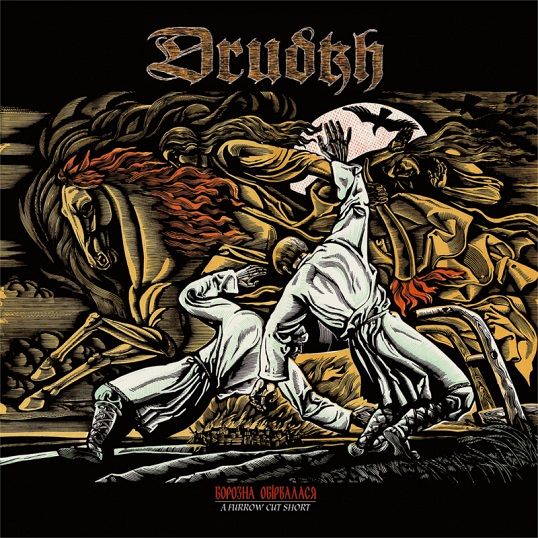
When I fired up Drudkh’s tenth studio album yesterday, A Furrow Cut Short, I was holding my breath in the dim hope that something awesome would slam into my brain from the get-go. After all, this is Drudkh. Not all of their releases have been met with equal acclaim, but they always seem to carry hype on their side.
The album began interestingly enough, with some bending tremolo guitar that kind of brought to mind Blut Aus Nord, and then I waited a bit and moved the play bar ahead. A pretty cool groove picked up around 1:50, and I rode it for a while. The song began to repeat an earlier passage with vocals tossed into the mix, and I moved the play bar ahead. There was that groove from 1:50 again. I rode it. I moved the bar ahead…
Greatness did not grace my ears in a neatly wrapped box, and that was fine. It was just a distant hope. At that point, my immediate instinct was to browse through the sixty minutes of content for all of the gripping moments that would surely rise out of the long black metal grind to knock my head around. A few came. Should I count them? Was that how best to measure this album’s worth? I started to feel a bit silly. This sort of fast-forward treasure hunt has been my subconscious approach to Drudkh for some time now. Here was a band that used to keep me wide-eyed through ten minute tracks as I waited for the peaks to overwhelm me, and over the course of ten albums the appeal had been reduced to skimming. What changed?
The production changed. That’s for certain. Since Microcosmos, Drudkh have been presenting a more deep and refined sound, and I don’t think it did them any favors. It was a technical improvement at the expense of the unique aesthetic appeal of their sound. They also largely left the world of folk music behind. On Songs of Grief and Solitude (2006), Drudkh reworked a variety of earlier melodies from their metal albums into a collection of instrumental folk tracks. It worked really well, and it’s something they would never be able to do with the tunes of Eternal Turn of the Wheel or A Furrow Cut Short.
Song: Cursed Sons I
<@Shad> One day
<@Shad> I will tell my children
<@Shad> That I started the Drudkh wikipedia page.
And there has been one other change. It’s something far beyond the band’s control, but it is significant: historical context. This first dawned on me when I was glancing over the reviews of A Furrow Cut Short already popping up on Encyclopaedia Metallum. One guy started off by writing “Ukraine is not a country where heavy metal thrives like in the UK or Scandinavia”. I stumbled over the words. I suppose fifteen years is a long time when you’re talking music. There are high school kids enjoying A Furrow Cut Short who weren’t born yet when Kharkiv was carving out its claim on the map of metal. That’s a little… weird for me, but it probably has a real impact on how I perceive this music too.
I will never really appreciate thrash metal, because I was never there. I encountered the genre as a prim and proper, cookie-cutter devolution of its original glory. I lacked the contextual sense that something new and monumental was overriding the standards of metal as I’d formerly known them. To me, thrash is just that sound Metallica pioneered, and I have no doubt that this perspective is woefully misguided. This same sort of historical misconception might be taking root on Ukrainian black metal. The reviewer I quoted… his statement would have been a reasonable introduction to Lunar Poetry or Goat Horns in the mid-90s, but by the time Drudkh started to gain attention, Kharkiv was no heavy metal backwater. It was a placename that you gobbled up. “Ukrainian” meant there was no need to sample an album first. You knew you wanted to hear it.
Nokturnal Mortum put Kharkiv on the map, and Knjaz Varggoth’s brainchild still stands leagues above anything else east of Prussia in my book. But Knjaz is also a racist piece of shit, and I can’t say I feel bad that the history books have been rewritten to regard Drudkh as the mother of all Ukrainian black metal. Still, we can’t forget the pre-existing spirit in which this band emerged. Standardized black metal was all about LaVeyan Satanism back then, its music a sort of declaration against society’s disposition to enforce religious values. “Satan” was a shallow facade, and once the point was made, the scene stagnated. Nokturnal Mortum ignited something novel by merging second-wave black metal’s counter-cultural rage with a sort of Bathory-esque true reverence for the old gods. Their music was as hateful as anything Mayhem or Emperor had produced, but it was also rabidly pagan. NeChrist slaughtered the tenets of modern society, smeared their blood across its chest, and danced naked on the pyre.
And that, to me at least, was the spirit of Ukrainian black metal entering the 21st century. It was not merely violent and destructive, but also highly contemplative. The means varied from band to band, but the idea was to bring a bygone spirituality to life. Musically, the tremolo and blast beats found themselves in the company of massive, sweeping auras of sound that might at any minute break into traditional melodies more savage and tribal than anything the co-emerging folk metal scene had to offer. Astrofaes and Hate Forest were two of the earliest bands to emerge from Kharkiv in this new tradition. Astrofaes, headed by Thurios, was the more melodic of the two, with forlorn chord progressions and folk allusions comparable to early Drudkh. Hate Forest, on the other hand, remains one of the most brutal bands I’ve ever heard. It was Thurios’ original collaboration with Roman Saenko, and it was so uncompromisingly violent and minimalistic that it made the most hellish Norwegian offerings feel tame. Yet it was entirely meditative. If Varg Vikernes popularized the notion of black metal as a trance-inducing journey, Hate Forest went leaps and bounds towards perfecting it.
When Thurios and Saenko went on to form Drudkh, the product was more tame than either of their parent projects. Thurios brought the folk and raw melody-crafting via Astrofaes, while Saenko added the trance state and fine touch for aesthetics. At least, that’s how I’ve interpreted it. I certainly can’t offer any informed view into their song-writing process. In any case, what they crafted, not so much on Forgotten Legends but definitely on Autumn Aurora, The Swan Road, and Blood in Our Wells, was totally unique and beautiful. But it did not feel unique to perhaps the extent that it really was. It felt like a brilliant addition to a scene that entailed so much more. (In more than one sense, and not all positive. I am sure the reviewer I mentioned must find it bizarre that almost every summary of Drudkh begins with a preface that they disavow all ties to racism/extremist ideologies.)
Song: To the Epoch of Unbowed Poets
I take two things from this. One is that Drudkh’s earlier sounds float on a cloud of nostalgia. An album that sounded a hell of a lot like Autumn Aurora would really excite me even if it was not half as good, because it would transport me back to a special place and time. The other is that a once unprecedented sound has become pretty common fair. Atmospheric black metal was not invented in Ukraine, but its modern roots run deep there. A lot of bands around the world have since come along and done more with it. They’ve taken it other places–incorporated it into other, equally novel sounds. Saor is a good recent example. In heaping praise on Andy Marshall’s solo project last year, I passively mentioned that it accomplishes its goal “without ever really breaching any new territory beyond the tried and true boundaries of pagan metal”. Well, Drudkh and the Ukrainian scene in general established a lot of those boundaries. And other bands took it further still, to the point where I could speak of an album like Aura without ever thinking “wow, this is original”.
A Furrow Cut Short has some really stand-out tracks. The two I sampled here especially struck me. But it is also lost in time. Changes to production and an abandonment of folk render the modern Drudkh incapable of reaching to the same plain of aesthetics that they once knew. I don’t think it incorporates anything new, either, that might allow me to hear it as a great example of where metal stands today. This album must stand or fall exclusively on its in-born aesthetic value, while competing with the vibe that it is a watered down version of what the band used to be.
That value is, well, average. You can get into the album if you try, but it will not sweep you off your feet. I am not one of these people who cling to the past and expect a band or style to sound exactly like it used to. I am always willing to humor “where are they headed now”, and I have a good deal of respect for what Drudkh did on Handful of Stars even if it didn’t much move me (or seemingly anybody else). At least they were trying to do something. Even Eternal Turn of the Wheel showed motion. A shying away from change, but motion at least, and I modestly enjoyed it for that. A Furrow Cut Short goes nowhere, and that fact drives home the feeling that this band’s sound has grown really stale.
I am a bit torn about A Furrow Cut Short. A part of me thinks “why did they bother?”, but a wiser side enjoys tracks like “Cursed Sons I” and “To the Epoch of Unbowed Poets” way too much to pretend I’d be better off without them. Still, I’m probably never going to listen to this album again. Maybe a quick revisit at the end of the year. There are just too many other bands doing something more original. And too many classics I’d rather rehash, for that matter. It’s strange, because Thurios, Saenko, and the rest of the crew haven’t lost their touch at all. They are doing great things with Blood of Kingu, and Dark Star on the Right Horn of the Crescent Moon would have definitely made my top albums list for 2014 if I had caught it in time. But considering every single member of Drudkh is in that band, I don’t get why Drudkh continue to sound so… redundant.
I tend to avoid split albums. A lot of times, it seems to me, you just end up with two bands’ b-sides that they couldn’t justify releasing independently. But after my first glorious encounter last year with Spectral Lore–Greece’s one-man circus of musical awesome complements of Ayloss–I am ready to lick up any and every track he’ll throw at me. Germany’s Nachtreich, on the other hand, are not a band I would probably ever stumble upon without this release. I gather that they aren’t really metal. They have metal tendencies on this album to be sure, but from what I’ve read they fall more into the neoclassical sphere. But even if I wanted to skip over their tracks–and I don’t–you can’t really do that on this album. It is not a product of two bands throwing whatever they feel like into the mix, but rather a pretty well-planned collaboration.
Track: Spectral Lore – Quivering
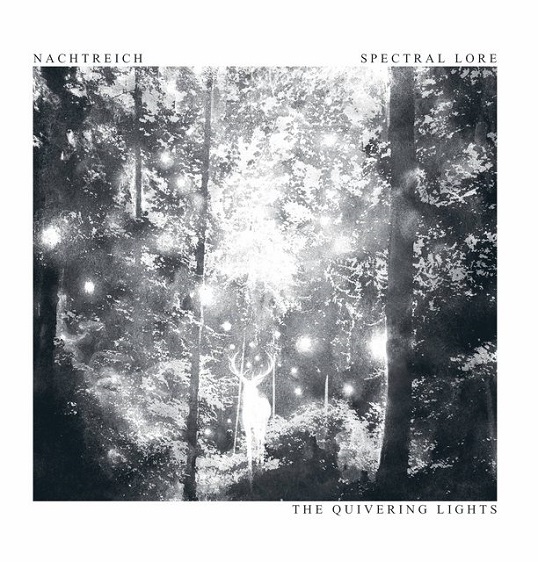
At 46 minutes, The Quivering Lights certainly carries the content of a full length album. The track order, moreover, intermixes the two artists’ contributions to create a single picture rather than two shorter sides to a story. The album kicks off with Nachtreich performing a pretty piano and string piece that would not feel out of place in a movie soundtrack. The first four minutes of “Lights” invite the listener into a warm, subtle scene appropriate for the album’s cover art, and then a lot of things change. We suddenly find ourselves beneath a wall of heavy distortion and arpeggiated piano, as the violin carries on the opening lament to a slow drum plod. It’s a bit jarring–not necessarily in a good or intended way–and it ends as abruptly as it arrived. A calmer piano carries out into the first Spectral Lore track.
On “Quivering”, the track sampled above, Spectral Lore prove more than adequate to answer Nachtreich’s proficiency at writing soft, moody music for piano and string. This song too moves on into metal, but here you have a much greater sense of what’s coming. Spectral Lore, moreover, kick off the black metal in the same grand form that III had brought to my attention last year. Ayloss’s ability to flow in and out of tremolo and double bass is spectacular. The guitar melody is goddamn beautiful, and the drumming restrains itself to maintain a mood devoid of aggression. The fuzzy, expansive vocal noise Ayloss generates feels totally at one with the atmosphere, fading back into an endless horizon. There is no sense of departure from the original landscape set by “Lights”, but rather a sort of heightened state of awareness in which you see all of the shapes and colors in exquisite detail.
Track: Nachtreich – Ghost Lights
The only downside to “Quivering” is that it so overshadows the metal side of Nachtreich that it makes the latter feel almost laughably simplistic. This effect is forgotten soon enough, as Nachtreich’s second contribution, “Greyness”, gives us a beautiful viola and violin duet without any hint of metal (or piano for that matter). On “Ghost Lights”, Nachtreich return to heavy sounds in more measured steps. Growled vocals appear first, creeping up from beneath a shroud of string and piano. It seemed out of place at first, but the more I listen the more I like it. As with Spectral Lore, Nachtreich’s vocals don’t carry the slightest sense of aggression. But here there is no harmony, either. The feeling is of some fetid taint beneath the surface, darkening the landscape. When “Ghost Lights” finally dawns its distortion, the transition is far more natural and compelling.
“Vanishing”, the next Spectral Lore track, picks up right where “Ghost Lights” ends, continuing the same melody on guitar, but it soon proves to be the longest (mostly) continuous chunk of metal on the album. A good bit darker and more chaotic than “Quivering”, its quality is not as forthcoming, but considering how long III took to grow on me, I am not about to write it off. The final song on the album, “Reflection”, is six minutes of brooding acoustic guitar. It feels to me like a song that ought to lead somewhere, and I was a bit startling to realize the album was over.
All in all, The Quivering Light is definitely worth checking out if you’re a fan of Spectral Lore. Don’t let the fact that it is a split turn you away, and don’t blow off the Nachtreich songs either. But if you are new to the band, III is still the place to start. I wouldn’t say Nachtreich impressed me enough to seek them out, but another day and another mood I might yet have a go at them. Their 2009 album Sturmgang got pretty positive reviews. The two bands adapt to each other nicely, and if I sometimes get a suspicion in the back of my mind that Spectral Lore vastly outclass Nachtreich, well, the key word is sometimes. The feeling certainly does not permeate the album, and it easily could have given the way these bands aimed to create a single cohesive work. The Quivering Light feels less disjointed than a lot of albums by one band let alone two. I think the opening track, “Lights”, is the weakest link, and the album is a fairly solid ride through to the end once you get over than hump.
Bosse-de-Nage (pronounced something like “Boss De Nazh”) are a four-piece band from San Francisco. They pumped out their first three albums in a span of three years, between 2010 and 2012, and then took their time getting this one together while cultivating a friendship with Deafheaven that lead to a split 12″ and some enhanced name recognition. All Fours was just released via Profound Lore Records last week, and any serious student of extreme music owes it to themselves to check it out. Just when I thought nothing in 2015 could be more stylistically unorthodox than Liturgy’s The Ark Work (ok, that claim probably still stands), Bosse-de-Nage turn up with an album that’s going to leave me scratching my head for a long time to come. What’s so interesting about All Fours is that you can walk away with a totally different impression of what the band is doing depending on your personal musical background.
Track: At Night
The album kicks off in post-metal mode, ebbing and flowing through a brooding, pessimistic mire beneath Bryan Manning’s desperate screams. Two minutes and change in, the song transitions to the sort of pounding fuzz that might call to mind Converge’s “Jane Doe”. As things continue to change, you get the feeling that it’s progressing towards an ever more desperate state. Black metal seems to play a major role in that intensification, with earlier passages reappearing in a more tightly packed onslaught of notes. The ending, for instance, revisits that Jane Doe sound, but the once cymbal-centric drumming is now competing with blast beats. “At Night” is a song in constant flux, and it could have been an erratic mess, but instead it’s strikingly fluid. Bosse-de-Nage manage to keep a thread of accelerating emotions taut throughout the long chain of ideas and influences that comprise it.
The next song, “The Industry of Distance”, sends a similar message. A simple, clean guitar lick repeats over bassy feedback for the better part of two minutes. Drums sneak up into a slow roll to cue distorted drawling guitar chords, and soon the song explodes in one of those beautiful melancholy post-black metal anthems we’ve been growing accustomed to. Instead of lightning quick tremolo and blast beats though, the drum and guitar initially seem to execute at half the frequency while Manning screams in his uniquely heartbroken style. It creates a sort of oscillating effect for an ear expecting black metal, every other note appearing to be missing. This eventually fills out into full speed tremolo and blast beats to complete another build-up through higher stages of emotional breakdown.
That’s my general metal take on All Fours. While a lot of what we’re calling post-black metal today diverges melodically from the genre’s origin, Bosse-de-Nage go further in exploring the techniques that characterize it. The drumming especially diversifies the package. Tremolo guitar and blast beats signify climaxes in a post-metal progression rather than perpetual constants, and a lot of care is given to make the development taking us there feel natural and captivating. Instead of the instant gratification of say, Liturgy or Krallice, Bosse-de-Nage effectively tap that post-rock tradition of “building up” to it.
Track: Washerwoman
That is probably a more accurate approach to understanding this album, because the band is firmly rooted in black metal. Manning at least has stated that he’s never heard of a lot of the other bands Bosse-de-Nage has been compared to lately. But the more this band diverges in technique from black metal, the more they find themselves labeled screamo and post-hardcore. If you’re familiar with that world of music, it’s a pretty fascinating truth. When bands play with the framework of a classic style, the boundaries of genre dissolve. Yes, “Washerwoman” could easily pass as a post-metal/black metal hybrid. Around the two minute mark it begins to sound strikingly similar to Isis. When the song breaks at four, they could be toying with black metal guitar by letting some of the notes ring out–a precursor to the proper bm onslaught that comes at five. But is that what you hear? Or do you hear a song straight off A Dead Sinking Story by Envy, peppered with spoken lines a la Indian Summer? It depends on where you’re coming from.
Envy-worship is actually how my brain interpreted “Washerwoman” on first listen, and I made immediate associations with other screamo acts throughout the album. I am not alone here. In the early reviews I’ve found so far, this album has been compared to Orchid, City of Caterpillar, Heroin, Moss Icon… Almost every track on All Fours feels extremely influenced by screamo. But it is not. It’s the same sort of thing that happened with Neige on Le Secret and Souvenirs d’un autre monde, when the pioneer of “shoegaze black metal” came out that he didn’t have a damn clue what “shoegaze” was.
I first mentioned screamo and black metal in the same sentence when Drudkh released Microcosmos (2009). “Ars Poetica”‘s climax screamed Orchid and The Kodan Armada and a half dozen other names to me as it slid up and down the neck with drum accents to punch it home, introduced by that classic clean guitar over tense, snare-centric drumming. Deafheaven’s Roads to Judah (2011) resurrected the idea, and Portals to a Better, Dead World (2013) by Cara Neir ultimately sealed it, making black metal screamo crossovers a certain reality. But was there any actual direct influence in any of these cases?
I used to think there was, and I know that Liturgy at least has a post-hardcore background, but any of these bands might have landed on their sounds totally independently. All Fours really sends that message home to me. It’s a window into natural affinities between genres. When Bosse-de-Nage break down the components of black metal into longer, more ringing tones while maintaining that post-bm sense of desperation, they are essentially playing screamo, and the way they seamlessly fuse it back into black metal instrumentation uniquely highlights the similarity. They’re playing post-black metal by definition, but in their approach the two styles are totally indistinguishable save through the cultures surrounding them. When a band can give me a new perspective on an entire genre of music, hey, that’s pretty cool.
Track: The Most Modern Staircase
Of All Four‘s seven proper songs, I am sold on all but “In a Yard Somewhere”. Each builds its way through catchy melodies and interesting stylistic digressions to a convincing emotional climax, and they do it differently from what I have heard before. That it is unique is obvious by the fact that so many people are tossing around band names from way outside of the box in an effort to define it. But there is one other hidden gem in Bosse-de-Nage that stands them apart from the crowd: the lyrics. Bryan Manning has an impeccable flare for the grotesque. From facepalm punchlines about poop and hookers, to really disturbing tales of insanity, to poems that make no discernible sense whatsoever yet pretend to hide some esoteric truth, nearly everything he writes is a ride in itself, independent from the music. Their previous album, III, defies any attempt I could make to describe it, and you should really just go read it all right now. Whether he’s meditatively contemplating a contortionist entering a box or explaining why turning yourself into a human tree was a bad idea, the wording is totally surreal.
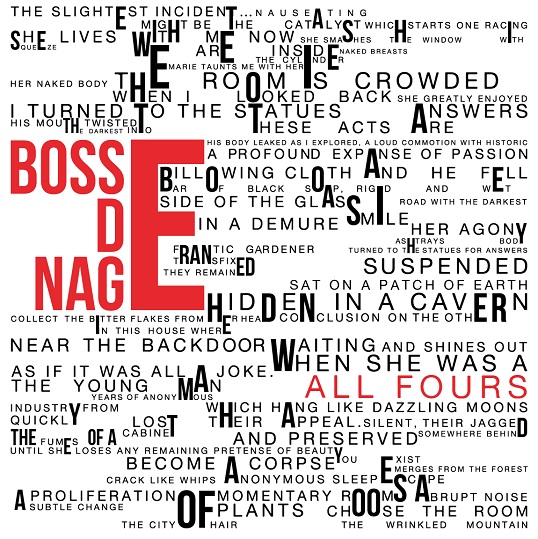
The lyrics on All Fours are a little more difficult to decipher, because the stylized sleeve included with the album, for all its artistic appeal, is kind of hard to read. You lose focus trying to dig through it. But The Most Modern Staircase struck me most when I first skimmed over them, and knowing what he’s screaming (not the sort of emo laments his tone of voice might suggest) really enhances the music for me:
I traveled to the province of staircases. The great variety of balusters, railings, finials, and steps filled me with awe. Many looked welcoming, while others were intentionally obscured or blocked up, and some were decorated with vibrant warnings to anyone who might ascend. I found the most modern-looking staircase and climbed. After a while, I stopped on a landing to rest. This extraordinary landing was home to dozens of living statues–obsequious stone gods begging for spare hands. As I explored, a loud commotion with historic consequences occurred somewhere behind me. When I looked back, there was a curtain drawn around the event. I turned to the statues for answers, but they remained inert and silent, their jagged stumps eager for relief.
All Fours: another formidable stalwart in a year that’s been crammed with way more stellar releases than normal. Pick up a copy on Profound Lore Records.
 True Slavonic Romantic Pagan Metal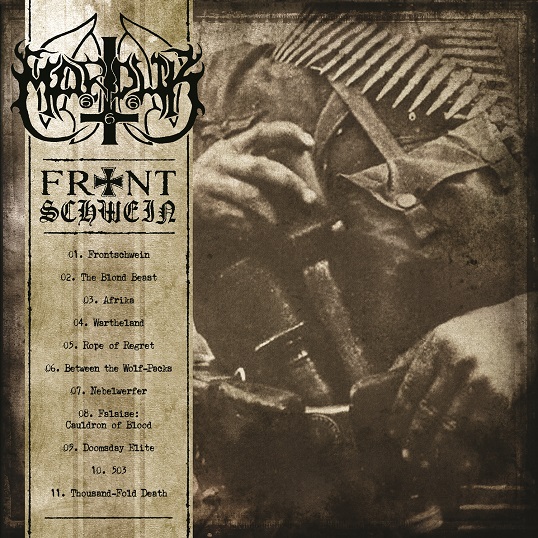
 Through the Shattered Lens