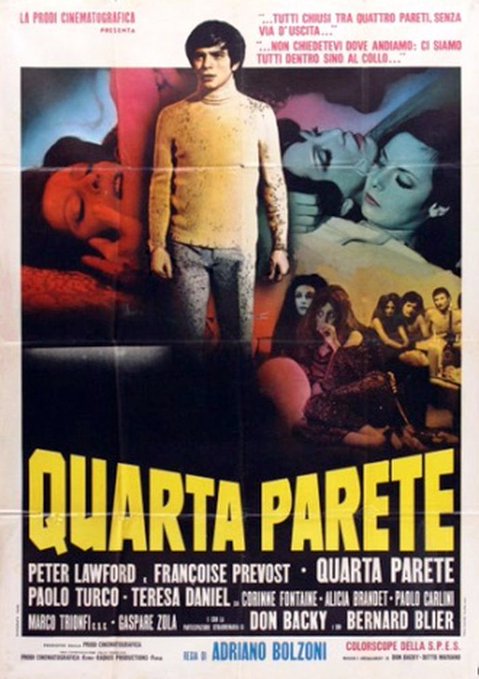
First released in 1969, The Fourth Wall opens with a series of photographs.
The grainy photographs all appear to have been taken at a political protest in London. The protestors are holding signs that say something about leaving Nigeria alone but the exact cause that is being supported is still left vague. Eventually, after viewing several photographs of long-haired college students holding signs, we reach some photographs of the police violently breaking up the protest and carting several of the protestors off to jail.
Amongst the protestors is a young Italian named Marco Baroni (Paolo Turco). Marco has spent the past four years in London, studying and apparently becoming politically active. However, it is time for him to return to Italy. When he reaches his home, we discover that, for all of his talk of protest and revolution, Marco comes from a wealthy, upper class family. Papa Baroni (Peter Lawford) is a businessman who is willing to bankrupt even his best friends and who openly flaunts the affair that he’s having with his Swedish secretary. Marco’s mother, Christiana (Francoise Prevost) spends her time in a haze of alcohol and ennui. Marco’s younger sister, Marzia (Tery Hare), is a fashion model who has become infamous for a serious nude photographs that were taken by the enigmatic Lona (Corraine Fontaine). Marzia’s room is full of picture of herself. When Marco returns home, she greets him more as if he were long-distance boyfriend than her brother. As the film progresses, it becomes clear that there is more to Marco and Marzia’s relationship than just sibling closeness.
It’s an odd and meandering film. Marco, having had his consciousness raised in London, is disgusted by his family’s decadence and hates the fact that his father seems to represent everything that he was arrested for protesting in the UK. At the same time, as much as Marco whines about the sins of his family, he finds himself repeatedly drawn to Marzia and her wild lifestyle. At one point, Marco finds himself observing a group of student radicals who can’t even agree on what they want to protest. At another point, he walks in on one of Marzia’s parties and watches as a rather tame orgy breaks out. This is the type of film where Marco spends a lot of time complaining about Marzia being more interested in hedonism than politics but the camera itself lingers on the nonstop nudity and the sight of Lona and Marzia kissing. For all of the film’s political pretensions, director Adriano Bolzoni obviously understood that sex sells better than speeches.
Bolzoni, himself, was not primarily a political filmmaker. The majority of his films were a mix of giallo thriller and spaghetti westerns. There are hints of the giallo genre in this film, with its vibrant colors and its shots of Marco slowly losing his mind as the full extent of his family’s decadence becomes clear to him. (That said, it’s hard not to laugh at the scene in which Marco runs through the rain while screaming, “NO!” over and over again.) The instrumental score is pure Spaghetti western, leading to some unintentionally funny moments. When Marco spots his father with his mistress, the mix of a zoom lens and a musical sting that sounds like it was lifted from a Sergio Leone showdown is more likely to leave you laughing than gasping. There are other scenes that are scored to songs that were apparently written to sound like Simon & Garfunkel’s contributions to The Graduate soundtrack.
As pretentious as the film is — and make no mistake, this is a very pretentious film — The Fourth Wall does do a good job of capturing Marco’s growing sense of unease as he returns home convinced that he’s figured out the world just to discover that no one else really cares about his politics, his ideals, or his outrage. Marco goes from being stridently idealistic to drowning in his own paranoia and it’s hard not to regret that Paolo Turco was a bit of a dull actor because, with better casting, the character’s descent would have been truly heartbreaking. Peter Lawford plays Papa Baroni with just the right amount of ruthless charm. He might be the epitome of everything that Marco is against but just watching him, you know that Papa Baroni is always going to get exactly what he wants. It doesn’t matter how much Marco whines or how many meetings Marco goes to or even how the film’s final burst of violence plays out. Papa Baroni will always thrive and survive.
 Through the Shattered Lens