Lisa Reviews An Oscar Nominee: Lady for A Day (dir by Frank Capra)


The 1933 film, Lady For A Day, tells the story of Apple Annie (May Robson) and Dave the Dude (Warren William), who is perhaps the nicest gangster that you could ever hope to meet.

Of course, when I refer to Dave the Dude as being a gangster, I should make clear that he’s not the type of gangster who guns down his rivals or sells drugs in back alleys.  I mean, I guess he might do that but we certainly don’t see much of evidence of it in the film.  Instead, Dave is just a dapper gambler who travels with a bodyguard named Happy McGuire (Ned Sparks) and whose girlfriend, Missouri Martin (Glenda Farrell), owns a nightclub where, since this is a pre-code film, the acts are slightly racy but not excessively salacious.  The country may be mired in a depression but Dave appears to be doing okay for himself.  Yes, Dave may be a criminal but at least he’s honest about it.

Surviving the Depression has proven to be far more difficult for Apple Annie.  She’s known as Apple Annie because she makes a meager living by selling fruit on the streets of New York City.  Dave is one of her regular customers, as he believes that her apples bring him good luck.  Annie has a daughter named Louise (Jean Parker).  Louise has never met her mother, having spent the majority of her life in a Spanish convict.  Annie regularly steals stationary from a high class hotel so that she can sends letters to Louise.  Not wanting her daughter to be ashamed of her, Annie has always presented herself as being a rich woman named Mrs. E. Worthington Manville.

However, it now appears that Annie’s charade is about to be exposed.  Louise is coming to New York with her fiance, Carlos (Barry Norton) and her prospective father-in-law, Count Romero (Walter Connolly).  Annie knows that when the Louise arrives, she’s going to discover that her mother is not wealthy and that the marriage will probably be called off.  So, led by Dave, Annie’s customers conspire to fool Louise into believing that her mother really is a member of high society.  And if that means that Dave is going to have to not only kidnap (but, let’s be clear, not harm) three nosy reporters and then make a deal with not just the mayor but also the governor to pull of the deception, that’s exactly what he’s going to do.

Though it may be disguised as a sweet and rather simple comedy, Lady For A Day is actually a rather melancholy little film.  Even when Annie and her friends are pretending to be wealthy members of high society, the film is aware that their escape from reality is only temporary.  Eventually, they’ll have to return to the reality of being poor in 1930s America.  At heart, it’s a sad story but May Robson, Warren William, Glenda Farrell, and Guy Kibbee (who plays the pool hustler who is recruited to pretend to be Annie’s husband) all bring such sincerity to their roles that you can’t help but smile while watching it.  Rejected by “polite” society, Annie and her friends have formed a community of outsiders and, throughout the film, the audience is happy that, no matter what, they have each other.

Lady for a Day was the first Frank Capra film to ever be nominated for Best Picture.  Capra was also nominated, for the first time, for best director but he had the misfortune to be competing with Frank Lloyd, who directed Cavalcade.  At the awards ceremony, when host Will Rogers, announced the winner for best director, he said, “Come on up here, Frank!”  An excited Capra ran down to the podium, just to discover that Rogers had actually been talking to Frank Lloyd.  Rogers, seeing what had happened, quickly invited the other nominated director, Little Women‘s George Cukor, to come join Lloyd and Capra at the podium.  Fortunately, one year later, Capra would win the directing Oscar for It Happened One Night.

Cavalcade would go on to win Best Picture but Capra retained so much affection for Lady For A Day that it was the only one of his films that he would subsequently remake.  A Pocketful Of Miracles came out in 1961 and featured Bette Davis in the lead role.  It would be Capra’s final theatrical film.

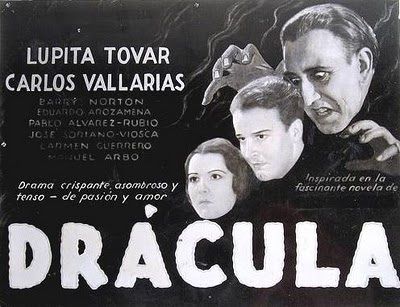
Horror Film Review: Drácula (dir by George Melford)


drac

One of the wonderful oddities of film history is that, in 1931, Universal produced not one but two versions of Dracula.  There’s the version that we all know, the one with Bela Lugosi.  And then there was the Spanish language version.

It was a common practice during the early days of the sound era for the studios to concurrently shoot Spanish-language versions of their films.  In the case of Dracula, the cast and the crew for the Spanish version would shoot at night, after Lugosi, Edward van Sloan, Dwight Frye, and everyone else had gone home.  The crew and the actor cast as Dracula, Carlos Villarias, were allowed to watch the dailies, with Villarias being specifically told to model his performance as much on Lugosi’s as possible.

Most of the early Hollywood’s Spanish films have been lost but Drácula has survived.  In fact, among some horror critics, it’s become a bit trendy to declare that the Spanish language version is superior to the English version.  While I was preparing for our annual October horrorthon, I decided to watch Drácula and see for myself.

In some ways, Drácula is indeed superior.  The film uses the same script as the English version and was filmed on the same sets.  But visually, it’s a far more interesting film.  Because director George Melford (who was quite an acclaimed silent film director) had a chance to watch Dracula‘s dailies, he also had the benefit of hindsight when it came to making decisions regarding lighting and camera angles.  If the English language Dracula suffers because its stationary camera work makes it feel like a filmed stage play, the Spanish-language Drácula feels like a real movie.

As well, there’s a passion to the Spanish language Drácula, a passion that often seems to be missing from the English language version.  The English language version often seems to be going out of its way not to offend — the screen fades to black whenever Dracula starts to bite anyone, Jonathan Harker and Mina Seward are both portrayed rather dully, and, with the exception of Lugosi, Dwight Frye, and Edward van Sloan, everyone seems to be a bit too restrained in their performances.

Perhaps because it was specifically being filmed for foreign distribution, the Spanish language Drácula is far less restrained.  We see what Dracula actually does to his victims.  We see Eva and Lucia’s ecstatic reactions to being bitten by the vampire.  As oppose to Dracula, where everyone was very proper and very covered, Drácula embraces cleavage and moaning in the same way that, 20 years later, would make Hammer Studios famous.  The actors in Drácula are far more passionate, emotional, and sensual than their English-language counterparts.  They’re far more … well, Spanish.  Spanish is an exciting language and it’s pretty much impossible for someone speaking it to be boring.

But, unfortunately, Drácula fails where it matters most.  In the role of the count, Carlos Villarias never exhibits the charisma that we associate with the best Draculas.  I get the feeling that he was mostly cast because he bore a passing resemblance to Bela Lugosi.  Since he was instructed to imitate Lugosi, that’s what his performance comes across as being.  While Villarias does a better Lugosi imitation than that guy that Ed Wood used in Plan Nine From Outer Space, it’s still just an imitation.

And unfortunately, you really can’t have a good Dracula film unless you have a good Dracula.  In a perfect world, we would have a combination of the two versions, with Bela Lugosi starring in the Spanish version.  However, we live in an imperfect world but at least it’s a world where we can watch both Dracula and Drácula.

dracula-spanish-language

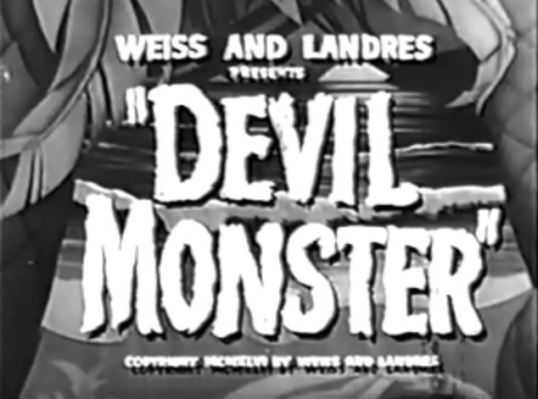
The TSL’S Daily Horror Grindhouse: Devil Monster (dir by S. Edwin Graham)


Devil_Monster_(1946)_-_Title

Oh my God, where to begin with this?

Okay, how about with a few confessions.

Number one, I came across the 1946 film Devil Monster in my 100 Horror Classic Movie Pack from Mill Creek.  The main reason that I decided to watch and review it was because it only had a running time of 64 minutes.  (On a good night, I have a 10-minute attention span.)

Number two, I guess it’s debatable whether or not Devil Monster really qualifies as horror movie.  I mean, it is called Devil Monster.  And there’s a big stingray that shows up during the final 10 minutes of the film and it rips off someone’s arm.  I assume the stingray is meant to be the devil monster of the title.  It’s not really scary but it’s supposed to be.  What matters is that, from the title and some of the dialogue, it’s obvious that an attempt was made to sell this movie as being at least partially a horror film.

Finally, you may have noticed that I mentioned that Devil Monster was a 1946 film.  Well, that’s actually debatable.  Devil Monster was apparently released in 1946 but, according to Wikipedia and the imdb, it’s actually a re-edited version of a 1936 film called The Sea Fiend.  Footage from The Sea Fiend was apparently mixed with stock footage and scenes lifted from other random films.  (One scene, featuring a bunch of island natives dancing, was clearly lifted from a silent film.)  The film was then dubbed over and a heavy-handed, nonstop narration was added in an attempt to link all of these random scenes together.  So, even though Devil Monster was released in 1946, it was actually filmed, in pieces, much earlier.

And really, that’s the main thing that I liked about Devil Monster.  It’s not that the film is in any way good or memorable.  (Well, it is memorable but mostly in a WTF sort of way.)  Instead, it’s a testament to the “never give up” attitude of the best B-filmmakers.  The producers of Devil Monster took a bunch of random footage, crammed it all together, and created something that resembles a movie.  Good for them.

As for the movie itself, it’s about a bunch of tuna fishermen who take the boat out and decide, in between searching for tuna, to stop by an island and pick up Jose (Jack Del Rio), who has been hiding out on the island ever since he was shipwrecked.  The problem is that Jose doesn’t want to go home and, after he’s forcefully dragged onto the boat, he decided to sail the boat into a part of the ocean that is home to the Devil Monster.  But then once the Devil Monster shows up, Jose changes his mind about killing everyone.  He jumps overboard and gets into a fight with the Devil Monster and … well, you simply have to watch it to truly understand how ludicrous this fight truly is.  Basically, footage of Jose throwing punches was superimposed over footage of a stingray in the ocean.  As a result, the scene features Jose punching the stingray and the stingray not reacting at all.  On top of all that, Jose is somewhat transparent.  You can literally see the ocean through him.  And, in the scenes where Jose is supposed to be swimming, you can see the hands of the crew holding him up in the air.

(Meanwhile, as we watch all this, we hear — but do not see — the tuna fishermen cheering Jose on.  “Get that devil fish, Jose!” someone yells.)

Of course, before that exciting scene, we get to see a battle between an octopus and a moray eel.  They are supposed to be at the bottom of the ocean but it’s obvious that they are actually in an aquarium.  How obvious?  Obvious enough that the studio lights are reflected in the glass and that the octopus tentacles gets stuck on the side of the aquarium in a few scenes.

And, before we watch the octopus/eel battle, the fisherman stop off at an island, where they meet a bunch of topless native girls.  We don’t actually see the fisherman interact with the natives.  Instead, we just hear the narrator tell us how much they enjoyed hanging out with the girls.  The natives, of course, change ethnicity from scene-to-scene, depending on from which source the footage has been lifted.

One of my favorite parts of this film comes at the end.  That’s where the boat captain’s son spots Jose and says, “There he is now.”  We then see Jose walking, before cutting back to the exact same footage of the son saying, “There he is now,” followed by the exact same footage of Jose walking.

My other favorite part of the film comes about 40 minutes in.  That’s when the screen goes black and we’re presented with a title card that reads, “One Moment Please, While We Change Reels.”

Of course, there’s also the scene where one of the fishermen suddenly yells, “TUNA!  TUNA!  TUNA!”  He’s just sounds so excited.

Devil Monster is in the public domain and can be found on YouTube.  Watch it at least once, just so you can say that you’ve seen it.