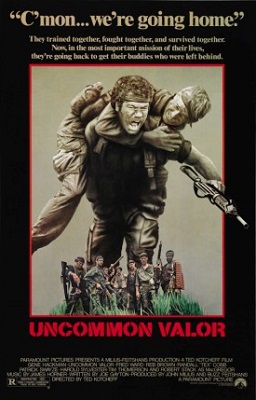
Uncommon Valor (1983, directed by Ted Kotcheff)


Retired Marine Colonel Jason Rhodes (Gene Hackman) and oilman Harry MacGregor (Robert Stack) share a tragic bonf.  Both of them have sons that served in Vietnam and are listed as being MIA.  Believing that their sons are still being secretly held in a POW camp in Loas, Rhodes and MacGregor put together a team to sneak into Southeast Asia and rescue them.

With MacGregor supplying the money and Rhodes leading the mission, the team includes Blaster (Red Brown), Wilkes (Fred Ward), Sailor (Randall “Tex” Cobb), and Charts (Tim Thomerson), all of whom served with Rhodes’s son.  Also joining in his helicopter pilot Curtis Johnson (Harold Sylvester) and former Marine Kevin Scott (Patrick Swayze), whose father was also listed as being MIA in Vietnam.  After a rough start, the group comes together and head into Laos to bring the prisoners home!

Uncommon Valor is one of the many movies released in the 80s in which Vietnam vets returned to Asia and rescued those who were left behind.  In the 80s, there was a very strong belief amongst many Americans that soldiers were still being held prisoner in Vietnam, Cambodia, and Laos and Hollywood was quick to take advantage of it.  The box office success of Uncommon Valor set the stage for films like Rambo and Missing In Action, film in which America got the victory that it had been denied in real life.

What set Uncommon Valor apart from the films that followed was the cast.  Not surprisingly, Gene Hackman brings a lot more feeling and nuance to his performance as the obsesses Col. Rhodes than Sylvester Stallone and Chuck Norris brought to their trips to Vietnam.  The film surrounds Hackman with a quirky supporting cast, all of whom represent different feelings about and reactions to the war in Vietnam.  Fred Ward’s character suffers from PTSD.  Randall “Tex” Cobb, not surprisingly, is a wild man.  Patrick Swayze’s character is trying to make the father he’ll never know proud.  Robert Stack and Gene Hackman represent the older generation, still trying to come to terms with everything that was lost in Vietnam and still mourning their sons.  The raid on the POW camp is exciting but it doesn’t feature the type of superhuman action that’s present in other POW-rescue films.  Col. Rhodes and his soldiers are ordinary men.  Not all of them survive and not all of them get what they want.

Uncommon Valor started out as a screenplay from Wings Hauser, though he’s not present in the cast of the final film and he was only given a “story” credit.  John Milius served as producer. Director Ted Kotcheff is best-known for First Blood, another action film about America’s struggle to come to terms with the Vietnam War.

Late Night Retro Television Reviews: Highway To Heaven 1.3 “To Touch The Moon”


Welcome to Late Night Retro Television Reviews, a feature where we review some of our favorite and least favorite shows of the past!  On Thursdays, I will be reviewing Highway to Heaven, which aired on NBC from 1984 to 1989.  The entire show is currently streaming on Tubi and several other services!

This week, Highway to Heaven is determined to make you cry.

Episode 1.3 “To Touch The Moon”

(Dir by Michael Landon, originally aired on September 26th, 1984)

Oh my God, this episode.  Seriously, this episode was a real tear-jerker and a good example of how this show’s earnest and extremely sincere approach could make even the most predictable of stories emotionally effective.

This episode deals with two young boys living in Houston.

Arthur Nealy (Barret Oliver) is the son of a man who flew to the Moon as a part of NASA and then died when the plane that he was flying crashed.  (Before the crash, Arthur’s father got the plane out over the ocean and saved the lives of everyone who was underneath him.)  For most of his short life, Arthur has struggled with Leukemia.  After a year of being in remission, the cancer has returned and, as his doctor (Don Starr) tells his mother (Carrie Snodgress), there is no hope this time.  Arthur’s only wish is to “touch the moon” before he dies.

Tony Rizzo (Tony La Torre) is a tough kid who has been in trouble with the police numerous times and who is on the verge of being kicked out his apartment by his own grandmother (Penny Santon).

Mark and Jonathan meet Tony while the latter is standing on the side of the road and hitchhiking.  Former cop Mark doesn’t want to stop to pick up any hitchhikers.  Jonathan, being an angel who can basically do anything, forces the car to stop anyways.  Jonathan and Mark agree to give Tony a ride but, when they stop off to get breakfast at a diner, Tony promptly steals Mark’s car.  While Jonathan goes off to do angel stuff, Mark pursues Tony.

Eventually, Mark tracks Tony down to his grandmother’s apartment but, when Mark discovers that Tony’s parents abandoned him and that his grandmother doesn’t even want him, Mark doesn’t have the heart to take Tony to the police.  (Awwwww!)  Instead, he takes Tony with him to an address that Jonathan give him earlier.

The address is the Nealy House, where Jonathan shows up to give Arthur a birthday gift and introduces himself as being a friend of Arthur’s father.  (The implication is that Jonathan and Arthur’s father have been conversing in Heaven.)  Arthur asks his mother if Tony can stay with him for a few days.  Arthur’s mother agrees.  When Tony tries to later sneak out of the house, he’s stopped by Jonathan, who reveals that Arthur has cancer and who gets Tony to agree to be Arthur’s friend for a few days.

You can probably guess where this is heading.  Tony and Arthur end up bonding.  Tony lets down his tough exterior.  Arthur says that he wants his mother to adopt Tony after he dies.  One happy family montage later, Arthur collapses in his bedroom and is taken to the hospital where Jonathan visits him in his hospital room and shows him that death is nothing to fear.  Arthur stares out the hospital window and the camera zooms in on the moon, the implication being the Arthur’s spirit is now free to touch the moon.

“Your home, son,” Jonathan says, his voice cracking, “you’re  home.”

I mean, Good Lord!  I’m crying just typing this up!  And really, that’s the best review that I can give you of this episode.  It was heavy-handed and sometimes the performances felt a little awkward but it totally made me cry.  There’s not a hint of cynicism to be found here, nor are there any hints of snarkiness.  There’s just a lot of very honest emotion.

Next week, I assume the show will make me cry again.