I cannot stand the phrase “pay it forward.”
The idea is that somebody does something nice for you and then they say, “Pay it forward” and suddenly, you are magically required to go out and do something nice for someone else. For one thing, I hate the obligation of it all. I have this fear that as soon as I finally get finished paying it forward, some stranger is going to hand me a Coke and say, “Pay it forward,” and suddenly I’ll have to do it all over again! And really, honestly, I shouldn’t have to pay it forward just because someone gives me a Coke. If you’re going to tell me to pay it forward, at least give me a car or a Victoria’s Secret gift card or something.
Ultimately, “pay it forward” is something that people say to make themselves feel good but it’s actually a pretty shallow concept.
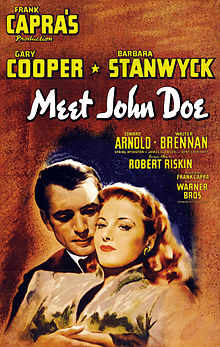
The same thing can be said about John Doeism, the philosophy that rests at the center of the 1941 film Meet John Doe, our latest entry in Shattered Politics. John Doeism is a grassroots political movement that is based around the slogan, “Be a Better Neighbor.” Much like “Pay it forward,” “Be a better neighbor” sounds good and it’s easy to say but its main appeal is that it doesn’t require that much thought. If anything, it sounds like the first step on the road to serfdom…
That said, I still like the film.
Meet John Doe opens with lay-offs at a major metropolitan newspaper. (These lay-offs are signified by a handsome young man who points at people and then runs his finger across his throat.) Among those laid off is columnist Ann Mitchell (Barbara Stanwyck). However, before Ann is officially let go, she is told to write one final column. Understandably angry over her treatment, Ann responds by making something up. She writes and prints a fake letter from a man calling himself “John Doe.” John Doe explains that he’s unemployed and that he will be committing suicide on Christmas Eve.
Well, quicker than you can say twitter death hoax, everyone in the entire country reads John Doe’s letter and demands to know who he is. The newspaper’s editor, Henry Connell (James Gleason), rehires Ann and puts her in charge of finding the real John Doe.
When numerous unemployed and homeless men start to show up at the newspaper, claiming to be the real John Doe, little do they realize that they are, in fact, auditioning. Ann finally decides that Joe Willoughby (Gary Cooper) has what it takes to be the public face of John Doe. Not only does he have a compelling personal story (he’s a former baseball player whose career was ended by an arm injury) but he looks and sounds like Gary Cooper.
(And, as I typed that last sentence, it suddenly occurred to me that Meet John Doe managed to predict American Idol…)
Joe is soon a celebrity, reading speeches that have been written for him by Ann and encouraging people across the nation to be a better neighbor. And Ann is falling in love with Joe. However, Joe is not comfortable with his new role. For one thing, he doesn’t like being a hero for telling a lie. Secondly, he knows that rival newsmen are eager to expose him as being a fraud. And finally, there’s a sinister publisher named D.B. Norton (played by Edward Arnold, who previously played corrupt Boss Taylor in Mr. Smith Goes To Washington) who is eager to be President of the United States. He wants to turn John Doeism into a fascist political movement and, unless Joe endorses him, he’ll reveal that Joe’s a fraud…
Meet John Doe was Frank Capra’s follow-up to Mr. Smith Goes To Washington. It features many of the same themes as Mr. Smith, with the main difference being that Meet John Doe is a lot more preachy. Whereas Mr. Smith saved its big speech for the end, Meet John Doe has several big speeches spread throughout its running time. (There’s also a scene where a guy named Bert tells the story of how he was inspired by John Doe and, I swear, it literally goes on forever.)
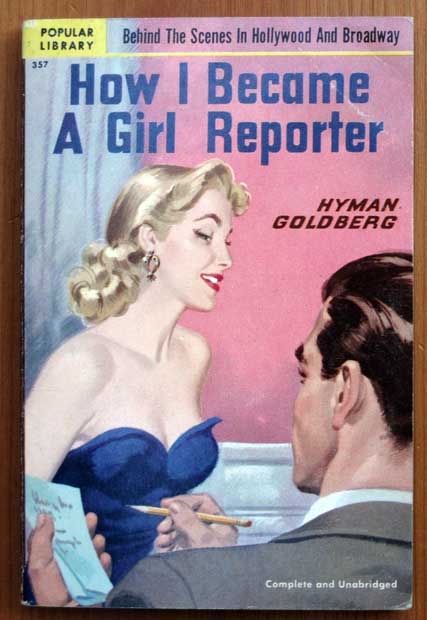
So, no, Meet John Doe is definitely no Mr. Smith Goes Go To Washington but I still liked it, mostly because of the chemistry between Gary Cooper and Barbara Stanwyck. I wanted to be Barbara Stanwyck’s character. Seriously, watching a film like Meet John Doe, leaves me convinced that I was born several decades too late. If I had been born in 1918, I could have been a quick-witted, cynical, and secretly romantic intrepid girl reporter at a major metropolitan newspaper.
Even better, I would never have to worry about ever being told to “pay it forward.”

 Through the Shattered Lens