Retro Television Review: Fantasy Island 6.22 “Love Island/The Sisters”


Welcome to Retro Television Reviews, a feature where we review some of our favorite and least favorite shows of the past!  On Tuesdays, I will be reviewing the original Fantasy Island, which ran on ABC from 1977 to 1984.  Unfortunately, the show has been removed from most streaming sites.  Fortunately, I’ve got nearly every episode on my DVR.
Today, the sixth season of Fantasy Island comes to a close and so does Tattoo’s time on the show.

Episode 6.22 “Love Island/The Sisters”

(Dir by Philip Leacock, originally aired on May 14th, 1983)

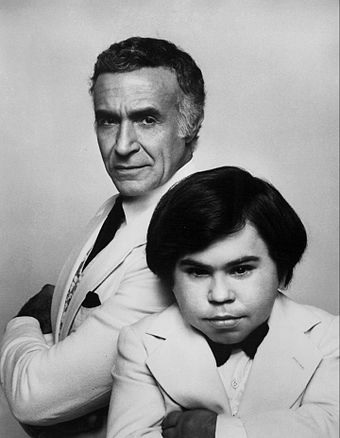
This is it.  This is not only the finale of season 6 but it’s also the final episode to feature Tattoo as Mr. Roarke’s assistant.

Why did Herve Villechaize leave Fantasy Island after the end of the sixth season?  The story that you always hear is that Villechaize wanted more money to continue working on the show.  He felt that he deserved to be paid as much as Ricardo Montalban.  The show’s producers disagreed.  To them, Montalban was not only the star of the show but also someone who has just appeared in a hit movie, Star Trek II: The Wrath of Kahn.  They felt that they could keep the show going without Villechaize and …. well, it turns out they were totally and completely wrong about that.

I have not seen much of the seventh season, in which Villechaize was replaced by Christopher Hewett.  And, due to the vagaries of my DVR, there’s a lot of season 7 that I won’t be able to review.  What I do know is that the show went from being #39 to bring ranked #47 in the ratings after Villechaize left.  Obviously, being the 39th ranked show was nothing to brag about but it was still a helluva lot better than #47.  Villechaize left and a lot of the audience left with him.

I’ve made a lot of jokes about Roarke and Tattoo’s relationship.  Especially during the early seasons, Roarke and Tattoo sometimes did seem to be friendly rivals.  (That was when Roarke was a far more enigmatic fellow and Tattoo always seemed to be trying to figure out a way to make some extra money on Fantasy Island.)  Remember when Tattoo ran against Mr. Roarke in an Island election?  That said, Roarke and Tattoo’s relationship really was the heart of the series.  The fantasies themselves were often forgettable.  How many times can you get excited about seeing a member of the Brady Bunch as a guest star?  The thing that people really remember about Fantasy Island is the relationship between Roarke and Tattoo.  Regardless of what went on behind the scenes, Montalban and Villechazie had a good on-camera chemistry.  It was fun to watch them interact.  I always enjoyed the episodes that allowed Villechaize to reveal Tattoo’s sensitive side.  (In real life, Villechaize was an advocate for abused children, often taking the time to personally visit with children who had been rescued from abusive households.)

This is all my long-winded way of saying that they should have just agreed to pay Herve Villechaize more money.

At the very least, they should have given him a proper goodbye episode.  The sixth season ends with a rather basic episode, with no mention made of Tattoo leaving or even thinking of leaving.  Instead, we get Maureen McCormick going to a mysterious mansion to rescue her old sister (Britt Ekland) from an abusive man (played by Peter Mark Richman).  And then we get Bob Denver and Paul Kreppel as two wannabe womanizers who end up in prehistoric times, trying to romance a cavewoman while dealing with dinosaurs.  The dinosaur effects were cheap but likable but they were also the only thing that really made either of their fantasies stand-out.

And so, season 6 ends, not with a bang but a whimper.  Tattoo waves goodbye one last time.  I’m going to miss him.
Film Review: Purple Rain (dir by Albert Magnoli)


“Prince could actually act.”

That was my main reaction to watching the 1984 film, Purple Rain, a few nights ago.  Over the years, there have been a lot of music stars who have attempted to make the transition to acting.  Some have been more successful than others.  While some have stuck to playing versions of themselves, others have attempted to become actual character actors and the end results have often been mixed.  Being a strong stage performer does not neccesarily mean that person is automatically going to be a convincing film actor and the history of the movies is full of famous singers whose personality seemed to evaporate as soon as they had to act for the cameras and try to sound convincing while reciting dialogue.  Taylor Swift has built up a strong and incredibly loyal fanbase but you wouldn’t necessarily believe that she was one of the world’s biggest stars if you only knew her from her wan and bland performances in Cats and Amsterdam.  Indeed, while watching her in Amsterdam, it’s kind of hard not to be thankful when that car drives up and brings her performance to an end.

Prince, on the other hand, could truly act.

In Purple Rain, he plays The Kid.  The Kid is an enigmatic musician living in Minneapolis, Minnesota.  He’s the front man of a band called The Revolution and he sings songs that are, at times, almost disturbingly personal.  The Kid rides a purple motorcycle and he’s one of those musicians who is driven to record almost every sound that he hears.  (At one point, The Kid listens to a recording of an unidentified woman sobbing.  Who exactly the woman was or why she was crying are questions that are never answered, though I think it’s possible it was supposed to be the Kid’s mother.)  He performs to escape from the scars of his upbringing.  His father (Clarence Williams III), a failed musician, regularly beats his mother (Olga Karlatos, who memorably lost an eye in Lucio Fulci’s Zombi 2).  No one can deny The Kid’s talent but he’s also known for being a bit of a control freak and the other members of the Revolution sometimes feel that he’s not willing to give them the credit and opportunities that they deserve and….

Okay, obviously there are some similarities between The Kid and the man playing him.  Purple Rain was Prince’s first film and his first acting role and it makes sense that he would want to play a character in a situation that he was familiar with.  But that still doesn’t change the fact that Prince gives an excellent and charismatic performance in the lead role.  Unlike so many other singers-turned-actors, he doesn’t lose his spark when he has to remember his lines.  His presence doesn’t evaporate when the camera is turned on him.  Instead, if anything, Price feels even more natural off-stage than on.  Whether the Kid is being playful or serious, driven or defeated, Prince is never less than convincing.  Yes, the audience never forgets that they’re watching Prince.  But, at the same time, the Kid comes to life as an individual character with his own life and problems and personality separate of the actor who is playing him.

As for the film’s plot, it’s a fairly simple one.  The Revolution is one of three bands that hold down the house band slot at the First Avenue nightclub.  The Kid’s rival, Morris Day (played by Morris Day), plots to replace the Revolution by putting together an all-girl group called Apollonia Six.  Apollonia Six is led by Apollonia (Apollonia Kotero), who is the Kid’s girlfriend.  As Morris explains it, the Kid is too wrapped up in himself to help out Apollonia or the Revolution’s Wendy and Lisa.

And Morris Day has a point.  As soon as Apollonia tells the Kid that she’s going to be working with Morris, the Kid responds by striking her.  It’s a shocking scene but, as the film shows, it’s all the Kid learned at the hands of his father.  It’s only after a personal tragedy that the Kid starts to realize that he does not have to be just like his father.  That said, let us hope that the Kid invested in some therapy and some anger management courses after the end credits rolled.

As a character, the Kid would be unbearable if not for the strength and charm of Prince’s performance.  Prince is amazing when he performs on stage and the film’s soundtrack still holds up but what makes the film work are the moments when Prince shows us the Kid’s vulnerable side.  Self-loathing is not an easy feeling to play and it’s an even more difficult feeling to make sympathetic but Prince does both.  The Kid knows that he’s self-destructive and immature but he’s also sincere in his desire to be better than his past. The film leaves you to wonder if he’ll succeed.

Personally, I really hope he did.