Film Review: La Dolce Vita (dir by Federico Fellini)


The great director Federico Fellini was born, on this day, 125 years ago.

He was born in Rimini.  That’s in Northern Italy.  (The Italian side of my family comes from Southern Italy and yes, there is a difference.)  Fellini was 19 years old when he enrolled in law school but records, which were admittedly spotty at the time, seem to indicate that he never attended a single class.  Instead, Fellini found work as a writer, working first as a journalist and then a screenwriter.  (He was one of the many credited for writing the screenplay for Rome, Open City.)  He began his directing career as a neorealist in the 50s but soon crafted his own unique style, one which openly mixed humor with drama and fantasy with earthiness.  Fellini established himself as one of the world’s best directors, a filmmaker who made art films that not only entertained but also provoked thought.  Fellini was a director who embraced life’s contradictions as well as being a strong anti-authoritarian who rarely commented on politics but did make known his distaste for communism.  He was also one of Mario Bava’s best friends.

My favorite Fellini film is 1960’s La Dolce Vita.

Ah, to be rich, decadent, and jaded in Rome in the early 60s!  Or maybe not.  Sometimes, being jaded is not as much fun as it seems.

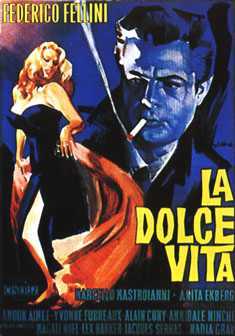
La Dolce Vita is largely remembered for the scene in which actress Sylvia (Anita Ekberg) and journalist Marcello (Marcello Mastroianni) wade into Rome’s Trevi Fountain.  While that it is a great and sensual scene and justifiably famous (and, in fact, the film’s poster was originally a shot of Ekberg in the fountain despite the fact that the scene is only a small part of a 3-hour movie), it’s often overlooked that the scene itself does not have a happy ending.  When Marcello and Sylvia return to Sylvia’s hotel, Sylvia is slapped by her loutish boyfriend (played by Lex Barker).  Marcello, meanwhile, has a fiancée named Emma (Yvonne Furneaux) who is recovering from a recent overdose.  Even though Marcello swears that he loves Emma and that he would do anything for her, he is still compulsively unfaithful.

When we first meet Marcello, he’s in a news helicopter, watching as a statue of Jesus is flown over Rome.  However, Marcello is distracted by the sight of a group of women sunbathing on a nearby rooftop and he tries to get their phone numbers before returning to following the statue.  That pretty much sets the tone for most of what we see of Marcello over the course of La Dolce Vita.  He’s searching for the profound and transcendent but he frequently gets distracted by his own more earthy desires.

The film follows Marcello as he encounters different people in Rome and the surrounding area.  Some of them are rich and some of them are poor.  All of them are looking for something but none of them seem to be quite sure what it is.  A possible sighting of the Madonna brings a crowd of people to the outskirts of Rome, where everyone asks for something but the end result is only chaos.  A meeting with an intellectual friend of Marcello seems to offer a solution to Marcello’s ennui until a tragedy reveals that his friend was even more lost than Marcello.  (The film’s sudden tragic turn took me very much by surprise when I first saw it, despite the fact that countless filmmakers have imitated the moment since.)  A possibly important conversation on a beach is made unintelligible by the crashing waves and, instead of providing enlightenment, it ends with a shrugs and an enigmatic smile.  There’s a definite strain melancholy running through the film though there’s also a certain joi de vivre to many of Marcello’s adventures.  Marcello is torn between seeking transcendence and seeking pleasure.  Fellini shows us that both are equally important.  It’s left to use to decide whether the pleasure is worth the heartache and vice versa.

La Dolce Vita is visually stunning portrait of life in Rome at a very particular cultural moment.  Marcello Mastroianni is the epitome of decadent cool in the lead role but he’s also a good enough actor to let us see that Marcello is never quite as proud of himself or as happt with his life as everyone assumes he is.  La Dolce Vita may be about a specific cultural moment but, as a film, it is timeless.
Cleaning Out The DVR: Sodom and Gomorrah (dir by Robert Aldrich)


I think we all know the story of Sodom and Gomorrah.

As told in the book of Genesis, Sodom and Gomorrah were two of the wickedest cities in what was then the civilized world. God grew so sick of their wickedness that he decided to wipe both of the cities and all of their inhabitants out of existence. However, because Abraham’s son, Lot, was living in Sodom with his family, God sent two angels to Sodom to warn Lot. Lot tried to argue that, if he could find 10 good people in the city, Sodom should be spared. However, then the people of Sodom showed up and demanded to “know” the angels and that pretty much sealed their fate. Lot and his family were told to leave the city and to not look back while it was being destroyed. Unfortunately, Lot’s wife just couldn’t resist the temptation and she ended up turning into a pillar of salt.

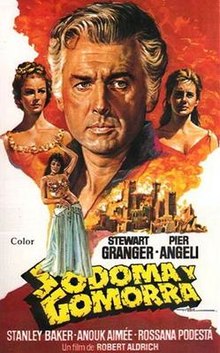
The 1962 film, Sodom and Gomorrah, recreates the Biblical story, though it takes a lot of liberties with the established narrative. Stewart Granger plays Lot. Anouk Aimee plays Bera, the decadent queen of Sodom who refuses to believe that the incoming destruction of her city is anything more than a dust storm. Pier Angeli plays Lot’s wife, who is imagined here as formerly being one of Bera’s slaves. Though she loves Lot, she loves her former life more and …. well, we all know the story. And then there’s several characters who were created specifically for the film. The most prominent of these is Astaroth (Stanley Baker), who is Bera’s scheming brother and who later is attracted to one of Lot’s daughters. The film was directed by Robert Aldrich. If you know anything about Aldrich’s filmography (Kiss Me Deadly, Twilight’s Last Gleaming, and Hustle among others), he’s not exactly the first name that comes to mind when you think of a director who you would expect to find directing a Biblical epic. And indeed, when compared to his other films, Aldrich often does seem to just be going through the motions when it comes to telling the film’s story.

Sodom and Gomorrah suffers from a problem that afflicted many Biblical epics. It takes forever to get to the good stuff. We’re all watching because we want to see the cities get destroyed and we want to watch Lot’s wife get transformed into a pillar of salt. However, this film — which has a running time of two and a half hours — takes forever to reach that point. First, we have to spend a lot of time listening to Astaroth plotting against his sister and scheming how to take over the Salt Trade, which is the source of the wealth of both of the cities. Then we spend an endless amount of time with Lot and his family wandering through the desert. There are a few good battle scenes but the film still feels dragged out. It takes forever to get to the destruction of Sodom and Gomorrah and it’s a bit of a let down when it finally does happen. The ground shakes, Dust fills the sky. Buildings start falling on people. Throughout it all, the Sodomites continue to behave wickedly, which leads to a few odd moments. (A man and a woman stop fleeing for a few minutes to make out against a wall. Naturally, the wall is the next thing to collapse.) After all of that build-up, the destruction scenes are maddeningly pedestrian.

Lot is probably one of the most interesting characters in Genesis, an imperfect man who tried to do the right thing but who often seemed to have terrible luck. Unfortunately, Stewart Granger is a bit of a stiff in the lead role and he’s never convincing as someone who could lead his people through the desert. He doesn’t have the innate authority that Charlton Heston had in The Ten Commandments. Far more successful are the performances of Stanley Baker and Anouk Aimee. Aimee, in particular, seems to being having a blast being bad. Or at least, she is until the walls come tumbling down.

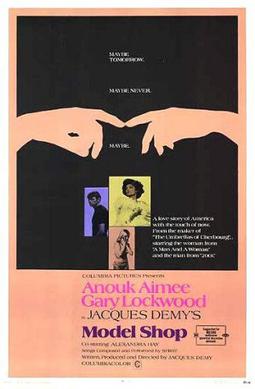
Film Review: Model Shop (dir by Jacques Demy)


The 1969 film, Model Shop, plays out like a dream.

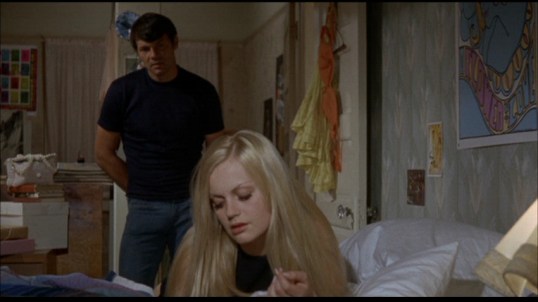
The film tells a simple enough story.  In fact, it’s tempting to say that Model Shop is plotless though it actually isn’t.  There’s a plot but, in many ways, the film is more about how the story is told than the story itself.  Gary Lockwood plays George Matthews, a former architectural student who is currently living in Los Angeles with his girlfriend, Gloria (Alexandra Hay).  Gloria is an actress while George …. well, George is just a drop out.  Throughout the film, we get clues that George might have once cared about things (for instance, some of his friends are putting out an underground newspaper while another is into creating protest music).  However, by the time we meet him, George seems to be rather detached from life.  Of course, some of that may be due to the fact that, because he’s no longer in college, George is now eligible to be drafted and sent to Vietnam.  (The film was made in 1969, after all.)  In fact, George has just received his induction notice.  He basically has a week left before joining the army.  At one point, in a flat tone of voice, he says, “It feels like a death sentence.”

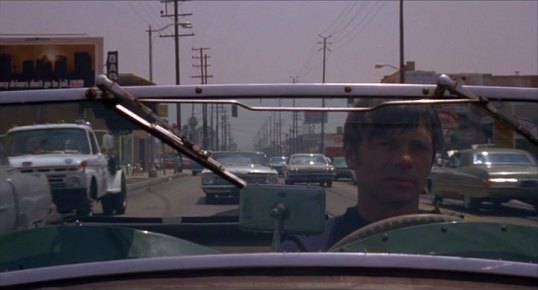
Getting drafted is not George’s only problem.  He’s also about to lose his beloved car!  George has a day to come up with a few hundred dollars so he can keep his beloved green roadster from being repossessed.  (In George’s defense, it is a pretty nice car.)  While Gloria goes off to shoot a soap commercial, George spends his day driving around Los Angeles and searching for money.  George has a lot of friends but most of them are too busy making music and setting up love-ins in Griffith Park to help him out.  George doesn’t want to call his mother for the money and when he tries to call his father, he gets a lecture about how his older brother served in Korea.  No one is willing to make any sacrifices to help out George.  That may have something to do with the fact that George is, at times, a tad whiny and a bit self-absorbed.

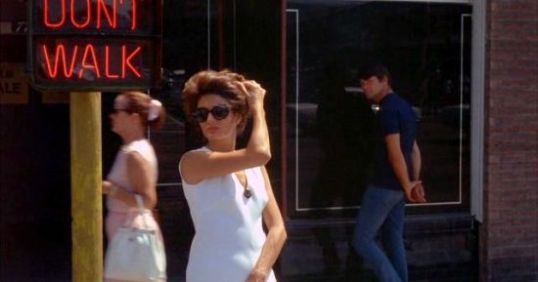
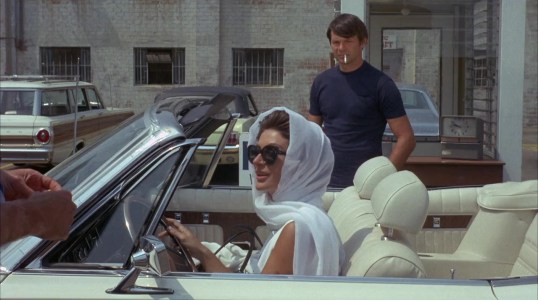
It’s while wandering around Los Angeles that George spots the beautiful Lola (Anouk Aimée).  The glamorous but sad Lola works at a model shop, a sleazy establishment where men pay to take her picture.  Lola has a tragic story of her own, one that finds her stranded in Los Angeles.  It all leads to a brief romance that’s as bittersweet as ennui in May.

(Ennui in May is also the title of a musical that I’ve been writing, off-and-on, since 2012.  Keep an eye out for more details!)

Model Shop was the first (and only) English-language film of French filmmaker Jacques Demy and one reason that the film seems so dream-like is because Demy wrote the dialogue-heavy script in French and then had it translated into English.  As such, this is an extremely talky film in which no one ever seems to have a real conversation.  (It should also be noted that what sounds beautiful and poetic in French can come across quite differently in the harsher tones of the English language.)  George, Gloria, and Lola all speak in pedantic, declarative sentences.  There’s none of the individual verbal quirks or changes in tone that would make it seem as if these were people having an actual conversation.  As well, nobody ever talks over anyone else.  No one ever attempts to interrupt anyone else’s train of thought.  At times, it seems like the cast is performing under the influence of hypnosis and they’ve been told, “Do nothing while anyone else is speaking.”  It creates a rather odd atmosphere.

Also adding to the film’s dream-like feel is Jacques Demy’s direction.  The pacing feels just a little bit off.  It’s not so far off as to harm the film.  In fact, the fact that everything seems to be moving just a little bit slower than expected is actually one of the film’s biggest strengths.  If nothing else, it reflects George’s own feelings of being on borrowed time.  Beyond that, though, Demy often seems less like a director than an anthropologist.  A good deal of the film is simply made up of shots of George driving around Los Angeles and one gets the feeling that Demy was more fascinated with capturing the unique style of America than with telling George’s story.  Demy directs the film like an outsider looking in and, as a result, he often seems to focus on the details of daily life — like the television and the billboards and the red Coke signs hanging over every store window — that Americans takes for granted.  At the start of the film, the camera lingers over an oil derrick, as if Demy is looking at this symbol of Americana and looking for clues to understand what makes America what it is.  Much as Michelangelo Antonioni did when he made Zabriskie Point, Demy seems to be trying to use this film to solve the riddle of America and how Americans — even with the country embroiled in an unpopular war — could remain so youthful and optimistic about the future.  Unlike Antonioni, Demy seems to be more bemused than angered by America’s contradictions.  Anonioni ended Zabriskie Point by blowing up a luxury, mountain-side home.  One gets the feeling that Demy would have found the same house to be rather charming.

Of course, the late 60s were a time when Hollywood studios felt that they were under attack, not just from television but from foreign films as well.  With all the critics talking about European films were superior to studio films in every way and young filmgoers flocking to foreign films, it would only make sense that the studios would would bring filmmakers over from Europe.  For the studios, it was a chance to try to convince people that they weren’t run by out-of-touch dinosaurs.  For the filmmakers, it was a chance to try to capture and explain America on film.  The end results were mixed, with many of the directors — like Fancois Traffuat and Michelangelo Antonioni — later testifying to the difficulty of trying to work with an American studio while having a European sensibility.  This was also true of Demy, who never did another English-language film after Model Shop.  Reportedly, Demy wanted to cast an unknown actor named Harrison Ford as George but Columbia Studios demanded that Demy use Gary Lockwood.  (Lockwood, of course, is best known for not showing a hint of emotion, even while hurtling to his death, in 2001: A Space Odyssey.)

Model Shop is definitely a film of it’s time, which is why I enjoyed watching it.  Yes, it’s pretentious and kind of silly.  But, at the same time, Demy is so fascinated with the Los Angeles of the late 60s that it’s hard not to share his fascination.  The film plays out like a dream of the past, like a time machine that puts you to sleep and then fills your head with images that you can see but you can’t quite reach.  It’s a time capsule, perfect for history nerds like you and me.

Someday, if films like Back to the Future and Happy Death Day 2U are any guide, we’ll have time machines and we’ll be able to personally experience the past.  Until then, we can watch films like Model Shop.