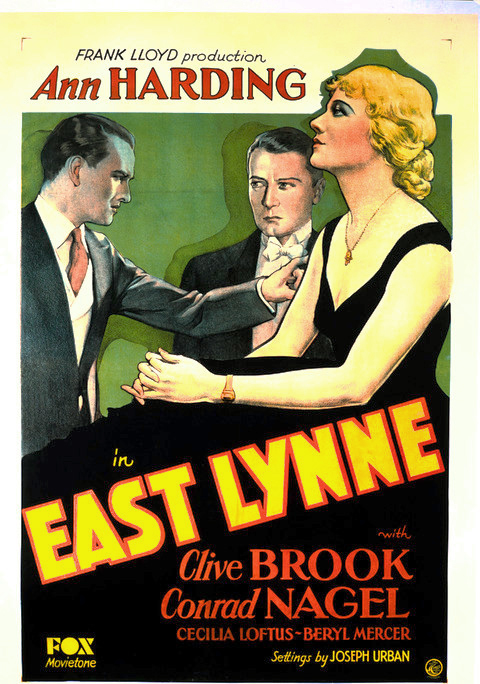
Lisa Reviews An Oscar Nominee: East Lynne (dir by Frank Lloyd)


In the history of the Academy Awards, East Lynne is a curiosity.

Released in 1931, East Lynne was one of the five films to be nominated for Best Picture at the fourth annual Academy Awards.  Best Picture was the only nomination that East Lynne received, which of course leaves you to wonder just what exactly was so good about it.  Why was it nominated as opposed to something like A Free Soul, which received nominations for Best Actress and Director and which won the Best Actor Oscar for Lionel Barrymore?  East Lynne was a success at the box office but so were The Public Enemy, Little Caesar, and Scarface.  None of those classic gangster films made much of an impression with the Academy but all of them are better remembered today than East Lynne.

One reason why East Lynne has fallen into obscurity is because it’s not an easy film to see.  There is only one complete print of East Lynne still in existence.  It’s housed at the UCLA’s Instructional Media Lab but it can only be viewed by appointment.  There are, however, a few bootleg copies on DVD.  The picture is grainy.  The sound is inconsistent.  Even worse, the bootleg is missing the last 12 minutes of the film.  Still, for those of us who don’t live near UCLA, that bootleg copy is the only convenient way to watch East Lynne.

That’s how I watched it.  (I also looked up how the film ended so I know where the story eventually led, despite those missing 12 minutes.)  Having now seen the film, I can now say that it makes even less sense that the film was nominated because it’s pretty bad.  I can only imagine that it received its nomination as a result of Fox Film Corporation (which would later merge with 20th Century Pictures to be come 20th Century Fox) demanding that its employees vote for it.

Based on a Victorian novel that had already been filmed several times during the silent era, East Lynne tells the story of Lady Isabella (Ann Harding), a British noblewoman who marries a stuffy attorney named Robert Carlyle (Conrad Nagel).  From the beginning it’s an awkward marriage.  Isabella is sociable and popular and wants to enjoy life.  Carlyle is a humorless jerk.  Not even the fact that they live in a nice mansion called East Lynne provides much comfort.

When Isabella accepts a kiss from a cad named Captain William Levinson (Clive Brook), Isabella’s sister-in-law uses it to drive a wedge between Isabella and Carlyle.  Carlyle, being a jerk, kicks Isabella out of the house and takes custody of their child.  Now viewed as being a figure of scandal, Isabella goes abroad with Levinson.  (Since this is a pre-code film, going abroad amounts to going to a then-racy show in Vienna.)  However, through a series of improbable events, Levinson ends up dead and Isabella ends up very slowly going blind.  However, Isabella is determined to see her child just once more before losing her sight so it’s up to her to convince a maid to sneak her back into East Lynne late at night….

And then the bootleg version of the film ends!  Now, I did my research and I discovered — here’s your SPOILER ALERT — that the film apparently ends with a blind Isabella stumbling over a cliff and her husband realizing too late that maybe he was kind of a jerk.  I’m kind of sorry that I didn’t get to see that.  I may have to book a flight to UCLA.

Anyway, from what I did see, East Lynne is a creaky old film.  This is one of those films where you can tell that the cast was still adjusting to the new sound era.  Ann Harding’s screen presence is a bit too insubstantial to keep the film’s melodramatic story grounded and neither Conrad Nagel nor Clive Brook seem to be worth all of the trouble that Isabella goes through.  Frank Lloyd’s direction is painfully slow and stagy, though things do pick up briefly when the action moves to Vienna.  Worst of all, the film is pretty much on Carlyle’s side.  He’s a jerk, the movie says, but Isabella should have made more of an effort to keep him happy.  Welcome to 1931!

East Lynne lost the best picture race to Cimarron, which was another fairly forgettable film.  Though there were plenty of good films to choose from in 1931, it doesn’t appear that the Academy nominated any of them.  Of course, that wouldn’t be the last time that would happen.
 

Christmas Surprise: IT HAPPENED ON 5TH AVENUE (Allied Artists 1947)


gary loggins's avatarcracked rear viewer

ithap1

I’d never heard of IT HAPPENED ON 5TH AVENUE until it’s recent broadcast on TCM. This unsung little holiday gem was a TV staple for decades before being pulled from viewing in 1990, only resurfacing in 2009 when a small but dedicated band of classic film fans put the pressure on to see it aired once again. And I’m glad they did, for this charming, unpretensious comedy boasts a marvelous cast, an Oscar-nominated screenplay, and a Frank Capra-esque feel without a lot of the Capra-corn.

Capra himself was scheduled to direct it back in 1945, but instead he chose to make another Christmas film you may have heard of, IT’S A WONDERFUL LIFE. Veteran Roy Del Ruth obtained the rights, and IT HAPPENED ON 5TH AVENUE became the first release of Allied Artists, the larger budgeted, more prestigious arm of Monogram Pictures (and you know how much I love Monogram movies!)…

View original post 683 more words

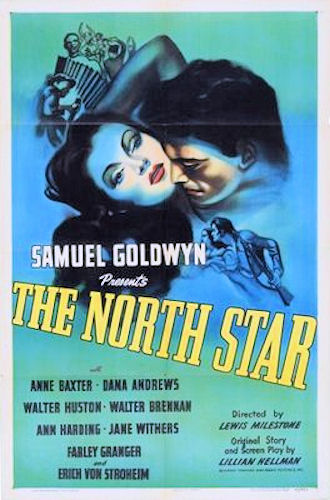
The Fabulous Forties #41: The North Star (dir by Lewis Milestone)


The North Star

The 40th film — wait a minute, I’m finally up to number 40!?  That means that there’s only ten more movies left to review!  And then I’ll be able to move on!  It’s always exiting for me whenever I’m doing a review series and I realize that I’m nearly done.

Anyway, where was I?

Oh yeah — the 40th film in Mill Creek’s Fabulous Forties box set was the 1943 war epic, The North Star.  This is one of the many war films to be included in the Fabulous Forties box set and I have to admit that they all kind of blend together for me.  Since these films were actually made at a time when America was at war, there really wasn’t much room for nuance.  Instead, every film follows pretty much the same formula: the Nazis invade, a combination of soldiers and villagers set aside their individual concerns and/or differences and team up to defeat the Nazis, there’s a big battle, a few good people sacrifice their lives, the Nazis are defeated, and the allies promise to keep fighting.

It’s a pretty predictable formula but that’s okay because it was all in the service of fighting the Nazis.  Could I legitimately point out that the villains in these movies are always kind of two-dimensional?  Sure, I could.  But you know what?  IT DOESN’T MATTER BECAUSE THEY’RE NAZIS!  Could I point out that the heroes are often idealized?  Sure, but again it doesn’t matter.  Why doesn’t it matter?  BECAUSE THEY’RE FIGHTING NAZIS!

That’s one reason why, even as our attitude towards war changes, World War II films will always be popular.  World War II was literally good vs evil.

Anyway, The North Star was a big studio tribute to America’s then ally, the Soviet Union.  When a farm in the Ukraine is occupied by the Nazis, the peasants and the farmers refuse to surrender.  They disappear into the surrounding hills and conduct guerilla warfare against the invading army.  It’s all pretty predictable but it’s also executed fairly well.  It doesn’t shy away from showing the brutality of war.  There’s a haunting scene in which we see the bodies of all of the villagers — including several children — who have been killed in a battle.

The Nazis are represented by Erich Von Stroheim.  Von Stroheim plays a German doctor who continually claims that he personally does not believe in the Nazi ideology and that he’s just following orders.  When wounded Nazi soldiers need blood transfusions, he takes the blood from the children of the village.  His rival, a Russian doctor, is played by all-American Walter Huston and indeed, all the Russians are played by American stars, the better to create a “we’re all in this together” type of spirit.  When Huston tells Von Stroheim that he is even worse than the committed Nazis because he recognized evil and chose to do nothing, he’s speaking for all of us.

Unfortunately, before the Nazis invade, The North Star devotes a lot of time to showing how idyllic life is in the communist collective and these scenes are so idealized that they totally ring false.  Everyone is so busy singing folk songs and talking about how happy they are being a part of a collective (as opposed to being an individual with concerns that are not shared by the other members of the collective) that it’s kind of unbearable.  Not surprisingly, The North Star was written by Lillian Hellman, who wrote some great melodramas (like The Little Foxes) but who was always at her most tedious when she was at her most overly political.

(Watching the opening of The North Star, I was reminded that I would be totally useless in a collectivist society.)

So, I have to admit, that I was rather annoyed with the villagers at first.  But then the Nazis invaded and I realized that we’re all in it together!  As I said earlier, you can forgive your heroes almost anything when they’re fighting Nazis.

The North Star is an above average war film and a below average piece of political propaganda.  See it as a double feature with The Last Chance.