Peering Beneath “The Black Hood”


Ryan C. (fourcolorapocalypse)'s avatarTrash Film Guru

blackhood11

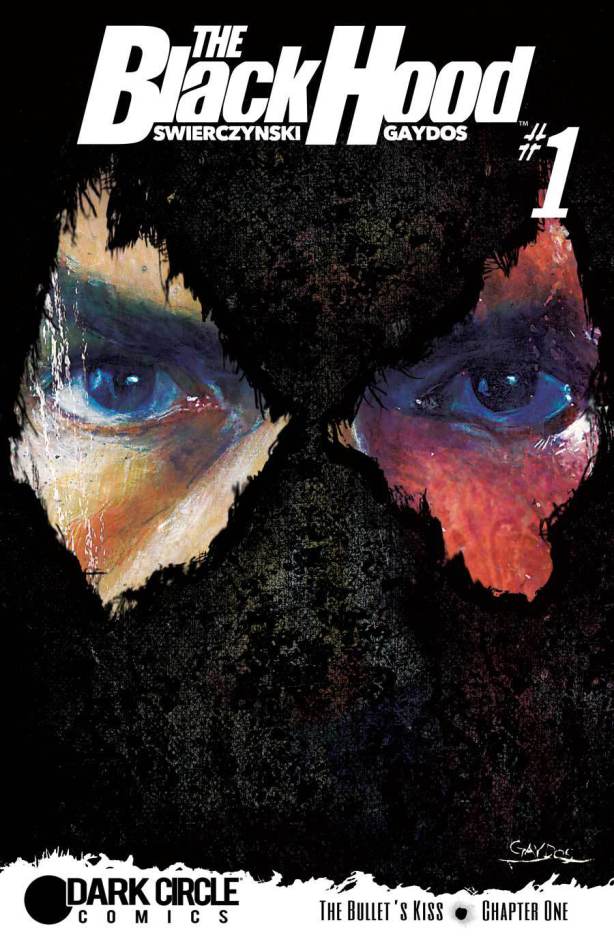
You’d think that any character that’s been around since 1940 would be at least a marginal “fan-favorite” — after all, it takes a certain level of popularity just to stick around that long — but in the case of The Black Hood, a super-vigilante from Archie Comics, you’d be wrong.

Not that I’m sure ol’ Hoodie doesn’t have some sort of fan following, mind you — any character that’s been around for over 70 years is bound to pick up at least a few adherents even if it’s entirely by accident — but there aren’t many, and whenever he’s come back to the printed page (most recently in the early ’90s for a 12-issue run as part of DC’s failed !mpact Comics imprint aimed at younger readers, which licensed a good number of Archie-owned properties) it hasn’t been for long. Could that be about to change? I’m sincerely hoping so.

View original post 902 more words

Say “Yo!” To Drugs With “Neverboy”


Ryan C. (fourcolorapocalypse)'s avatarTrash Film Guru

26238

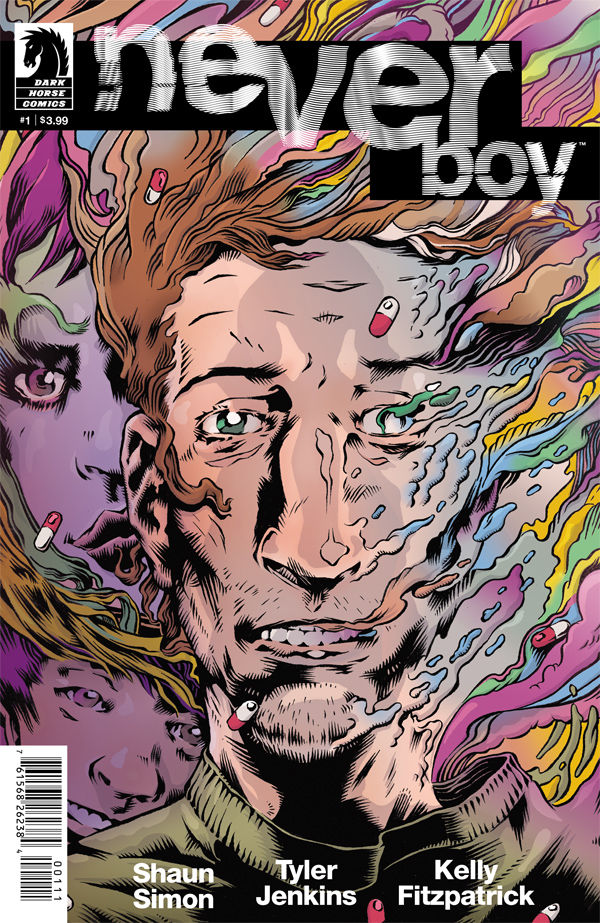
If there’s one thing that sucked most about growing up in the 1980s — among many worthy contenders from that culturally blighted decade — it was the rampant anti-drug hysteria that started with our figurehead “leaders” at the top, Ron n’ Nancy, and filtered its way down until it permeated pretty much every corner of society. Drugs — even essentially risk-free recreational stuff like pot — were considered “bad,” and their users were “bad people.” This stuf’ll kill ya, kids — why, if you don’t believe us, just turn on the TV, because that’s what every single cop show is all about.

Never mind, I suppose, that TV is the most prevalent and most harmful drug of all, or that most of the pseudo-righteous political figures profiting from drug hysteria were either being funded to the tune of millions by Wall Street cokeheads or, in the case of Bush…

View original post 973 more words

“All-New Hawkeye” #1 Hits The Mark


4426838-01

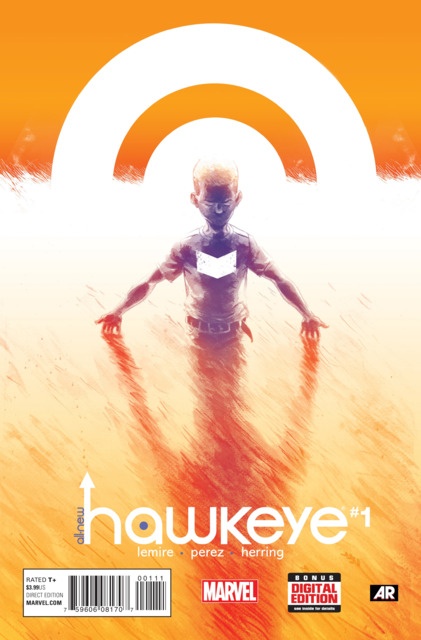
Let’s be honest : as far as descriptives go, “all-new” is getting pretty fucking old — especially at Marvel Comics, where at this very moment it’s being flat-out used to death all across their entire line. Right now they’ve got All-New InvadersAll-New X-MenAll-New Captain America —hell, recently they even branded their entire “soft reboot” All-New Marvel Now! (which came right on the heels of the prior Marvel Now!) and saw fit, a couple of months back, to momentarily slap the label on their prestigious series of Miracleman reprints with All-New Miracelman Annual #1, despite the fact that the “headline” strip in that book was an unused Grant Morrison “inventory story” that had been sitting around gathering dust for nearly two decades.

Still, if there’s one thing the so-called “House Of Ideas” has always excelled at, it’s overkill, and now we can add All-New Hawkeye to the list, even though a) the series it’s “replacing” — namely Matt Fraction and David Aja’s more simply-titled Hawkeye — isn’t even over with yet, and has one more issue to go which will be every bit as “all-new” as this one is; and b) there’s really nothing terribly “new” about this series (apart from the cover price jumping from $2.99 to $3.99), especially in terms of tone and style,  anyway.

Which isn’t to say it’s bad, mind you — quite the reverse, in fact. It’s probably no secret to those who follow my comics review on here that I’m generally less-than-enamored with Marvel for a variety of reasons, but Fraction and Aja’s Hawekeye has certainly been an exception : I’ve loved their take on Clint Barton, his brother Barney, and his protege, Kate Bishop, from the outset, and while the book’s critics do raise a number of semi-valid points (let’s remember that the “Hawkguy” label actually originated with those who found the “everyman” tone of the series to be cliched and overly-self-conscious before it was “repurposed” and turned into a positive by its fans), at the end of the day I could care less — the humor, heart, and humanity that the Matt n’ Dave tandem (with more-than-able assistance from occasional fill-in artist Annie Wu) brought to the table drowned out their detractors with grace, confidence, ease and, yes, style — which probably especially bugs the shit out of the curmudgeonly crew of “haters” because the fact that the book was supposedly “too stylish” was one of their chief complaints. So while “give us more of the same” has been the bane of comics, both creatively and commercially, for ages now, when it comes to all things Hawkeye, ya know what? It’s just fine with me — up to a point.

HAWKEYE2015001-int2-1-3d81e

By and large, it seems like it’s fine with the new creative team of writer Jeff Lemire — who has a fair amount of experience with a certain emerald-clad archer over at DC — and artist Ramon Perez, as well, given that their supposedly “all-new” take on the character feels very much like a continuation of what’s come before, albeit with a few semi-significant new wrinkles added in. As the page reproduced directly above shows, Perez’s art is a reasonable approximation of Aja’s style, and Lemire’s got the characterization of Clint and Kate down pat, so if you don’t want to see this particular boat rocked too much, the first issue of this new series (which kicks off a five-part storyline titled “Wunderkammer”) will leave you feeling in very safe hands, indeed.

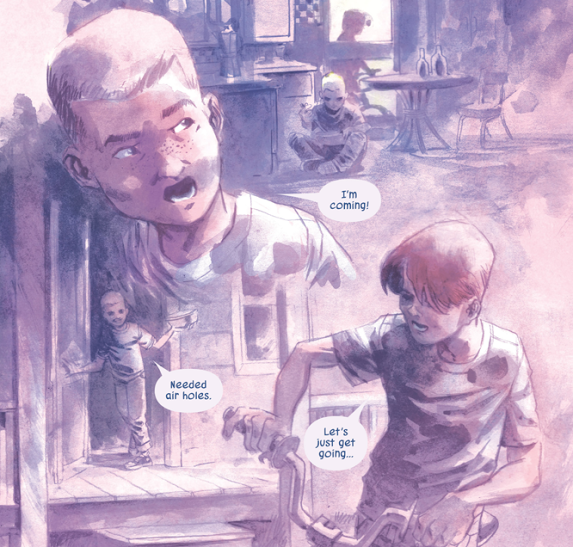
Which isn’t to say that they don’t appear to have at least some level of ambition — I’m sure Lemire, Perez, and co-colorist (more on that in a moment) Ian Herring would prefer to label what they’re doing as “building upon” the foundation laid by Fraction and Aja rather than merely “emulating” or, even more uncharitably, “imitating” it, but I’ve gotta be honest and say that the jury’s still out on which way all of that is going to go. All-New Hawkeye #1 throws out some hints in that direction, given that half the story is a flashback to Clint and Barney’s troubled upbringing in an abusive foster home and those pages/scenes feature a remarkably different art style (see below) that showcase Perez tackling the hues on his own with a limited  watercolor palette (one that’s,  appropriately enough given our hero’s costume, heavy on the purple) over his own “sketchier,” more fluid pencils and inks, but the “present-day” action is a rather bog-standard runaround with the two Hawkeyes busting into a “secret” Hydra base at the behest of S.H.I.E.L.D. for reasons that will, in due course, become fully apparent, I’m sure. It’s fine and dandy stuff, don’t get me wrong, and is more or less exactly what I was hoping to get from this comic, but it’s definitely — well, what is it they say about the sincerest form of flattery again?

all-new-hawkeye-1-flashback

In any case, it’s  probably fair to guess that “some tinkering around the margins” is all the more leeway that Marvel editorial is willing to give the new creators on this book, at least to start with, and to be honest, that’s probably all that us long-time readers want, too, so I really don’t want to sound too much like I’m bitching here — yeah, I love to see established characters taken in new and surprising directions by writers and artists with a bold and unique vision all their own, but it’s not like that’s what every comic needs all the time.Sure, I’ll be disappointed if Lemire and Perez choose not to develop a more distinctive take on the character at some point (or, even more depressingly, if they’re not allowed to by company “suits”), but I have no problem with them easing us along by means of  a somewhat extended transition period. In short, I don’t mind the fact that All-New Hawkeye isn’t all that new just yet.

all-new-hawkeye-1-interior

But it’ll have to be at some point, won’t it? Much as I’ve thoroughly enjoyed what Fraction and Aja have done on their run — and I’m eagerly looking forward to seeing how they wrap it all up with issue #22 — I don’t want a “new” series that feels like a faint approximation of the old, which puts Lemire and Perez in a tricky spot : they’ve gotta prove that they have their own ideas for the book, but they can’t rush the journey from point A to point Z for fear of alienating loyal fans. As of right now, they appear to be taking a “one step at a time approach” — which is exactly right — but if “Wunderkammer” ends up feeling like five issues of them trying to ape their predecessors,  with some niftily-illustrated childhood memories added into the mix, well — that’s not gonna make anyone happy, is it? Folks who like constantly-developing-and-evolving characters and narratives will slam them for lack of ambition and/or effort, while folks who openly admit that “same old, same old” is all they’re looking for will rightly ask “why not just leave Fraction and Aja on the book, then?” I’m choosing to remain optimistic for the time being — this debut installment certainly doesn’t give me any reason not to be, I suppose — but it’s definitely a cautious optimism.

Even so, there’s certainly such a thing as over-thinking matters, and maybe by focusing on this series’ potential future, I’m losing out on the chance to feel good about its present state. When I take off my “worry-wart” cap, go with the flow, and appreciate All-New Hawkeye #1 for what it is — rather than, ya know,  spending/wasting all my time speculating about what it might be — I have to admit it’s a whole lot of fun.


Committing (To) “Suiciders”


4412553-01

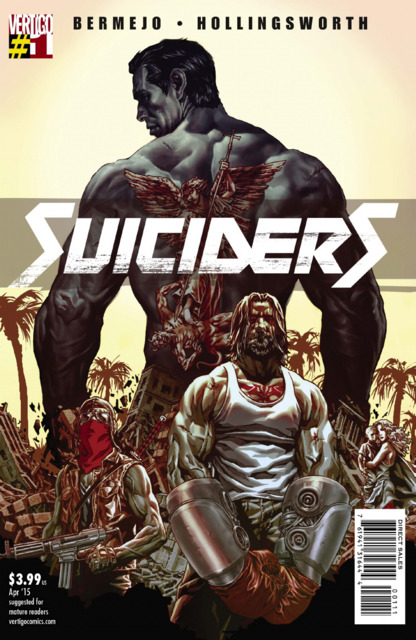
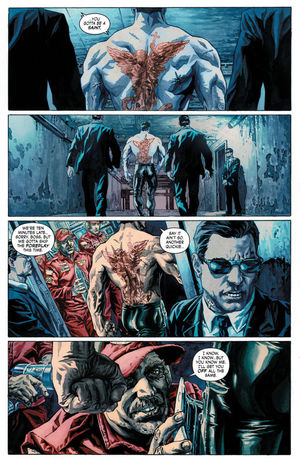
When I learned, after reading the first issue of Lee Bermejo’s new monthly Vertigo series Suiciders, that the writer/artist made his home in Italy, I can’t say I was terribly surprised, given that the basic set-up for this book appears to have torn at least a page from spaghetti exploitation stalwart Joe D’Amato’s post-apocalyptic “thrillers” Endgame and 2020 Texas Gladiators, but please don’t get the wrong idea — derivative as the premise here may be, I still think we’re in for a fun and intelligent ride that promises to explore issues of economic inequality and media saturation in a more straightforward way than most mainstream comics, particularly those of a superhero-ish bent, can or would ever dare to. The Vertigo imprint in general appears to be hitting something of a creative stride once again, after far too many years, and while so far sales numbers for their recently-added titles like FBP and Coffin Hill have generally been rather weak, let’s hope they decide to see them through and wait for them to gain an audience, because there’s some very promising stuff coming from the house that Moore, Gaiman, Morrison, et.al. built, and sooner or later the comics-buying public is bound to start paying attention — right?

Well, possibly. Or at least hopefully, at any rate — and you can add Suiciders to the list of new (relatively speaking) Vertigo books that definitely deserve more attention than they’re probably likely to get. Bermejo is certainly a “known quantity” as an artist, given that his detailed, gritty, realistic illustrations have been featured in some rather high-profile DC projects in recent years, most notably the Joker graphic novel and Before Watchmen : Rorschach (both done in collaboration with writer Brian Azzarello), and he was allowed to showcase both his writing and drawing skills on Batman : Noel, so a “solo” monthly of his own was probably due to happen at some point here, but I honestly couldn’t have predicted that he’d tackle his turn in the spotlight with this much confidence and clarity. The world of Suiciders seems to have arrived on comic store shelves fully realized down to the last detail, and even though we’re only given tantalizing glimpses into it here in issue #1, it’s a fairly safe bet that most readers — particularly those with a penchant for “after doomsday” scenarios such as myself — will be left hungry for a whole lot more, even at $3.999 a pop (incidentally, has anyone else noticed Vertigo quietly sneaking more and more of their titles up a dollar? Sure, they usually give you a high-gloss cover for that extra buck you’re laying out, but it’s still a drag).

Suiciders_1_pg1

Here’s a brief rundown of the particulars, for those inclined to know more before they buy : in the future, L.A. has been devastated by a massive earthquake (I guess the whole nuke angle is kinda played out) and in the aftermath of that catastrophe, rather than rebuild per se,  the powers that be have just decided to start all over from scratch — for the 1%. Hence,  the city has bifurcated into two distinct regions — the glitzy and wealthy New Angeles, and the decimated and impoverished “old city.” It appears that the division isn’t too terribly dissimilar to the prevailing socio-economic structure of apartheid-era South Africa, where blacks far outnumbered whites but had no real voice in government despite doing all the menial labor that the privileged minority counted on for basic survival — and for their trouble, found themelves  warehoused in desperately poor, sickeningly inhumane “homelands” on the other side of a fence from their social “betters.” We might think that’s all a thing of the past, I suppose,  but the situation in Israel today isn’t much different, with Palestinians living in squalid conditions in the outdoor concentration camp that is Gaza and having to carry a pass and proceed through a security checkpoint to get to their jobs in places like Jeruslaem, Tel Aviv, etc. where they do the blue-collar and service-related work the wealthier, lighter-skinned folks are dependent upon  — and it’s not like we’re immune to this sort of de-humanizing bullshit in the US, either, as the rich increasingly flee to mansions in gated “communities” where you have to present ID to gain access, while the poor, whose labor the folks behind gates are both exploiting and in need of, see their inner-city neighborhoods deteriorate further and further at the same time their social safety net is being raided and squandered by the those  who already have way more than enough.

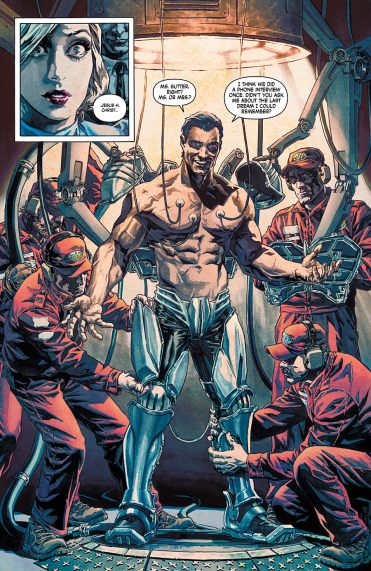
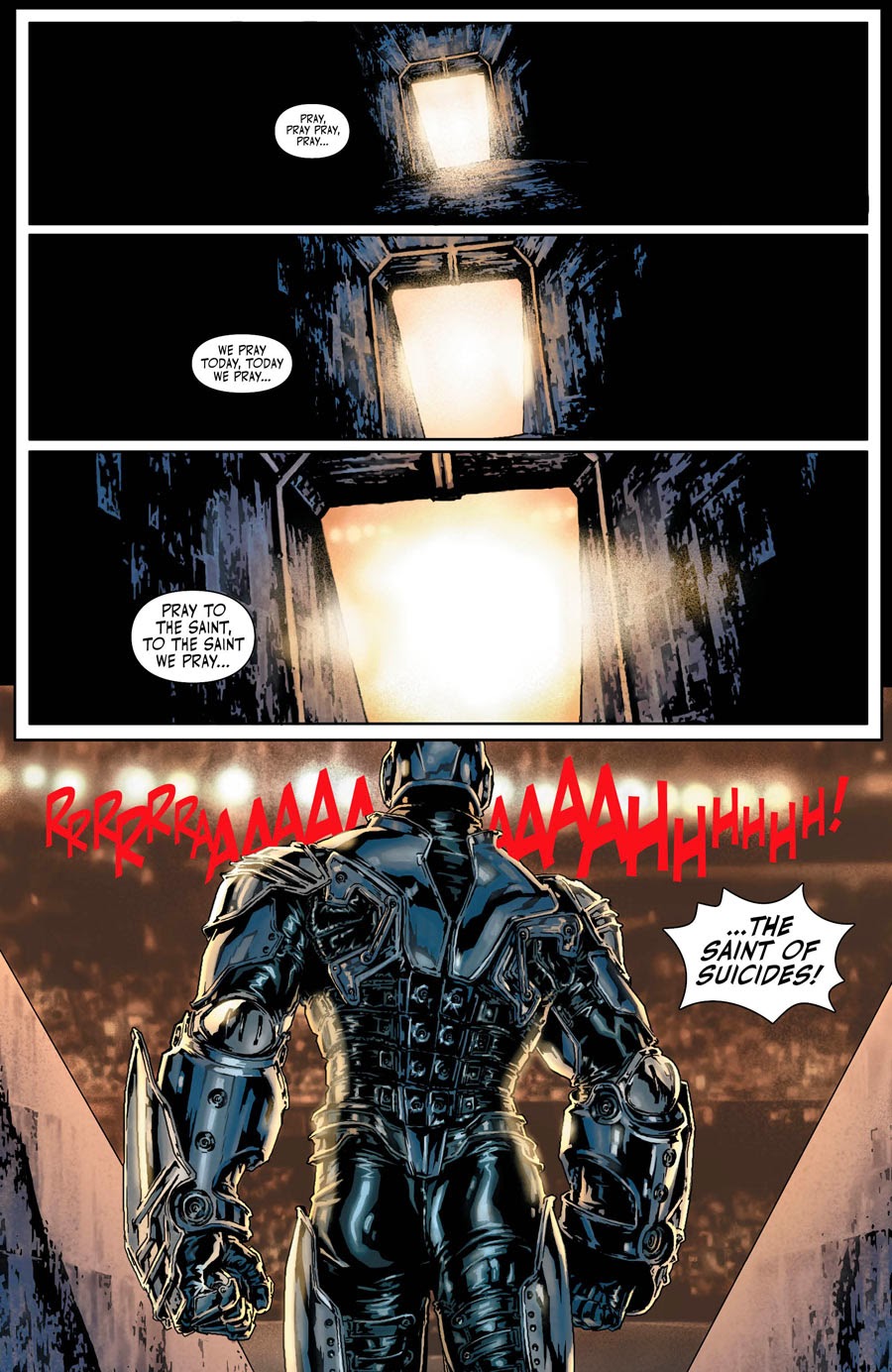
What to do to distract the populace from this abhorrent state of affairs? The Romans called it “bread and circuses,” these days we call it pro sports and TV (because we don’t feel the need to keep the peasants fed anymore), and in New Angeles they call it “Suiciding” — a sort of high-tech combination of American Gladiators and MMA fighting that you can definitely see coming down the pipeline in the next 10-to-20 years (if that).  The biggest star of the Suicide Ring is a rugged, handsome bruiser known as The Saint, and while he appears to be our ostensible “hero” of the story, Bermejo wisely plays it close to the vest and reveals very little about him beyond the fact that there’s more going on with him than meets the eye. Shit, we don’t even know his real name or anything of substance about his background yet, but you just get a feeling that there are sides to him that his well-oiled PR machine would rather have the public — and, by extension, us readers — kept in the dark about.

SUICIDERS-1-6-2cc08


The bulk of the action in this debut installment is consumed with The Saint’s latest championship battle, and Bermejo makes you feel every punch and kick with his fluid pacing and high-octane visuals, ably abetted by colorist extraordinaire Matt Hollingsworth, who imbues the penciler/inker’s pages with a radically different, but no less impressive, palette that Barbara Ciardo did on Joker and Before Wathcmen : Rorschach (a book I’m now convinced Bermejo should have written himself because, let’s face it, Azzarello’s script was a lazy, uninspired mess). All in all, the two of them concoct a feast for the eyes here that you’ll find yourself studying in detail for fear of missing anything too intricate,  awesome, or both.

But how does it read? Pretty damn well, I’m pleased to report. Bermejo has a solid grip on both characterization and world-building, and the sub-plot that runs concurrent with the main storyline, about a hapless band of refugees looking to sneak into New Angeles to provide a better life for their families, is both believable and repulsive in equal measure. It doesn’t end well (spoiler alert), and you never expect it to (cancel said spoiler alert), but you feel it all the same when tragedy strikes, nonetheless — a sure sign that a writer knows what he or she is doing. Not every script sets out to reinvent the wheel, but when the author is able to get you to  invest yourself in their story despite the fact that you know where it’s headed, well , that’s always worthy of a measure of respect, in my book.

SUIC-1-Preview1

And my respect — whatever that’s worth — is definitely something that Bermejo has won back with Suiciders #1. More or less everyone who participated in the Before Watchmen debacle (with the exception of Amanda Conner, who did sublime work — as she always does) saw their reputations knocked down a good few notches in the eyes of many, myself included, but this book is just the right combination of socially aware critique, sci-fi dystopianism, and bad-ass action to keep me hooked for a good long while. There’s a grim, remorseless, polarized, and utterly believable future society beckoning for us to come explore it in these pages, and Bermejo and Hollingsworth are proving themselves, at least to this point, to be excellent tour guides.

Fair warning, though : things  look as though they’re gonna get pretty dangerous pretty fast, so I’m thinking some Saint-style body armor will probably be in order if you want to make it out of Suiciders alive.

Marvel Gives Fans The Middle Finger With “Star Wars : Darth Vader” #1


Ryan C. (fourcolorapocalypse)'s avatarTrash Film Guru

4383684-01

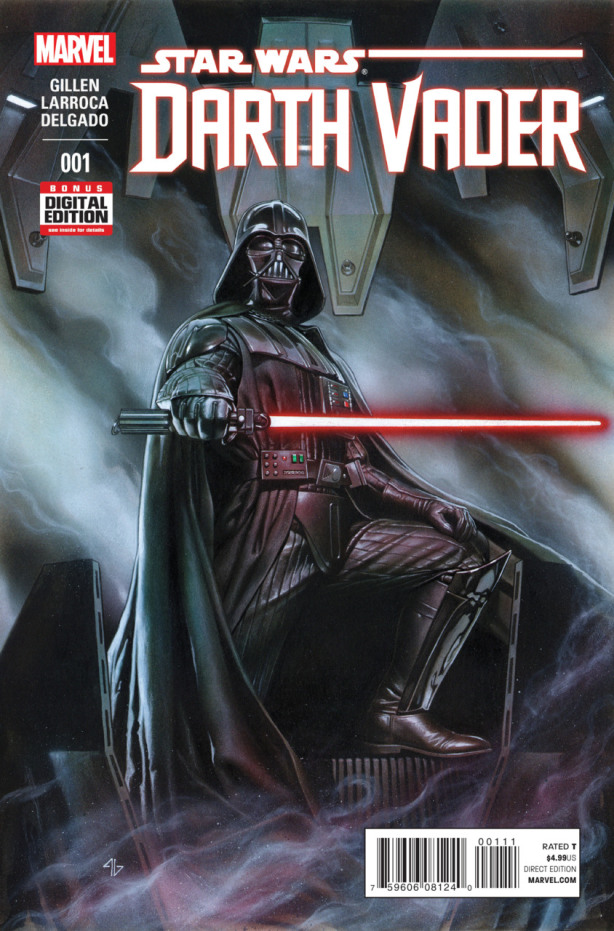
To quote the Man In Black himself — “I sense something, a presence I’ve not felt since —” oh yeah, since the last horeshit Star Wars comic I read, Jason Aaron and John Cassaday’s Star Wars #1. Marvel cranked out the second issue (which I didn’t buy) of that series a mere two weeks after the first, and now here we are a week on from that with the debut installment of their first “spin-off” book, Star Wars : Darth Vader, which comes our way courtesy of respected creators Kieron Gillen and Salvador Larocca.

Given the thorough dressing-down I gave of Aaron and Cassaday’s comic (a view not shared by many, as most write-ups online have been positively effusive in their praise for it) , some readers might be surprised that I forked over five bucks for this one, but I was determined to give it a shot simply…

View original post 970 more words

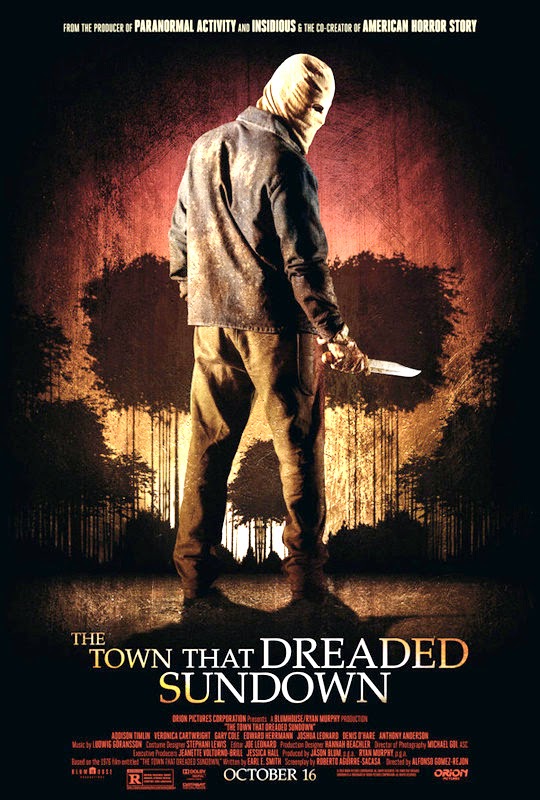
“The Town That Dreaded Sundown” (2014) : Everything Old Is New Again — Or Is It?


Ryan C. (fourcolorapocalypse)'s avatarTrash Film Guru

tumblr_ni0wusI1VY1s49vg7o1_540

We may as well be clear about one thing right off the bat — director Alfonso Gomez-Rejon’s 2014 film The Town That Dreaded Sundown (now available via instant streaming on both Netflix and Amazon Prime — before it’s even out on Blu-ray or DVD!) isn’t so much a remake of Charles B. Pierce’s 1976 “true-crime slasher” of the same name as it is an updated take on more or less the same material (to such an extent that original screenwriter Earl E. Smith is even given a story credit here) that semi-cleverly incorporates its cinematic progenitor into the proceedings as a “metafictional” trope in a way that almost makes the new flick closer to a sequel than anything else — but not quite.

For the sake of those who absolutely must categorize this in some way, shape, or form, let’s just call it an “extension” of Pierce’s movie and leave…

View original post 1,116 more words

Let Me Play “Postal” Worker For A Minute —


4370333-01b


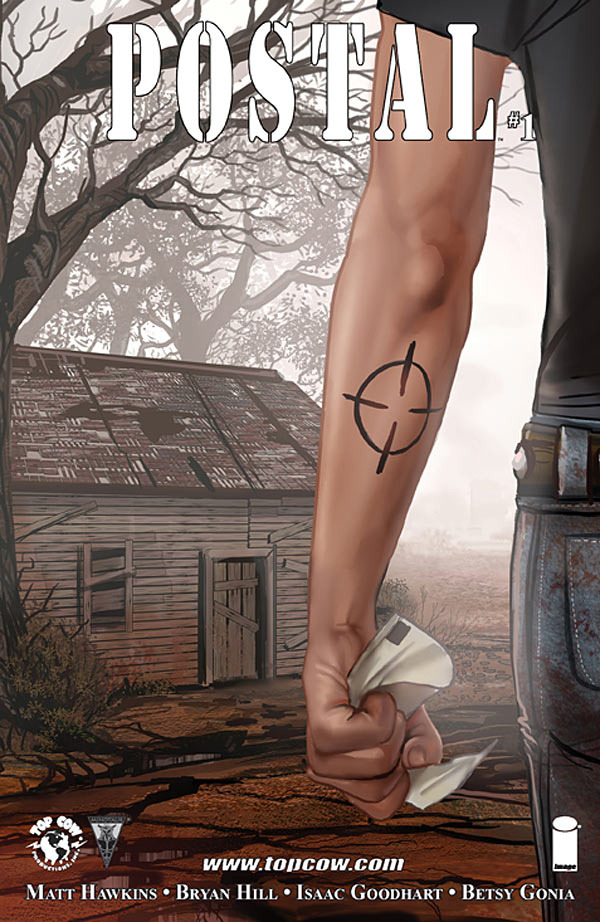
One of my favorite things about reviewing comics is finding a hidden gem that no one’s really talking about and doing my part to help spread the word just a bit, and while Top Cow’s new ongoing series Postal (a product of their Minotaur Press sub-imprint) is, in fact,  generating at least a little bit of online “buzz,” given that it’s being released, as ever, by Image Comics, it’s understandably finding itself rather buried under all the hoopla surrounding the debut issue of Grant Morrison and Chris Burnham’s Nameless, which also comes out today. It’s probably not fair to say that Nameless is sucking all of the oxygen out of the room, but — well, it’s coming pretty close. So let’s do what we can to even the scales a bit here, shall we?

I’ll admit right off the bat to not being much of a fan of Top Cow’s “shared universe” titles, but they’ve published  some interesting workset outside of its confines lately, and in particular I found myself intrigued by their recent four-part “eco-thriller” mini-series Wildfire, which was written by Matt Hawkins (who’s probably more talented than his status as a Top Cow “suit” would lead knee-jerk readers to believe) and illustrated in superb fashion by Linda Sejic, so given that much of the Wildfire  crew has re-assembled itself for Postal (Hawkins is co-writing it along with Bryan Hill while Sejic is doing the covers and colorist extraordinaire Betsy Gonia is joining in on both the covers and interior pages), I was bound to give at least the first issue a look — and my oh my am I glad I did.

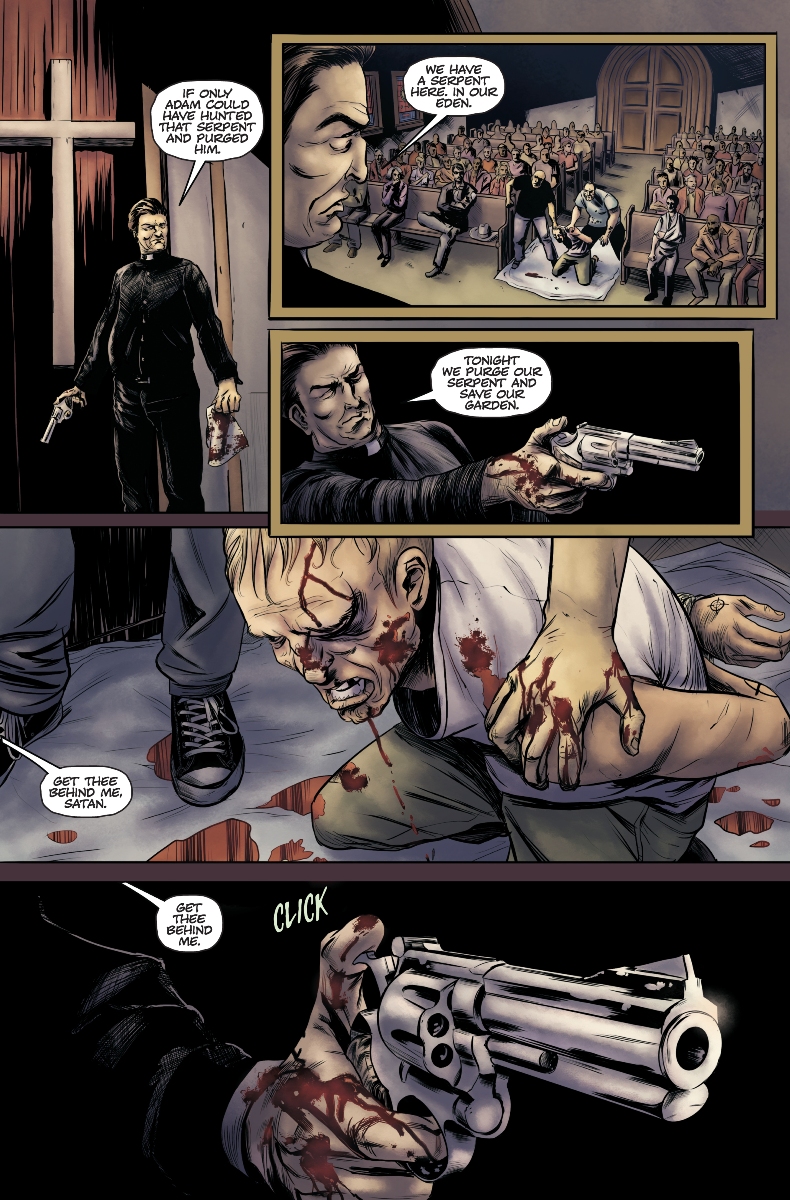
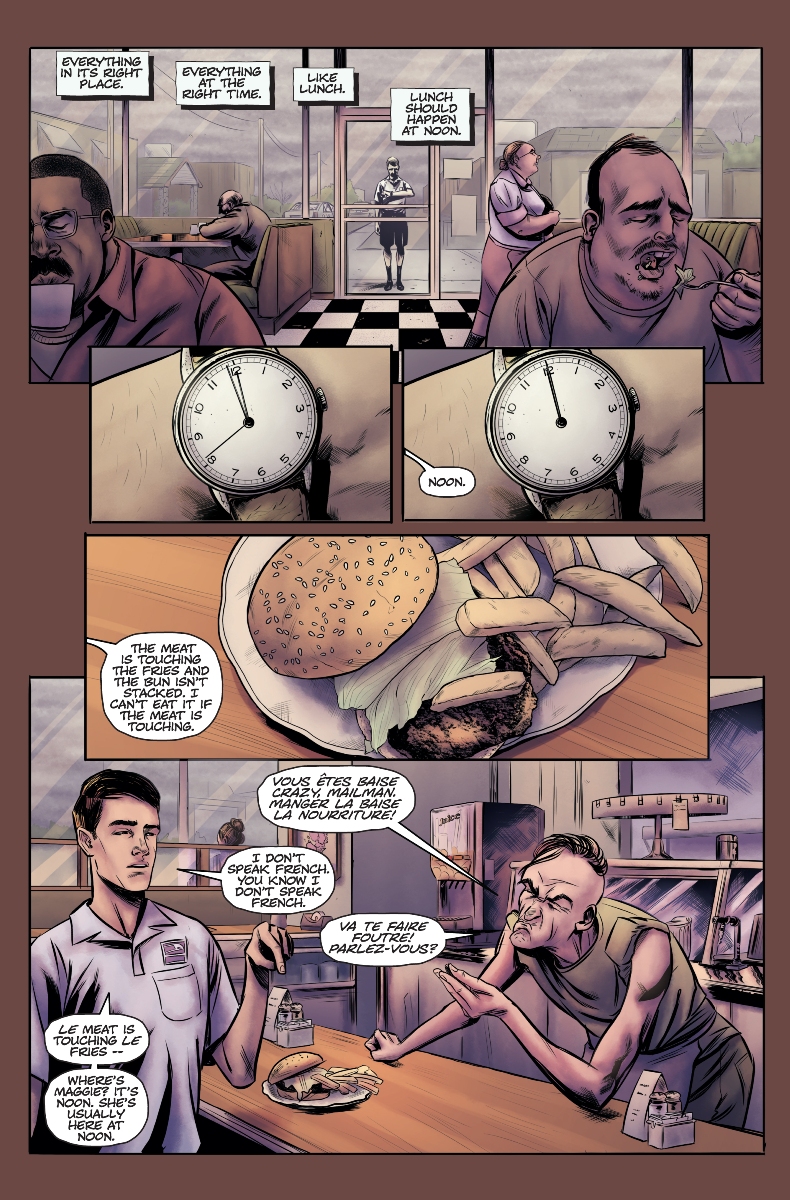
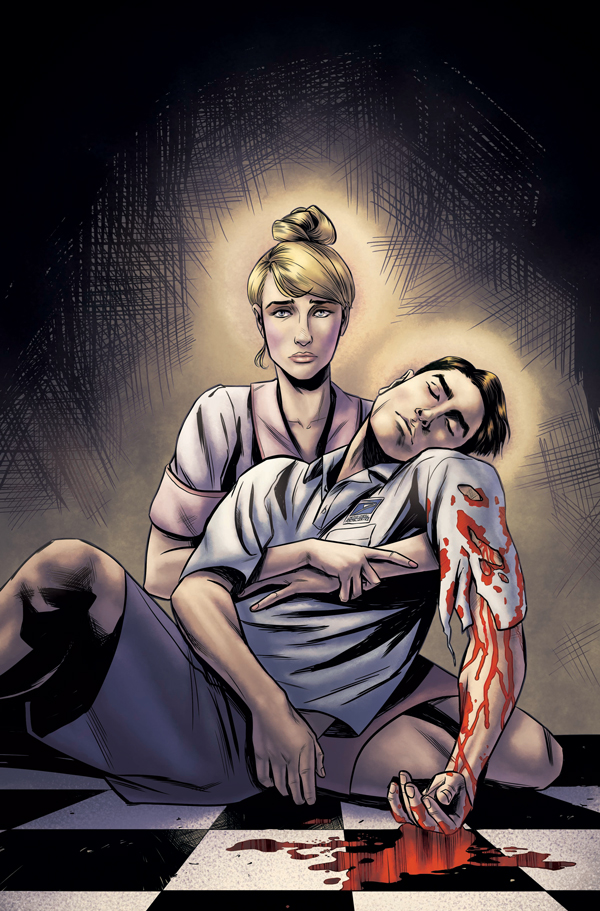
Postal is an exercise in fairly comprehensive “world-building” that centers on the fictional town of Eden, Wyoming (population 2,198) as seen through the eyes of local mailman Mark Shiffron. Mark’s got an unusual perspective given that he suffers from Asperger’s syndrome, and while characters with Asperger’s have certainly appeared in comics pages before (most notably in the form of American Splendor‘s Toby Radloff), this marks, at least to my knowledge, the first time one of them has been given center stage in any considerable way. Three cheers to Hawkins and Hill for doing a bit of trailblazing, then — and for absolutely “nailing it” in terms of Mark’s ongoing interior monologue as well as his dialogue and mannerisms — but how’s the story itself, apart from that?

PO001_preview02

So far, so good, I’m pleased to report — the “secret” Eden is built on (which I’ll refrain from “spoiling” here) is given away maybe a bit too early (it may have made for a nice cliffhanger “revelation” at the end rather than a “gotcha” moment halfway through the issue), but given the necessity of getting the murder mystery that’s apparently at the heart of the story rolling, I can understand why they structured the script the way they did. Apart from that, though, I have absolutely zero complaints about the quality of the writing here. Eden is a town populated by rich and diverse characters, and most of the notable ones are given a chance to make at least something of a mark in the story, with the back-matter “trading-card style” profiles at the end of the book serving to enhance our knowledge of them rather than acting as a crutch. These are all individuals you’re going to want to know more about, and I can’t really think of the last time that a series with such a large, ensemble cast arrived on the scene as well-thought-out as this one.

PO001_preview05

As for the art, it comes our way courtesy of relative newcomer Isaac Goodhart, who won Top Cow’s “new talent search” contest last year and is certainly deserving of a regular monthly gig. His style won’t bowl you over with its flashiness or anything (thank goodness), but he’s got a seasoned eye for visual storytelling and seems equally at home illustrating both the book’s slower, “talky” scenes and its dramatic, “high impact” pages. Postal has much the same “rural noir” feel as fellow Image series Revival, and Goodhart breathes a lot of life into the characters he’s drawing by imbuing each of them with unique visual “tics” and traits that make them instantly stand out. I’m probably not the first person to make this comparison and I doubt I’ll be the last, but the pacing and flow of the story and pictures here are also reminiscent of a number of early Vertigo books, and that’s pretty high praise indeed for both the writing and the art.

PO001_covAsocial

Yeah, okay,  so murder mysteries have certainly been done to death across all media, but when you populate a well-worn premise with unique and memorable characters and set it in an inventive locale, there’s a great chance that you’ll still be able to squeeze blood from a rock. I’m ready to go Postal — you should be, too.


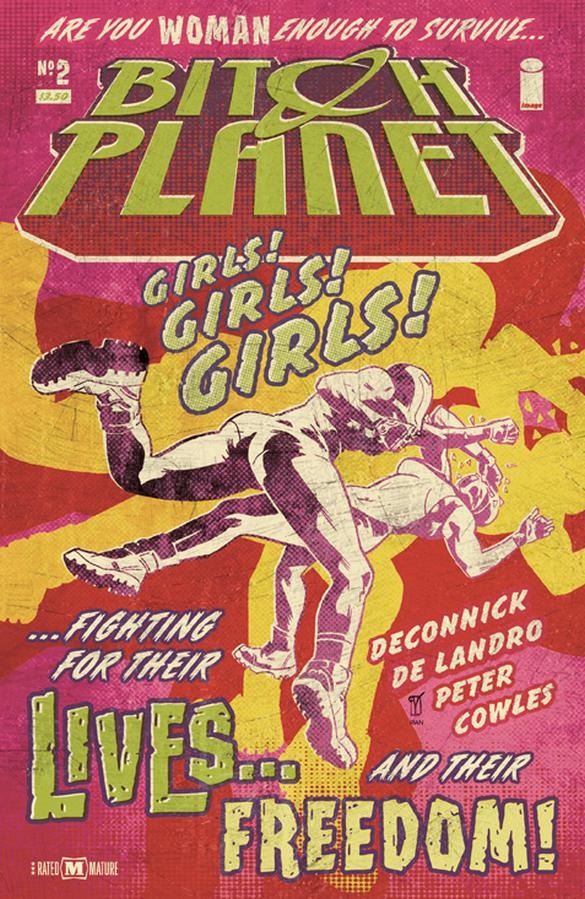
Am I Woman Enough To Survive “Bitch Planet” ?


4265196-01

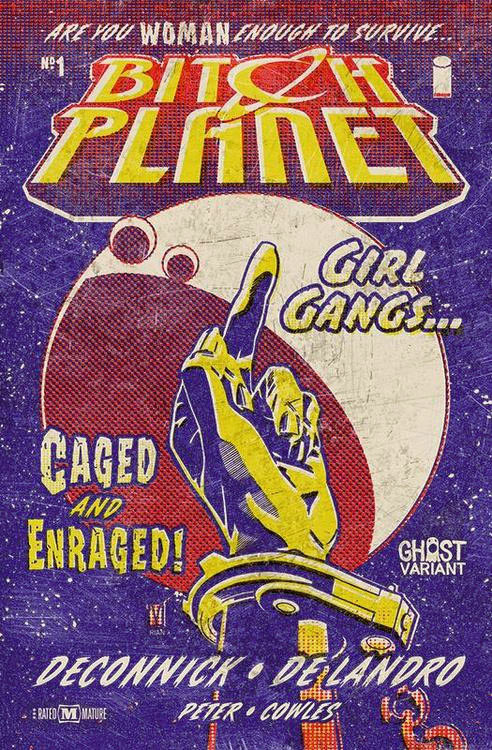
Right off the bat, the answer to the question I pose in the headline here is a definitive “no,” simply because — well, I’m not a woman. And the interstellar penal colony that is the setting for writer Kelly Sue DeConnick and artist Valentine De Landro’s new Image Comics series, Bitch Planet, looks like kind of a rough place, so even if I could get in, it’s doubtful that I’d make it out alive.

Tell you what, though — I’m lucky. There’s just no way I could ever be sentenced to do time there, and not only because it’s fictitious. See, the BP is a special place reserved for only female convicts, and it houses the worst of the worst. Terrorists. Hardened killers. Bloodthirsty axe-murderers. Psychotic sexual deviants.

Just kidding — it’s where a future patriarchy sends its “non-compliant” second-class citizens who are guilty of such “crimes” as not getting the dishes done, being bad cooks, not “putting out” as often as their old man wants (or in the way that he wants), or even just getting too old to fit society’s standards of “attractiveness” anymore. Don’t ask me how future Earth got to be so relentlessly misogynistic, but I’m betting Mike Huckabee was elected president at some point and things just sorta slid from there.
4288085-01-ghost

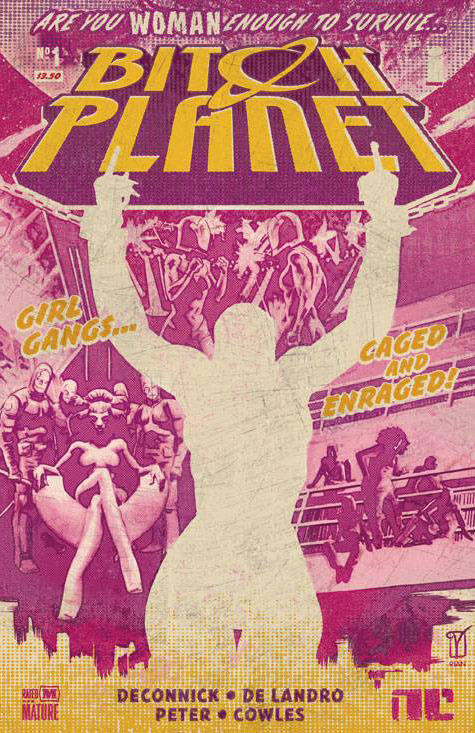
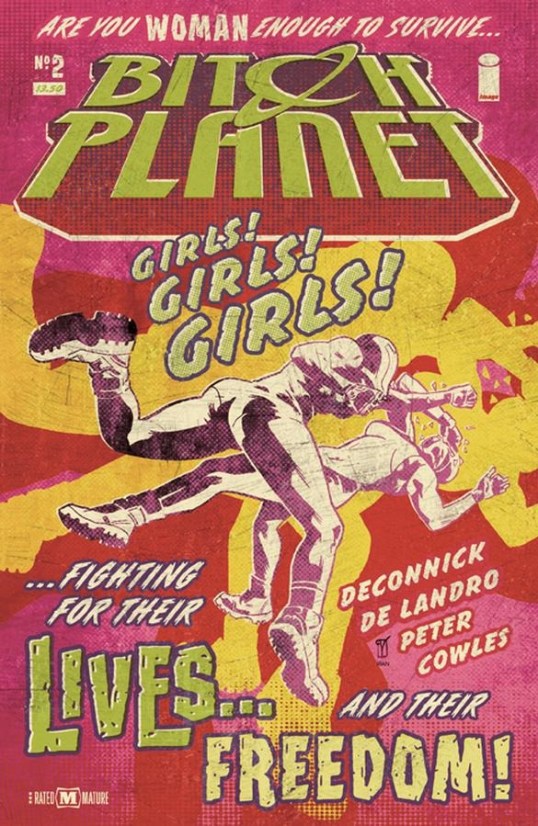
As I’m sure is no doubt obvious by now, Bitch Planet is a comic with a definite point of view, and that’s certainly something that’s all too rare in today’s milquetoast, “be careful not to offend anyone” marketplace. De Connick is crafting an unabashedly feminist sci-fi action story here, and to call it a breath of fresh air is quite the understatement. The first issue landed like a ton of bricks last month and got everybody talking, and the second issue, wherein our creators limn the boundaries of the world they’re crafting in a bit more detail and introduce the ever-popular element of TV bloodsports, shows that nobody’s going to be taking their foot off the gas anytime soon here. They’re determined to give us material that’s as thought-provoking as it is exciting every 30 days, and I couldn’t be happier.

That being said — I think at least a hat-tip is owed to fellow feminist comics scribe Alex de Campi, who explored some of these same themes in a two-part story called “Prison Ship Antares” that she did last year as part of her Grindhouse : Doors Open At Midnight mini-series for Dark Horse, and utilized some of the same “B-movie” stylistic trappings that De Connick and De Landro employ to such stunning effect here.  The politics of Bitch Planet, however,  are much more overt, and we all know that ideas take a fair amount of time to go from the brain to the printed page, so just who thought of what first is an open question. I simply thought it was worth mention  — just as I think both books are well worth your time and money.
4354253-bitch+planet

Now then — since trying to take an “objective” look at BP without its jubilantly-stated viewpoint entering into the discussion is an exercise in futility, let me just say this : if you’ve got a problem with feminism, for whatever reason, this isn’t the comic for you. De Connick’s overriding ambition with her story is to take dead aim at patriarchy and fire a kill shot. That doesn’t mean that men should feel threatened by this book’s contents by any means, of course — provided you’re the sort of guy who’s honest enough to admit that our entire social structure is still bent toward keeping women, to one degree or another, “in their place.” The fluffy sense of faux- sexual-equality we’re spoon-fed by the media is a lie, and if owning up to that reality offends you, then Bitch Planet will probably offend you even more. But ya know what? Some people deserve to be offended.

Think about it, guys : when was the last time we had to put up with leering glances from strangers or cat-calls on the street? When was the last time we had to answer to our employers for our health care choices? When was the last time we were judged on the basis of our physical appearance before  anything else is taken into consideration? When was the last time we were told that we didn’t have to be paid as much as someone of the opposite sex for doing the exact same work?

Geez, when you look at things that way, maybe the out-of-control phallo-centric future on display in these pages isn’t so much an exaggeration of the current state of affairs as it is a reflection of them — albeit one where all the pretense is stripped away.

Clearly, though, the term “feminism” is one that means different things to different people, and the really cool thing about what De Connick is doing here is that she acknowledges that fact and is trying her level best, in both the script and the book’s idea-crammed back matter (overseen and assembled with the help of series editor Lauren Sankovitch, who used to work at Marvel but has now apparently gone freelance) to present multiple perspectives of current feminist thought. Sure, we can probably all agree that at its core, feminism is about empowering women to make whatever choices they want in life and about respecting those choices, but how we get there from here, and what’s preventing it from happening, is open for much debate and discussion. De Connick certainly has ideas about all of it, but she’s opening up the pages of her comic to “let it all hang out,” so to speak, which makes for a damn engrossing cover-to-cover read (and those back covers! Oh my how I do love ’em!)

Women of color are front and center here, as well, in the form of both series protagonist Kamau Kogo and “instant-fan-favorite” character Penny Rolle, who’s probably got a thing or two (or more) to say about size-acceptance issues, I’m prepared to bet. It also seems more likely than not (although it’s only a guess at this point) that homophobia and transphobia  will be working their way onto the Bitch Planet radar screen before too long, as this series also seems tailor-made for addressing those particular (and persistent) societal ills.

And the art — oh my, the art! De Connick has come under at least a little bit of criticism for doing this book with a male artist, but apparently De Landro has been a full involved co-creator from the outset, he’s very much “on board,” philosophically speaking, with everything that’s going on here, and his passion for the subject shows in every panel. The double-splash title pages are a thing of beauty, to be sure, but it’s not like he’s “slacking” anywhere else. Add in the superb colors of Chris Peter and you’ve got a comic that’s quite often breathtaking to look at (yes, it’s still okay to judge a comic based on looks — just not people).

I’ve been around the comics scene for a long time, and the strides toward inclusiveness that fandom has made have been significant. Even as little as ten years ago it was unusual to see a woman in a comic store, and now look — we’ve got books like Bitch Planet proving that female creators, and readers,  aren’t about to take a back seat to anyone. But let’s not mistake progress for “problem solved.” The very existence of this series  proves that we’ve come a long a long way, sure, but its raison d’etre lies in showing us just how far we still have to go and challenging us to come up with ways of getting there. Sure,  I’m not a woman (as we’ve already established), but I’m proud to throw my lot in with the team behind this comic as be as loudly and proudly non-compliant as any of them.

“American Sniper” Hits The Mark For Melodrama, But Misses Badly For Veracity


Ryan C. (fourcolorapocalypse)'s avatarTrash Film Guru

american-sniper-poster

What is it that makes a hero?

There are probably as many different answers to that question as there are people reading this (in other words, probably a few hundred if my daily wordpress stats are to be believed), but there are some character traits that I think we would all consider to be heroic : willingness to sacrifice oneself for the well-being of others, truthfulness, bravery in the face of overwhelming odds, staying firm in one’s ideals (assuming they’re decent ideals, of course) even when it’s dangerous to do so, etc.

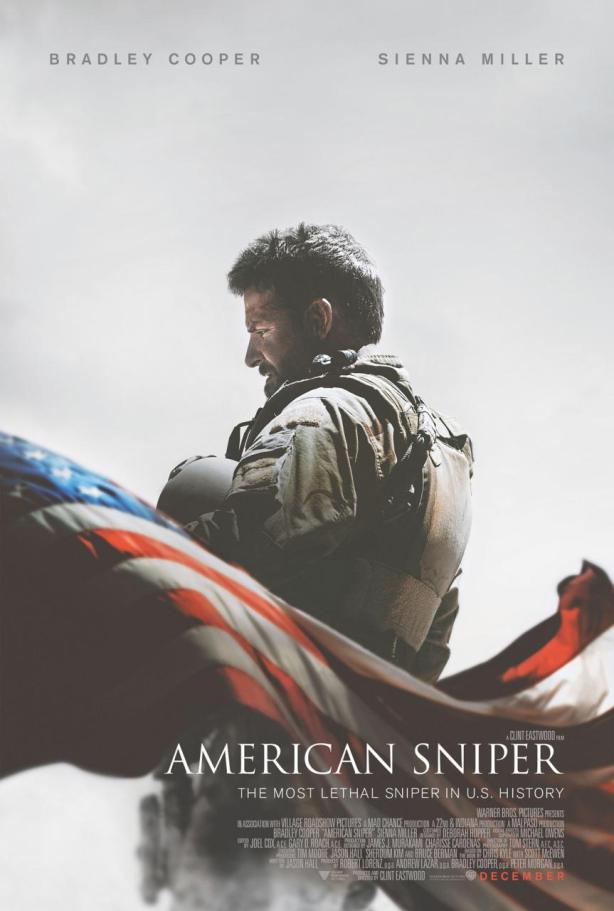
By those standards, then, the “most lethal sniper in U.S. history,” Chris Kyle — who is credited by the Navy with over 160 kills in Iraq, while in his  memoir, American Sniper (upon which, needless to say, Clint Eastwood’s new film is based), he himelf puts the number northwards of 250 — probably meets most people’s definition of what…

View original post 2,040 more words

George Romero Closes A Chapter — And Leaves Plenty Of Threads Hanging — In “Empire Of The Dead : Act Two” #5


4326470-05

And so we find ourselves at the close of another act of what is proving to the longest-form epic to ever come from the mind and pen of the father of the modern zombie genre with George Romero’s Empire Of The Dead Act Two #5, and underneath Alexander Lozano’s absolutely superb pulp-inspired cover painting we find that the guy who started it all is ending this one on a decidedly more small-scale — and downbeat — note than the “looming disaster” finale he gave us in his first act.

Not that disaster isn’t still looming — it certainly is, and it’s more mystery-shrouded than ever, but just when everything — and I do mean everything — seems to be boiling over in this issue, Romero takes a side-step, dials back on the danger, and gives us a genuinely personal and frankly tragic cliffhanger to send this five-issue arc out on.I won’t say much more about the finale beyond that since the book just came out today and the few of you out there who are, like myself, following this comic in singles every month may not have had a chance to read it yet, but you may want to prepare yourself to get a little bit choked up come the last page.

What’s most surprising to me about the contrasting tones between the finales of the premier and secondary acts of this developing story, though, is how much more free-flowing, naturalistic, and dare I say even nochalant the fifth issue of Empire Act Two is in comparison to the fifth issue of Empire Act One. There was a sense during the in the concluding chapter of the first arc that Romero was rushing to fit a number of pieces into place and making up for lost time due to some early floundering he engaged in, script-wise, in issues two (especially) and three, whereas here his approach has been a lot more calm and methodical. He’s trusting his characters to take us along with them rather than shoe-horning them into place, and while that may result in a somewhat less “stupendous” conclusion this time around, it means that the entirety of the second act has played out much more evenly than the first. In short, he’s getting a little bit better at this as he goes.

Yeah, okay, the “big revelation” Paul Barnum finally clues Dr. Penny Jones in on is something that we all saw coming from a mile off, but there are still a few surprises to be had here, most notably in the discslosure of a prior relationship between Barnum and somebody extremely close to Mayor Chandrake , and Chandrake proves himself to be an even bigger bastard than we already thought in one scene, so it’s not like everything here is cut-and-dried predictable up until those final few panels. Chandrake’s entire world seems to be in serious danger of crumbling down around him, in fact, as his inability to deal with rival candidate “Chilly” Dobbs calls into question how much efficacy he really has left in him while the investigations of Detective “Bucky” Perez are getting closer and closer to unraveling the thread that might undo the whole ball. The main question our dogged cop is now pursuing :  why are kids being loaded up onto buses when there are no more public schools (guess Chandrake’s a Republican) — and why are they never coming back?

Getting back to those aforementioned final few panels for a moment — one thing that does reduce their impact somewhat is the inking. While I’ve just about gotten used to Dalibor Talajic’s pencil art on this series, and have generally welcomed the addition of inker Rick Magyar, apparently Magyar ran into some deadline trouble with this issue (hey, it happens) and the last four pages are inked by Goran Sudzuka, who employs a mush heavier and less detailed approach with his brush that results in a more blocky, “cartoonish” style. For a few pages here and there I wouldn’t gripe much, but Sudzuka’s work seriously detracts from the impact of the heart-wrenching cliffhanger here, and that’s a real shame.

So — I guess we’ll see where this book goes, art-wise, when it returns for Act Three in April, but I’m feeling more confident than ever in Romero’s storytelling. There are big things ahead, folks, and if you haven’t been following along, catching up with this series by way of trade paperback —the second of which comes out next month — is definitely a smart move, as the next arc promises to be out-and-out explosive.