October Music Series: Kukulcan – Tlamictilia Quixtiani


There’s no good reason for pagan metal to be dormant in Central and South America. Hell, they have more to be pissed off about than anyone. As it stands though, Kukulcan is one of the only bands I have ever heard with a distinctly Aztec/Mayan theme. They come from Tlaxcala and Valle de Chalco, areas in the south of Mexico near the capital.

Apparently they have six demos and splits out now, but still no full-length cds. Tlamictilia Quixtiani is the opening track to Yaotlachinolli, their first demo, released in 2006. Here black metal serves as the backdrop for what sounds like a militant call to arms, amidst war horns, native drumming, and a woodwind that wavers between mourning and madness. That symbol in the four corners of the album cover is actually the Aztec swastika, which I couldn’t find much information on. But just in case such ambiguity fails to offend you, they made sure to plant a good old modern swastika in the middle of it. Ah, that must explain the Gothic font they used for their band logo. Such creative young lads…

But really, this demo is pretty great as pagan black metal goes. It’s an angry reassertion of pre-colonial heritage, noisily representing an indigenous American culture that gets largely ignored in the modern world.
October Music Series: Стары Ольса – Дрыгула


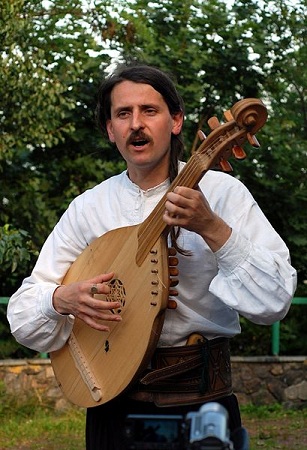
Time has been getting the better of me so far this month, and I haven’t really been able to structure these posts in the order I’d initially intended. But while the songs I had in mind that require a bit more research go on hold, I offer you another taste of Belarusian folk/early music masterminds Stary Olsa.

I came across Дрыгула (Drygula) while I was posting up Dances, when I discovered that a number of their more recent songs were available for free download on their official website. Drygula is the title track to their 2009 release. To quote their website:

“This CD presents dance music from the late Middle Ages to early baroque, written in the Grand Duchy of Lithuania (Polacak Adversaria) and Western European countries. During these works’ performance, the instruments which correspond to their times are used.”

So according to the band, what you’re hearing here is uncompromised, authentic music of the Middle Ages. That is… pretty hard for me to believe, but who knows? Maybe 16th century Lithuania really was this awesome.

October Music Series: John Lee Hooker – Hobo Blues


I’m going to turn west for my next few posts, and when we look at American folk we can’t ignore the blues. It’s an unfortunate fact that I know absolutely nothing about this genre. It’s a genre I’ve wanted to explore for a long, long time, but free time and interest simply haven’t yet coincided. I stumbled upon Hobo Blues entirely by accident about a year ago and have had a note glaring me in the face ever since: I had to work this song into a post one way or another.

You might ask how it legitimately fits into my theme. It’s certainly not about mythology or horror or anything that might immediately come to mind for the season. Quite the contrary, it calls to mind gritty dust and sweltering heat, tattered clothes and haggard spirits. But this is American folk and American tradition in a very real sense, and no old gods need be invoked to imbue it with otherwordly power. John Lee Hooker is in this video a man possessed, standing firm as steel while delivering an emotionally overwhelming performance. He taps into that same seemingly spiritual power that so many of the eastern bands I’ve featured aim to conjure, he just unabashedly draws it from within himself.

October Music Series: Векша – На Пороге Ночи


I’m not sure how На Пороге Ночи (Na Poroge Nochi) ever found its way to my collection. The 20 minute demo was released back in 1998, and it is to the best of my knowledge the only thing Векша (Veksha) ever released. Perhaps simply being Russian pagan metal in 1998 (they come from Yaroslavl) was enough to preserve them. The recording quality is clearly terrible, verging on the point of comical, but for me this is the selling point. What might have been a fairly average song in a top notch studio sounds here pretty bizarre. The first time you hear the vocals will be a definite “wtf” moment.

The song/album name appears to translate to “Midnight on the Threshold”, at least according to Google. When I first saw it I thought it was saying something about pierogies, but it was not. At least this is the only major disappointment. Good luck finding anything more than track titles out about this obscure band though.

October Music Series: Natural Spirit – Внукам Даждь-Бога


Here’s a song I thought fit the season rather nicely. Natural Spirit is a folk/pagan metal band from Ukraine, and Внукам Даждь-Бога (To The Grandchildren of Dazhd-God, at least as Encyclopaedia Metallum translates it) appears on their original 1999 demo Star Throne. The band have released three albums since, most recently in 2011, but this is the only one I’ve heard, so I can’t speak for what they sound like these days.

I’m always a sucker for that cheap, almost SNES-sounding keyboard you find especially on Ukrainian pagan metal albums (Nokturnal Mortum’s cover of “Sorrow of the Moon” by Celtic Frost could be straight out of Secret of Mana or Soul Blazer at times). Of course there’s nothing authentic about it, but its primitive sound in comparison to other synth puts it in a unique position to sound both ancient and entirely unnatural. It’s both reverently pagan and haunting in a dark, fantasy-themed way, uniting visions of Tolkienic landscapes with conjurations of long forgotten gods.

The name in the title, Dazhd-God, refers to the Slavic sun god Dažbog, son of the fire god Svarog. The frequent references to Slavic mythology in Eastern European folk and folk metal are always revealing, if only for the lack of attention this pantheon receives. Translations of the Prose and Poetic Eddas are a dime a dozen, and most people who have the slightest passing interest in mythology have probably read at least some segments of them. History and Germanic Studies departments around the world specialize in them. As diligent as metal bands have been in preserving tales of the Norse gods, the historical texts are there to be had with or without them. With no Slavic Snorri Sturluson to fall back on, Eastern European bands interested in preserving and resurrecting the past share less company. They are far more uniquely responsible for my having ever even heard these names. It is perhaps a consequence of this that lends Slavic pagan metal a stronger affinity with mysticism, often coupled with an almost violent, desperate sense of pride. Внукам Даждь-Бога avoids the latter, but it definitely presents Dažbog in an otherwordly, supernatural light that you won’t find much of in Norse-centric metal beyond Burzum.

October Music Series: Стары Ольса – Танцы


I want to say Стары Ольса (Stary Olsa) are my favorite non-metal folk band, but to be honest I have only heard two of their albums. That just might suffice. Stary Olsa formed in Belarus in 1999. Келіх кола (Loving Cup) is their first album, and they have released eight more since (of which I have only heard their first live album, Шлях (Šlach). It contains much of the same material.) So I can’t really speak for the band as a whole, but Loving Cup is easily one of the best albums in my entire musical collection. Their self-described style is “medieval”, though I don’t know if the Belarusian word they use, сярэднявечнай, carries precisely the same context (it is not a cognate). Their music lacks (to its advantage) a lot of the formalism I associate with western early music. (The average Drolls song will give you an idea of what I mean.) There’s something a lot more free-spirited about Stary Olsa’s sound, which lends it closer continuity with modern folk.

Part of that is an inevitable consequence of the most awesome instrument in the world: the bagpipe. (Did I say the whistle was my favorite just a few days ago? Ah well, close enough.) Stary Olsa do a wonderful job of going into thorough detail about the instruments and styles they employ on their official website. Unfortunately the English translations they provide are not very fluent. Stary Olsa employ three different variants of the Belarusian bagpipe, known as a duda. In the case of this song they also use some more contemporary instrumentation. I gather from what their site says that the flute is in fact a standard modern flute, or something close to it. They make no mention of the tambourine, but I have to wonder just how common an instrument that required metal could have been. The drum they use is likely an authentic medieval instrument, though I’m no good at guessing which. The hurdy gurdy has been known in Belarus since the late 16th or early 17th century, called there the колавая ліра, or “wheel lira”.

Танцы (Dances) is not my favorite Stary Olsa song though. There’ll be plenty more by them to come. In the meantime, you can check out a live recording of this song.

October Music Series: Finsterforst – Urquell


…zum Tode hin was the most pleasant surprise of 2009. Like Turisas in 2007 and Nekrogoblikon in 2011, Finsterforst managed to rise from the depths of mediocrity to greatness in a single album. I’d spun Weltenkraft often enough to know them when I heard them, but there was absolutely nothing special about it. I only grabbed …zum Tode hin in the first place because I was very actively keeping up with metal in general at the time, and it ended up on my top 10 list come the end of the year.

…zum Tode hin adopts a folk-black sound which should immediately appeal to fans of Moonsorrow, while maintaining the strong emphasis on accordion that characterized Weltenkraft. But unlike Moonsorrow (at least for me), Finsterforst’s melodies are extraordinarily memorable. I can’t tell you how many times I’ve got Urquell stuck in my head, and this never proves a nuisance. Looking over my 2009 list again, …zum Tode hin is fairly unique in having stood the test of time. I still have yet to grow tired of listening to it.

Finsterforst are a German band that formed in 2004. Their name means “dark forest”. The album title translates to “Towards Death”, and this particular track to “Original Source”. They haven’t released an album since …zum Tode hin, and singer Marco Schomas has since left the band. That’s a bit disconcerting, because his vocals fit their style perfectly, but the good news is a new record’s finally on its way. “Rastlos” should be available by November 27th. Cheers.

October Music Series: Nokturnal Mortum – Cheremosh


Nokturnal Mortum is a name one should only ever drop with caution. They are unfortunately the flagship band of the Ukrainian white supremacist nsbm scene. One might expect idiotic ideas to lead to pretty dim-witted music, but Nokturnal Mortum broke the mold. In fact, they’re one of the most talented bands I have ever heard. Knjaz Varggoth has a seemingly unshakable knack for infusing his music with the all of the pride and hatred that his ideology implies. From 1996 up to the present they have remained on the cutting edge of the folk/pagan metal scene, like it or not.

Cheremosh is conveniently a track with no ideological strings attached. Appearing initially on the 1997 Marble Moon ep and then in slightly more refined form on To the Gates of Blasphemous Fire in 1998, Cheremosh is an instrumental song. The name refers to the Cheremosh river in western Ukraine. With a distinct build-up and climax characteristic of many of their finest songs, Cheremosh transitions from a secluded scene of the river rolling along to some convincing and bizarre pagan ritual. The folk is mostly keyboards–Nokturnal Mortum did not begin to employ traditional instrumentation extensively until the following year on NeChrist. (NeChrist, I recently discovered, is a pun. “Nechist” are evil spirits in Russian folklore.) Nokturnal Mortum did a pretty impressive job of inventing their own folk sound through synth though, and their first three albums gain a lot from it. If you can stomach their ideology, Nokturnal Mortum present some of the most compelling pagan metal on the market, and this isn’t the last time I’ll be featuring them this month.

October Music Series: Тарас Компаніченко – Танець


Here’s an obscure one for you. I don’t have much time to write today, so I’ll keep it short. Тарас Компаніченко (Taras Kompanichenko) is a Ukrainian early music and folk musician born in 1969. Wikipedia describes him as “an influential kobzar, bandurist, lutenist, lira player”, and I’ll leave those terms for you to investigate. The world of Ukrainian folk is vast, both unique in its own right and a major participant in the greater sphere of Eastern European music. It seems like over the last twenty years especially the former Soviet-dominated nations have exploded in a renaissance of music and tradition. If you like what you’re hearing here, dig around a bit for more. It might be hard to find at first, but when you learn where to look there’s a wealth of it out there.

October Music Series: Muzsikás – Dunántúli Friss Csárdások


Hungarian folk group Muzsikás have been around since 1973, but this song is much older. Dunántúli Friss Csárdások translates as “Transdanubian Fast Csárdás”, and “Csárdás” in turn refers to a Hungarian folk dance. It derives from an old Hungarian word for “tavern”.

It’s not always clear to me where exactly folk music comes from. Bands preserve it as best they can, but there aren’t exactly that many options for research. It’s not like we have a written record. What’s gone is gone. When the last village musician dies, hundreds, maybe thousands of years of musical tradition dies with him. With the aid of easy recording and generous grants, it is easy enough for what still remains today to be preserved (and more often than not exploited into that crime against culture we call ‘world music’), but at this point just how much is left? I don’t mean that to be rhetorical; I’d really like to know how modern folk and folk metal bands acquire their sources.

Dunántúli Friss Csárdások and the rest of the songs on this album are an exceptionally clear case. They result from the efforts of Béla Bartók (1881-1945), one of the earliest musicians to consciously recognize folk music’s peril and attempt to preserve it. Trained as a classical musician, from 1904 on he set his focus on Eastern European folk, not only transcribing it and incorporating it into his classical compositions, but also making over 1000 actual recordings, mostly between 1906 and the start of the war. A random example will more likely than not yield a bland 10 seconds of someone talking or humming, but after listening to twenty or so I found one that really impressed me:

Does Dunántúli Friss Csárdások and the rest of the Muzsikás album derive from one of Bartók’s field recordings, or from one of his original compositions based upon them? That I’m not sure about, but one could always just ask the band. Frankly I think it might be a bit more fun to dig through the full collection of Bartók recordings looking for them.