Ten Years #31: Turisas


Decade of last.fm scrobbling countdown:
31. Turisas (1,040 plays)
Top track (96 plays): In the Court of Jarisleif, from The Varangian Way (2007)
Featured track: Miklagard Overture, from The Varangian Way

The Varangian Way was one of the last albums I expected to matter when I grabbed the pre-release leak in 2007. Having owned Battle Metal (2004) since its release, I remembered Turisas as a run of the mill band with one really outstanding song–Sahti-Waari–and a bunch of generic try-too-hard epic numbers to their name. It took about one minute in 2007 to realize that this band had achieved one of the most impressive turn-arounds in the history of metal. A captivating concept album packed with outstanding vocals and folk instrumentation, a brilliant symphonic backdrop, and thoroughly convincing lyrics, The Varangian Way was my favorite album of 2007 and remains a top 10 all time contender for me today. Mathias Nygård and company crafted an inspiring musical journey from Viking Age Scandinavia through Russia to the seat of the Byzantine empire with all the gloss of a Hollywood blockbuster. From the symphonic prog suspense of “The Dnieper Rapids” to the drunken folk romp of “In the Court of Jarisleif” to the orchestral majesty of “Miklagard Overture”, Turisas employed a world of musical styles to uniquely capture every stage of the voyage. As a concept album, they delivered the full package to an extent that is perhaps only trumped by Blind Guardian’s Nightfall in Middle-Earth. This was no fluke, either. Their follow-up album, Stand Up and Fight (2011), might have lacked the fulfilling sense of completeness that only a concept album can deliver, but it by and large maintained the level of quality of its predecessor, ensuring that Battle Metal could be remembered as a freshman effort and not the more accurate representation of their matured sound. Their fourth studio album, Turisas2013, is set to release this Wednesday (August 21st). While its awkward title and cover art will require some substantiation, I have really high hopes.

I’ll leave you with the lyrics to “Miklagard Overture”. I especially love how Turisas cultivate the power of names to really drive this anthem home; they employ the fact that Constantinople is known in so many languages as a testament to its glory. I personally visited Istanbul last summer, and I can confidently say that it remains one of the most overwhelming cities on this earth, breathing 2000 years of history not in ruin but in vibrant life. Turisas manage to do it justice in a way few other artists could.

Long have I drifted without a course
A rudderless ship I have sailed
The Nile just keeps flowing without a source
Maybe all the seekers just failed

To Holmgard and beyond
In search of a bond
Far from home I’ve come
But the road has just begun

Breathing history
Veiled in mystery
The sublime
The greatest of our time
Tsargrad!

“Come with us to the south
Write your name on our roll”
I was told;

Konstantinopolis
Sui generis
The saints and emperors
Of bygone centuries
The man-made birds in their trees
Out load their paean rings
Immortality!

In astonishing colours the East meets the West
The hill-banks arise in their green
In wonder I sit on my empty chest
As we glide down the strait in between

To Holmgard and beyond
In search of a bond
Distant church bells toll
For their god they chant and troll

Breathing history
Veiled in mystery
The sublime
The greatest of our time
Tsargrad!

The Norwegian of rank
In the court of The Prince
I was convinced

Konstantinopolis
Ten gates to eternity
Seen all for centuries
Your inconquerable walls
Your temples and your halls
See all, hear all, know all

My sun rose in the North and now sets in the South
The Golden Horn lives up to its name
From tower to tower a chain guards its mouth
Unbreakable, they claim

To Holmgard and beyond
In search of a bond
Adventures lie ahead
Many knots lie unravelled on my thread

Breathing history
Veiled in mystery
The sublime
The greatest of our time
Tsargrad!

Konstantinopolis
Queen of the cities
Your welcoming smile
Made all worthwhile
The sweat and the pain

Bathing in gold
Endless rooftops unfold
The sun sets for a while just to rise again

Great walls
Great halls
Greatest of all, Miklagard

Ten Years #32: Elliott Smith


Decade of last.fm scrobbling countdown:
32. Elliott Smith (946 plays)
Top track (95 plays): Southern Belle, from Elliott Smith (1995)
Featured track: St. Ides Heaven, from Elliott Smith

This October will mark ten years since Elliott Smith’s tragic death. I remember hearing the news only a few months after I started listening to him. The Royal Tenenbaums was my favorite movie at the time, and I picked up his self-titled album after hearing Needle in the Hay in the suicide scene. As if the album’s lyrics weren’t bleak enough already, the relevance of my first experience of Elliott Smith to his death added a whole new weight. It’s a pleasant if odd coincidence that the album soon became intimately tied with one of the most positive experiences of my life.

Smith died in October, and I shipped off to basic training the following month. Music deprivation–the only really challenging aspect of the whole three month process–came to an end when I was marched out of my barracks with my confiscated cd collection back in tow and shipped off to my year-long advanced training. I hopped on a plane in a bitter sub-zero St. Louis February and fell back off in the palm-tree coastal paradise of Monterey, California. Elliott Smith was spinning all the while, and it kept on playing until I left that strange and beautiful place for good. Something about the juxtaposition of Smith’s depressing lyrics and ethereal performance perfectly captured the simultaneous homesickness and bewilderment that I experienced as a rural 19 year old alone and out of his element with an enormous Army pay check, left to roam the hills of one of America’s most affluent coastal cities every night. That otherworldly vision of a serene Pacific bay surrounded by city lights will always go hand-in-hand with this album for me, and I can’t bring myself to listen to any other Elliott Smith recording without being overcome by a desire to put his self-titled back on, close my eyes, and relive the experience. It might not be exactly what Smith had in mind when he recorded it, but I would rather like to remember him for the beauty lying beneath his depression than for his death.

Ten Years #33: Аркона


Decade of last.fm scrobbling countdown:
33. Аркона (909 plays)
Top track (49 plays): Покровы небесного старца, from От сердца к небу (2007)
Featured track: Гой, Купала!!!, from От сердца к небу

It’s no coincidence that a lot of folk-oriented Slavic metal bands have more of an edge than their western counterparts. There is a spirit of primitivism and barbarism that seems to permeate these acts; while Alestorm and Korpiklaani are reveling in booze, bands like Arkona are delighting in something more savage. Grittier distortion, harsher vocals, lower quality production, and a tendency to incorporate black metal all play a role. While this has allowed a lot of Slavic folk metal bands to capture a slightly deeper, more introspective connection to their cultural roots, it has also reduced their accessibility. Arkona are impervious to this consequence; they manage to invoke that essence of savage Slavic glory while still constructing songs I wouldn’t hesitate to recommend to people unconditioned to extreme metal. This is due in part to their above-average production quality (obviously lacking in a youtube rip), but more so to Masha’s wildly diverse range of sung and screamed vocals, often accompanied by a glorious operatic Russian chorus.

As with the last entry in my last.fm series, there is not much I care to say about Arkona that I did not already cover in a previous post. Their position as my 33rd most listened to band of the past decade is no accident. Hell, they’re the initial reason I learned how to transliterate Cyrillic.

Capcom Announces Breath of Fire 6


…and kids will be playing it who weren’t even born yet the last time Capcom gave us any news about the status of the main series. Yes, some time next year Capcom will be releasing the first new major title in their petrified RPG blockbuster series since 2002. Western fans have no guarantees just yet–it was only announced for Japan–but there is at least some hope now that Ryu and Nina will be reborn in English once again. The announcement was made yesterday at Capcom’s Network Game Conference, and it’s hard to say just how excited we ought to be. An abandoned western fanbase has been dying for a decade to see classic RPG series likes Breath of Fire, Suikoden, and Final Fantasy reborn or in the latter case resuscitated, but that does not necessarily mean Capcom is going to see a western market or throw enough weight behind this game to effectively appeal to it. Breath of Fire did persist in Japan, like so many other former great franchises, in the form of low budget mobile game spinoffs, and if that remains the most lucrative outlet for JRPGs, then the significance of that 6 next to the title (as opposed to say, 4 Dragon of Ultimate Death 7 Quest Episode 3), might amount to little more than a half-hearted pitch to sell a few more copies. Breath of Fire 6 appears to be technologically bridging the gap between the mobile market and more sedentary gaming, with a touch screen mobile device interface that will also be designed to function on a PC as the same game–not a port–with transferable save states.

It will be worth keeping an eye in the months to follow on just how much Capcom markets this game. If they expect the 6 to sell itself and do little more to promote it, we probably shouldn’t expect (or even necessarily desire) a port. But if they make a big deal about it, then get excited, because I doubt they would put forth all of the necessary effort to create a legitimate, worthy installment to the Breath of Fire series and then forget to ship it overseas.

Ten Years #34: Hiroki Kikuta


Decade of last.fm scrobbling countdown:
34. Hiroki Kikuta (909 plays)
Top track (105 plays): A Wish, from Seiken Densetsu 2 (Secret of Mana) (1993)

Hiroki Kikuta–or 菊田裕樹 as I like to tag my artists–is in reality my #1 most listened to artist of the past decade, if only because Premonition from Secret of Mana has been my cell phone ring tone since something like 1999. (I actually manually recorded the song on my phone and set it up as a ring tone back before you could load mp3s.) The fact that I still have yet to tire of it is a testament to just how great the Secret of Mana soundtrack was. I regard the first half of the 1990s as the pinnacle of video game music, thanks in no small part to Square’s exquisite attention to audio at the time. Hiroki Kikuta, like Yasunori Mitsuda two years later, was something of a no name in the world of vgm who Square tasked with an enormously high-demand project and who rose to the challenge in full.

Everything I could desire to say about Kikuta I’ve already summed up in the Secret of Mana entry to my video game music series last year, so I’ll make this entry to my current post series brief. Suffice to say I think Kikuta was a brilliant composer on par with Uematsu and Mitsuda. He unfortunately made some relatively poor career choices which prohibited him from being tasked with enough high budget game projects to make his name as much of a lasting fixture in the history of vgm as these latter two, but the Secret of Mana soundtrack rightly deserves a place among the finest gaming music ever conceived.

Real Time Combat Tutorial–RPG Maker VX Ace


I mentioned back in January that I had purchased RPG Maker VX Ace, and then I never said another word about it. Well, it hasn’t been collecting dust. I decided to take a break from my current game project to make a little combat tutorial I thought might be useful.

RPG Maker is an outstanding product, but it heavily favors the classic Dragon Quest-style RPG. My project has a futuristic cyberpunk setting, so a lot of my options are limited. There are some fantastic sci-fi tile sets out there (I am eternally in debt to Celianna’s Futuristic Tiles–well worth the $19.99), but the non-fantasy battlers selection on the market was still dismal last I checked. With VX Ace’s default combat system out of the picture for me, I had to get a little creative. I’ve been trying to develop increasingly more complex in-map combat sequences, and I thought it would be a fun break to make a little demo of the Region exploitation that’s been empowering it all.

In this video, I employ Regions, Game Data variables, and the Get Location Info function to generate a map in which combat events are triggered by the player’s location in relation to a moving enemy. You might notice I overlooked a few commands in the victory sequence that will prohibit the player from winning while facing down. Simply copy and paste the previous conditional, change the direction fix from up to down, and switch the jump direction from -2 Y to +2 Y.

I noticed this video sometimes ends early for no apparent reason in its embedded form. You can view it at its proper length of 19 minutes directly on youtube if it’s not working here.

Ten Years #35: Blur


Decade of last.fm scrobbling countdown:
35. Blur (850 plays)
Top track (43 plays): Parklife, from Parklife (1994)

It wasn’t until about 1996 that my mother decided it would be acceptable to allow me to purchase cds. Prior to that, all non-Evangelical Christian music and television was banned in our household (aside from The Beatles and Pink Floyd; she liked them as a kid, so they must have never done drugs or any of that Satanic stuff). Her lovely father was exploiting me for slave labor at that point for the fair wage of 25 cents an hour, and I found that, at $8 a pop through the BMG music distribution club, I could buy a new cd every four days. I quickly replaced all of my secret cassette recordings of radio singles with actual albums, and some time the following year that lead to the acquisition of Blur’s Parklife. I was initially appalled to find that it did not contain “Song 2”–the only Blur track that most Americans have ever heard–and considered writing to BMG demanding my money back for their faulty advertising. How dare they sell me some other cd by a band that, according to my radio, only ever wrote one song worth listening to.

Well, suffice to say I gave it a few more listens and it became one of my lasting favorites of that decade. I was oblivious to its tongue-in-cheek social commentary at the time. What I heard was a vision of some foreign, advanced culture in which people spoke in tantalizing accents and could sing about subjects other than religion without resorting to aggression. The novel experience of a world beyond a particularly self-isolating yet prominent American subculture and its proclaimed enemies (grunge music and video games–we hadn’t reinstated the Crusades yet) is largely responsible for my persistent, overly glamorous and unrealistic Europhilia today. Blur’s ability to craft a sound that perfectly reflected the modern British life they were mocking placed them at the forefront of this experience. For me at the time, the most popular band in Britain was a close-kept secret. To have grown up and realized they really were one of the most talented and creative bands of their generation is just icing on the cake. Blur remains one of my most listened-to non-metal bands today–my 35th most-played band of the past decade–and I can’t imagine I’ll tire of them any time soon.

Ten Years #36: The Mountain Goats


Decade of last.fm scrobbling countdown:
36. The Mountain Goats (846 plays)
Top track (37 plays): Home Again Garden Grove, from We Shall All Be Healed (2004)
Featured track: Fault Lines, from All Hail West Texas (2002)

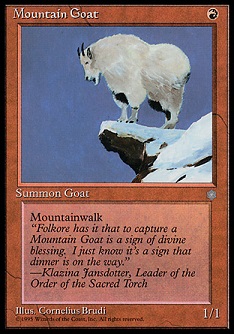
Back in my later high school days, when my early obsession with metal music coexisted with an active participation in games like Magic: The Gathering and Dungeons & Dragons, I remember stumbling across a 1/1 beast in Ice Age that I became bound and determined to name a pseudo-grim heavy metal band after:

I was very briefly disappointed to find that a band had already beaten me to the punch on that one. One of the things that makes John Darnielle an awesome person, though, is the very real possibility that this is no coincidence and he took his band name from M:tG too. (Probably not, given that his first album came out in 1994, but you never know.) This guy has made a guest appearance on an Aesop Rock hip-hop album and written an acoustic love song set to a Marduk black metal concert in the same year; his appreciation for the awkward and out-of-place couples with an above-average awareness of other musical scenes to conjure a constantly befuddling self-image. The first time I saw him live, before I was very aware of his works, I wasn’t sure if I ought to take the dialogue between each track as stand-up comedy or legitimate commentary by someone who was hopelessly socially inept. In retrospect, it was more the former, but the heart-felt sincerity Darnielle packs into everything he says or writes is both a quintessential part of the act and a reflection of who he really is–someone both incredibly aware and controlling of his public image and just a little bit legitimately weird. He has made his claim to fame writing sentimental solo acoustic songs with over-the-top lyrics and awkward subject matters that are simultaneously heart-felt and tongue-in-cheek. He has cultivated his awkwardness into some of the best solo acoustic albums recorded since Bob Dylan.

Lately, The Mountain Goats have evolved from a solo project to more of a full band. Last time I went to their show the audience had expanded from about a hundred to a few thousand, and Darnielle was hamming up the rock-star image with a shit-eating grin on his face the whole time. I absolutely love this guy and his works, and while I can’t say that I’ve kept up with him consistently over the years (his discography is massive), I’ve certainly listened to him enough to rank in my top 50 most played artists of the past decade. Here are the lines to Fault Lines, to give you some idea of his brilliantly bizarre lyrics:

Down here where the heat’s so fine
I’ll drink to your health and you drink to mine
As we try to make the money we scored out in Vegas hold out for a while
We drink vodka from Russia
We get our chocolates from Belgium
We have our strawberries flown in from England
But none of the money we spend seems to do us much good in the end
I got a cracked engine block, both of us do
Yeah the house, the jewels, the Italian race car
They don’t make us feel better about who we are
I got termites in the framework, so do you
Down here where the watermelon grows so sweet
Where I worshiped the ground underneath of your feet
We are experts in the art of frivolous spending
It’s gone on like this for three years I guess
And we’re drunk all the time, and our lives are a mess
And the deathless love we swore to protect with our bodies
is stumbling across its bleak ending
But none of the rage in our eyes
Seems to finish it off where it lies
I got sugar in the fuel lines, both of us do
Yeah the fights and the lies that we both love to tell
Fail to send our love to its reward down in hell
I got pudding for a backbone, and so do you
La la la la! Hey hey!

Song of the Day: Tool – H.


For those of you who have yet to get the memo, music industry giants in 2013 decided that it was time for the 1990s to be cool again. I’m pretty goddamn stoked about it myself, and I hope the sort of neo-grunge/alternative that’s going to be really popular 3-4 years from now inspires a lot of talented musicians to crawl out of the woodwork and start producing quality uncastrated rock again. In the meantime, I’ve been dusting off my neigh-forgotten guitar and revisiting a lot of the bands from my high school days to see if they were really as great as I remembered. (Alice in Chains? Check. Rage Against the Machine? Holy mother of Check. Sublime? Bzzzz, back to the “nostalgia” m3u and dusty jewel case with you.)

There have been a few 90s bands that never really left my playlist all this time. Smashing Pumpkins’ catalog from Siamese Dream though Machina kept on rolling like they were all just released yesterday. Pearl Jam and Nirvana still found their way into Winamp from time to time. And I never quit listening to Tool. My Tool selection for the past decade though has consisted almost exclusively of the Opiate EP and Undertow–those nostalgic recordings that were inevitably rolling in the background every time I ever skipped school to play paintball, experimented with a new drug (I haven’t done any “drugs” since high school, but I must say tripping on shrooms completely changed my perspective on life in a positive way), or got drunk when it was still a novel experience.

When I was a teenager though, it was never Opiate or Undertow that I listened to at home. They were the party albums that all of my friends would play ad pleasant nauseam. In private, I listened to Ænima. I’d all but forgotten about it until a week ago. I’ve kept it on repeat while engaging in the oh-so-rebellious task of remodeling my kitchen, and wow… Fast-forward from having naively experienced a few hundred mass-marketed bands to having researched and intelligently engaged thousands of different acts, I have to say Ænima remains one of the greatest recordings I have ever heard.

Right now I’m peaking on Pushit. It was, alongside Jimmy and Third Eye, one of the tracks I pretty much ignored as a kid, and I’m now hearing it in a new light as one of the most overwhelming tracks on the album. I want to showcase H. though, because it was my favorite Tool song prior to the release of Lateralus (the way I connected with the lyrics to Lateralus’ title track at the time is difficult to describe and sadly lost to me now), and because I do still regard it as my favorite track on the album (Ænema comes pretty close).

The way Maynard’s vocals interplay with the instrumentation is absolutely beautiful; I think Ænima represents Tool’s peak as innovative song-writers, bridging the gap between their earlier edginess and their later brooding experimentalism, and no song captures that quite so extensively as H. The crushing chorus acts as cement to piece together Maynard’s vocals and Adam’s guitar at their most mutually fragile peak. The lyrics present a simple clash between emotions and wisdom under a veil so deliciously esoteric that it might feel personally and uniquely relevant to each individual listener in a legitimately different way:

What’s coming through is a lie.
What’s holding up is a mirror.
What’s singing songs is a snake,
Looking to turn my piss to wine.
They’re both totally void of hate,
But killing me just he same.
The snake behind me hisses what my damage could have been.
My blood before me begs me, open up my heart again.
And I feel this coming over like a storm again.
Venomous voice tempts me, drains me, bleeds me,
Leaves me cracked and empty,
Drags me down like some sweet gravity.
The snake behind me hisses what my damage could have been.
My blood before me begs me open up my heart again.
And I feel this coming over like a storm again.
I am too connected to you to slip away, fade away.
Days away I still feel you, touching me, changing me,
Considerately killing me.
Without the skin,
Here beneath the storm,
Under these tears,
The walls came down.
At last the snake has drowned,
And as I look in his eyes,
My fears begin to fade,
Recalling all of the times
I could have cried then.
I should have cried then.
As the walls come down,
And as I look in your eyes,
My fear begins to fade,
Recalling all of the times
I have died,
and will die.
It’s alright.
I don’t mind.
I am too connected to you to slip away, fade away.
Days away I still feel you, touching me, changing me,
And considerately killing me.

Ten Years #37: Drudkh


Decade of last.fm scrobbling countdown:
37. Drudkh (841 plays)
Top track (67 plays): Fate, from The Swan Road (2005)

Ukraine was my gateway into black metal. My earliest exposure to bm in general was met with a closed mind; I remember picking up IX Equilibrium not long after it came out, hearing nothing but distortion and blast beats, and wondering what all the fuss was about, as if its brilliant classical component was non-existent. But somehow Nokturnal Mortum’s Goat Horns blew my mind on first exposure, when I was still a teenager rocking out to In Flames, Opeth, Iced Earth and the like. That pagan spirit screaming murder beneath a wall of chaos struck me with more force than “satanic” or “progressive” bm ever would, then or now. I spent a substantial chunk of my paychecks at The End Records in the years that followed, and I was not searching for “black metal” so much as “Ukraine”. The consequence was that I got to enjoy bands like Drudkh, Hate Forest, and Astrofaes before it was “cool” to do so. (Let’s face it, hype always influences our perspective on a band in one way or another, whether we like to admit it or not.)

Drudkh quickly became my second favorite band in that scene after Nokturnal Mortum, and what I have heard in them over the years is nothing like the steady degradation from Forgotten Legends downward that supposedly “old school” fans are inclined to proclaim. I don’t know why so many people see Drudkh as a one-track band. Perhaps it is because the rate at which they release new material softens perception of the major shifts in their evolution as artists. Handful of Stars (2010) was the only album on which fans actually had to stop and go “wait, is this still Drudkh?”, and the band answered that question decisively with the Slavonic Chronicles EP. But if you listen to Drudkh as a band who played the same solid thing for four or five albums and then got too successful and lost their touch, you’re fairly misguided. It’s true that their first three albums have a lot of similarities. I sort of feel as though their vision on all three was roughly the same, with Swan Road (2005) marking the point at which they had enough recording experience to really make their sound fully capture that vision. The band has rarely repeated the same sound since. Blood in Our Wells (2006), my personal favorite, was a tremendous shift in favor of their pagan undertones, with songs like “Solitude” and “Eternity” crushing the listener through anthems more than atmospherics. Songs of Grief and Solitude (2006) was perhaps the best folk interlude album in black metal since Ulver famously did it, and Estrangement (2007) completely revisioned their sound, replacing characteristic deep plods with rabid, shrill blast beats and grittier production. Microcosmos (2009) was a significant change in production towards the other end of the spectrum, and I rather doubt the gut-wrenching quality of “Ars Poetica” (a song I still think has an almost screamo vibe to it at the climax) would have hit home so forcefully otherwise.

Drudkh’s trip to France on Handful of Stars (2010) may have left some fans disgusted, but it would be frankly stupid to call a band so consistently open to change “sell-outs” the moment their vision failed to reflect stereotypical expectations of aggression, masculinity, whatever the fuck tr00 cvlt dandies demand. And anyone who thinks Eternal Turn of the Wheel (2012) was some grand return to the good old days is in stark denial of the (I think quite intentional) persistent French influence underlining this newest chapter in their discography.

If I seem to be taking a defensive stance here, it might be in part because I’m arguing against my own initial inclinations. I’ve made the shallow mistake of blowing off Drudkh as washed up many times before, and I never fail to regret it once I’ve given the album in question substantially more time to grow on me. (My initial review here of Eternal Turn of the Wheel was cautiously negative. Today I would say it’s great.) I think over the years I’ve developed some boneheaded stereotype of Ukraine as a third world nation–an opinion based mainly on Ukrainian Americans whose pseudo-heritage reeks of self-debasing Cold War propaganda and “world music” zines. (“Only my American non-profit organization can preserve the endangered culture of our pathetic, eternally oppressed, utopianly pacifistic Slavic ancestors! I’ll give you a cultural awareness award and my new Carpathian-Caribbean fusion cd! Buy my shitty handicrafts! Send money!”) I try to forget about it and remind myself that these people are the ultimate American idiots with no actual connection to the people they pretend to represent, but I still find it hard at times to give Slavic musicians the intellectual credit they deserve. Roman Saenko and co are actually among the most intelligent musicians of our generation, and when I remind myself of that and revisit their discography, I realize again that it has been consistently solid from start to finish.