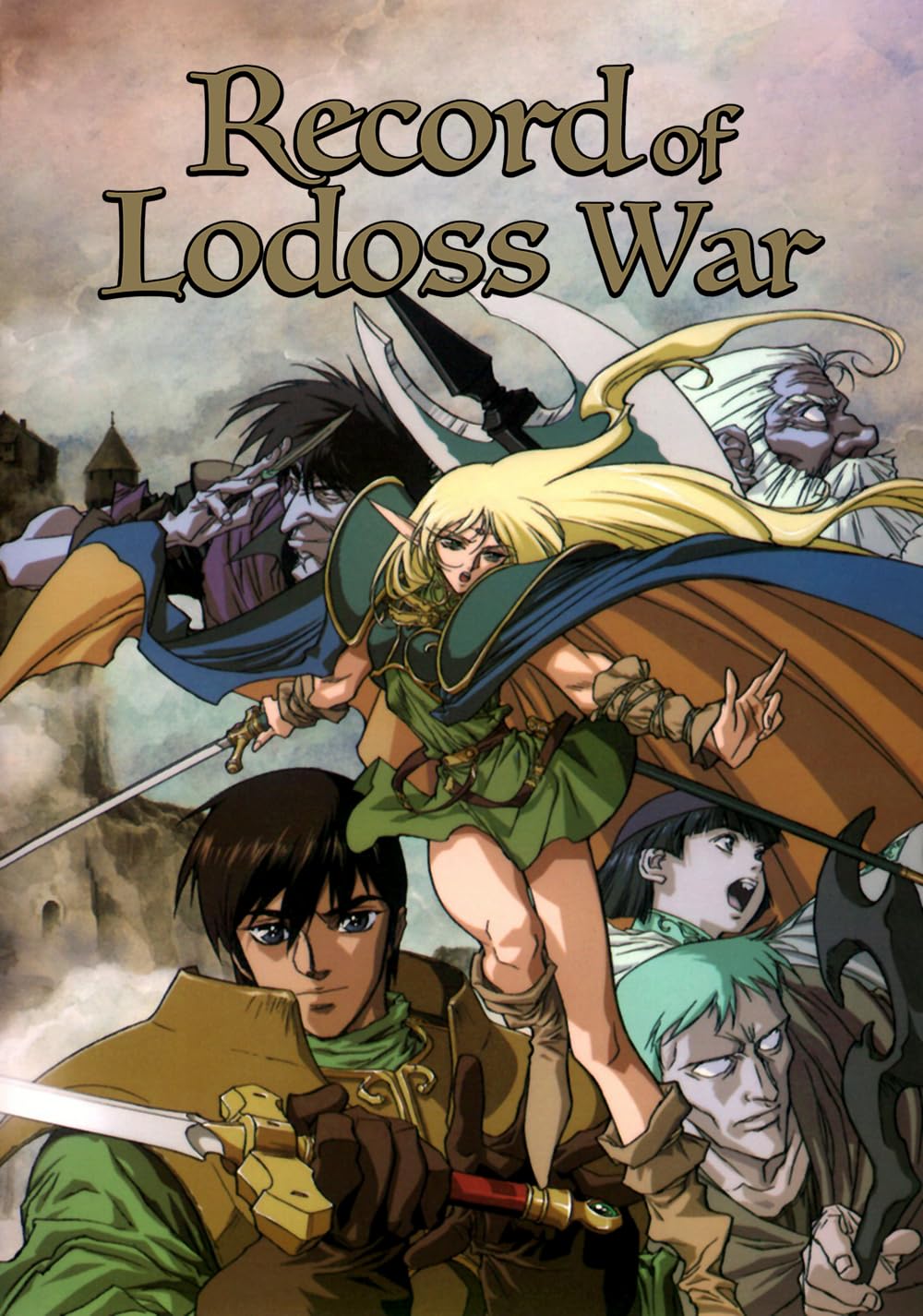
“I don’t understand you humans at all. But then, maybe that’s what makes you so fascinating!” — Deedlit
Record of Lodoss War is one of those series that feels less like a single anime and more like a crystallized moment in the evolution of fantasy storytelling in Japan: ambitious, clunky, oddly moving, and unmistakably rooted in tabletop role-playing DNA. It is also a work that shows its age in both craft and politics, which makes revisiting it today a fascinating mix of admiration and frustration.
Set on the war-torn island of Lodoss, the story follows Parn, the disgraced knight’s son who sets out to restore his family’s honor, gathering around him the quintessential fantasy party: Etoh the priest, Slayn the mage, Ghim the dwarf, Deedlit the high elf, and Woodchuck the thief. On paper, this is pure campaign log: goblin attacks, dragon encounters, cursed relics, warring kingdoms, and an encroaching darkness embodied by Marmo and its champions, all framed as a grand war for the fate of the land. What makes Record of Lodoss War interesting is how openly it wears that structure; it rarely tries to hide its tabletop origins, and that transparency becomes both a charm and a structural limitation.
The narrative in the original OVA moves briskly to the point of feeling compressed, jumping between key battles, political shifts, and character revelations with very little connective tissue. Characters appear, declare their motivations, and are folded into the party or into the enemy ranks as though someone summarized last week’s game session before tonight’s adventure. That can be engaging—there’s a constant sense that something important is happening—but it also means emotional beats often rely on the audience’s familiarity with genre shorthand rather than carefully built arcs. The later TV series, Record of Lodoss War: Chronicles of the Heroic Knight, attempts to extend and reframe this story, moving the timeline forward and giving more room to Ashram and the continuing conflicts around the scepter of domination, but it still largely lives in that same campaign-style rhythm.
If you come to Record of Lodoss War for worldbuilding, it mostly delivers. Lodoss feels like a fully mapped fantasy setting, complete with divine factions, ancient wars, feuding human kingdoms, and a clear sense of geopolitical stakes. The franchise’s origins in novels and game material mean that offhanded references to past conflicts or legendary heroes feel like the tip of a much larger iceberg rather than improvisations thrown in on the spot. That sense of a lived-in world is one of the show’s enduring strengths, and it’s not hard to see why it earned “anime Lord of the Rings” comparisons for some viewers. At the same time, the story’s focus is surprisingly narrow in practice; we spend most of our time tracking a small cluster of heroes and villains, which can make the world feel oddly claustrophobic despite its epic framing.
Parn is a divisive protagonist, and your tolerance for him may shape how much you enjoy the series. He’s deliberately written as inexperienced and impulsive, a young man who rushes headlong into danger and has to be humbled, trained, and repeatedly corrected by those around him. That arc tracks the classic “wannabe hero becomes real knight” trajectory, and there is a certain sincerity to his straightforward commitment to honor that feels very of its era. On the other hand, his lack of nuance and his tendency to charge spellcasters as if basic tactics don’t exist can make him feel more like an archetype than a fully realized character, especially to modern viewers used to more subversive leads. The series wants you to root for Parn because he is earnest and good-hearted, and if you can accept that at face value, his journey has an old-school charm; if you can’t, he may come off as frustratingly bland.
The supporting cast generally fares better and often carries the emotional weight of the story. Ghim’s quest to free Leylia from the control of the enigmatic Grey Witch Karla has a tragic nobility that gives him more emotional complexity than his gruff dwarf stereotype suggests. Deedlit, meanwhile, is both a clear audience favorite and a bundle of contradictions: proud high elf, jealous love interest, powerful magic user, and emotional anchor for Parn’s growth. There are interesting dynamics scattered throughout—Karla’s manipulative neutrality, Ashram’s stern loyalty, and King Kashue’s charismatic leadership—but the limited runtime and brisk pacing mean that many of these threads feel more sketched than deeply explored. Still, the show does succeed in one key area: it communicates that no one is entirely safe, and deaths and sacrifices land with more impact because the narrative doesn’t treat the core party as invincible.
From a visual standpoint, Record of Lodoss War is a time capsule of late-80s and early-90s OVA aesthetics, complete with lush fantasy backgrounds, detailed armor designs, and occasional bursts of impressive sakuga. Dragons, enchanted forests, and battlefield panoramas often look fantastic, and when the animation budget aligns with central set-pieces, the result can still be striking. That said, the budget limitations are impossible to ignore: reused shots, still frames, and noticeably uneven animation quality crop up often enough to break immersion, especially during less critical scenes. The contrast between its best sequences and its weaker cuts is stark, and modern viewers accustomed to consistently polished fantasy action may find the inconsistency distracting.
Tonally, the series is earnest to the point of feeling almost old-fashioned now. Its focus on honor, duty, and chivalric ideals is straightforward and rarely interrogated, creating a cast of characters who largely operate within established moral frameworks rather than questioning them. That gives the story a kind of mythic simplicity—good kings, cursed knights, devoted priests—that can be comforting in the way classic fantasy often is. But it also means that viewers looking for moral ambiguity, systemic critique, or characters who challenge the underlying social order of their world may find Record of Lodoss War thematically limited. Some of its perspectives, especially regarding gender roles and heroic archetypes, feel antiquated when held up against contemporary fantasy anime that deliberately complicate or deconstruct those tropes.
One of the highlights of the anime series is its orchestral soundtrack composed by Mitsuo Hagita. Symphonic tracks underscore the grander battles with sweeping majesty, while softer themes highlight moments of connection between Parn and Deedlit or the quieter interludes between campaigns. The overall effect is to push the story closer to high fantasy melodrama, which suits the material perfectly; when the writing and visuals are in sync with Hagita’s score, you can see exactly why this anime lodged itself so firmly in fans’ memories. Voice performances, in both Japanese and English dubs, tend to lean into archetype—stoic knights, booming kings, mysterious witches—but that broadness pairs naturally with the show’s narrative style.
A fair assessment of Record of Lodoss War has to acknowledge its historical importance alongside its genuine flaws. It stands as a significant waypoint for fantasy anime, showing that a series could aim for a sweeping, quasi-novelistic epic with detailed lore and long-running political conflict. Many later works, from more grounded fantasy to meta-takes on RPG structures, benefit indirectly from the groundwork Lodoss and its peers laid in translating tabletop sensibilities to the screen. At the same time, its uneven pacing, underdeveloped character arcs, inconsistent animation, and sometimes simplistic moral framing keep it from feeling timeless in the way its influences clearly aspired to be.
Whether Record of Lodoss War is worth watching now depends heavily on what you’re looking for. If you have a soft spot for classic fantasy, tabletop RPG roots, or the particular look and feel of 90s OVAs, the series offers a rewarding, if imperfect, journey through a world that still feels distinct and carefully built. If you prioritize tight plotting, modern character complexity, or consistent visual polish, Lodoss may feel more like an important relic than a compelling contemporary experience. Taken on its own terms—as an earnest, sometimes clumsy, but heartfelt attempt to stage a sprawling heroic saga—it remains a notable, if not unassailable, part of anime history.
 Through the Shattered Lens