Whatever you do, please — don’t call her “She-Hulk” anymore!
In the aftermath of the near-universally-panned (and not without good reason) Civil War II, Jennifer Walters is feeling even less herself than usual. Her cousin, Bruce Banner, is dead (for now, at any rate) and she’s recently spent a fair amount of time comatose, herself (as did most readers, but that’s another matter). So, with no “incredible” Hulk left, the now-adjectiveless mantle belongs to our gal Jen. Except — she really doesn’t want it. And she’s doing anything she can to remain calm and prevent her transformation from triggering. Her “mellowing-out” habit of choice? Watching YouTube cooking videos. I’d get downright sleepy, myself.
Oh, and she’s going back to the lawyering thing, taking on a new gig at a firm that primarily represents super-hero clients. That could be interesting, I suppose. Unfortunately, nothing else about Marvel’s new Hulk #1 is.
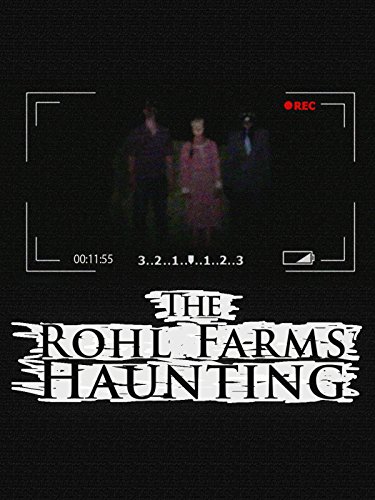
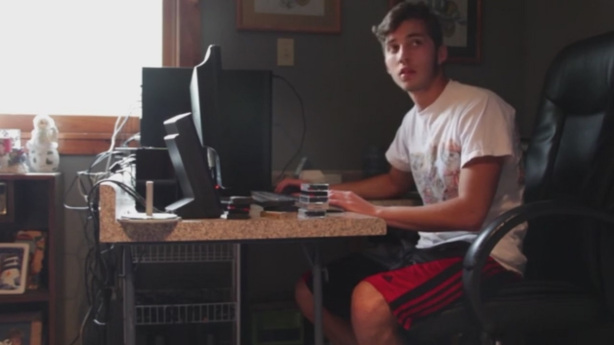
There’s only so much you can do in the middle of BF Wisconsin with a thousand bucks and a hand-held digital cam, but what the hell — in 2013 those limitations didn’t stop writer/director/actor Cordero Roman from figuring he could shoot, and star in, his very own horror flick. And while the fruit of his labor, The Rohl Farms Haunting, is hardly destined to set the cinematic world on fire, it has made it as far as the streaming queue on Amazon Prime, and that’s at least something.
Homemade “found footage” efforts like this are a dime a dozen, of course — we certainly talk about enough of ’em around these parts — but this one at least shows something vaguely resembling the generally-accepted dictionary definition of “ambition” : Roman starts out looking to film a “slice-of-life” documentary about his long-time friend, Luke Rohl (who’s also “playing himself”)…
I was originally planning to start 2017 off by working through the videos that aired on the first day of MTV. At the last minute, I decided I would do a retrospective of the music videos of ABBA with special days off for certain holidays or events. It is a little tough to do and kind of easy. It is tough because once you get back into the 1970s, then you run into several problems.
First, it is sometimes difficult to tell whether a music video is just a release of a live performance they gave or is what we think of as a music video. This is a particular problem with ABBA since the more and more I look at YouTube, the more and more I become convinced that every performance they ever gave is on there. A good example of this issue is that there is another version of Ring, Ring. The problem is that while it could be released as a music video, it really looks like it was a live broadcast rather than something recorded in advance. I will probably do that though. Another great example is Mony Mony by Tommy James & The Shondells. It could easily be a music video or something they did live. It’s not like A Whiter Shade Of Pale by Procol Harum or Nights In White Satin by The Moody Blues that are clear-cut music videos.
Second, you really get into the issue of different versions. In the case of Dancing Queen, it looks like there might be four different versions. This also includes the Spanish versions of some their songs. In the case of the song Happy New Year, there are two different versions of the video. They didn’t just dub the video in Spanish. They actually reshot certain things, maybe shot some new material, and rearranged parts of the video. It’s distinctly different.
Third, there are undocumented videos. This is always a problem. Meat Loaf will be a nightmare when I decide to do his 1980s videos rather than just the Bat Out Of Hell ones. In the case of ABBA, mvdbase and IMVDb have them covered pretty well. Also, the ABBA VEVO channel seems to have just about every official video they made, including the one called The Last Video that isn’t documented in either database.
Fourth, there are videos out there that were made after the group either broke up or came into existence years after the song was released. A video for Joy Division’s Atmosphere was made years after the group broke up after the suicide of Ian Curtis. Also, there is a music video for Money by Pink Floyd that sure looks like it was made in the 1970s. It is even listed as having been released in 1973. However, they also list that Wayne Isham directed the music video. Isham would have had to have been fifteen when he made it. When you go to his IMDb page, you can find a big list of his music videos. Money was actually made in 1989.
Finally, there are going to be videos that I can see possibly exist, but I can’t find a copy of to embed. A great example of that is this video right here. According to mvdbase, there is a music video for People Need Love that came out either just before, or after this one. I can find live performances of that song. I can’t find a music video.
In general, I will be leaning towards the conservative side of things. If I come across something later on that I clearly missed, then I will add it.
Now for the video.
This is about as basic an ABBA music video as you are going to get. You have them in a straight line with the primary focus on Agnetha and Frida, and they are all trapped in the white dimension. However, as we go through their music videos, you can see the evolution of the promo film to what we think of as a modern music video.
One of the hallmarks of an ABBA music video is the profile shot. You can also see Hallström played with focus during those shots. My favorite part of the profile shot is when it doesn’t cut from them singing to the guitar, but instead pans down from their faces and changes focus to bring a very close-up shot of the guitar being played into focus.
I also like the part of the video when the video uses a side shot through Agnetha and Frida so we can see Benny on the piano.
I get the strong feeling that Hallström looked at earlier music videos like the one for Hello, Goodbye by The Beatles, and started thinking how he could change that up using different filmmaking techniques. It’s a similar video, but there’s a polish and style missing from it that is in this one. Ring, Ring would become a basis for You Better Run by Pat Benatar in 1981 and other such simple put-the-band-on-a-set-and-have-them-perform videos.
Owe Sandström and Lars Wigenius were costume designers on this music video.
You can watch Sandström talk about ABBA costumes in general below.



 Through the Shattered Lens