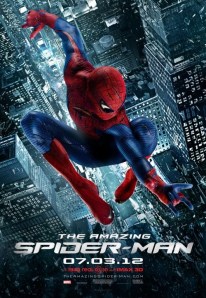
I know, I know — it’s really not even fair, is it? To review director Marc Webb’s probably-happening-to-quickly relaunch of Marvel’s Spider-Man franchise in the wake of Christopher Nolan’s The Dark Knight Rises seems like setting this flick up for defeat. Truth be told, though, I actually saw this flick on opening night, and held off on reviewing it here on Through The Shattered Lens because, well — everybody else was already having a crack at it on here. I swear. I think this is the fourth or fifth review of this film to go up here. So I held off. And honestly, the fact that I wasn’t rushing home to sit down and review it right away should tell you something right there, shouldn’t it?
Not that The Amazing Spider-Man isn’t a perfectly decent little superhero flick, it is. But that’s all it is. I can’t find much fault here, really — Webb’s directive from Columbia seems to have been to, in effect, Nolan-ize the Spider-Man story with this reboot, and on the surface, he seems to have done that. The tone is darker and more somber. James Garfield’s take on Peter Parker is altogether more haunted and troubling than was Tobey Maguire’s. He’s less likable, too — a development I actually welcome. Emma Stone does a nice job as high-school love interest Gwen Stacy. Martin Sheen’s Uncle Ben in an altogether more realistic and involving take on the character than we got in Sam Raimi’s first flick. Sally Field is great as Aunt May. Dennis Leary does a fine job as Gwen’s dad, police Captain George Stacy, who has a hard-on to arrest Spider-Man. Campbell Scott, in flashback scenes as Peter Parker’s dad, cuts both a kindly and haunting figure, and the decision of the filmmakers/studio to concentrate on the mystery surrounding the elder Parkers is a good one that gives the series a little bit more depth.About the only two serious knocks against the film are the normally-reliable Rhys Ifans’ take on the villainous Curt Connors/Lizard, his performance in both roles being of a distinctly lacking/mail-in-in nature, and the CGI effects in general, which are of middling quality, particularly in terms of their realization of Connors’ Lizard persona (or maybe that should be reptile-ona). They’re not bad, but they’re not up to the level we expect in our summer blockbusters at this point, and I would say they’re pretty of a piece, quality-wise, with, say, the second Hulk flick.
Anyway, by and large, the word we’re looking for here, across the board, is competent. Not inspired, by any means, and not groundbreaking — just competent. I’ll be honest and admit I liked this flick better than Joss Whedon’s Avengers, since it at least provided some level of human melodrama to back up the action, but it seems that the lesson studios have taken from Nolan raising the bar on the entire superhero genre is not that we want more complex, challenging, higher-quality, more technically-brilliant, more multi-faceted fare, but that we just want these flicks to be “darker” and “more realistic.” They “get” what the success of the Batman films means on a surface level, but they really don’t “get it” at all.
For those of you who are old enough to remember the “evolution” of the comics medium in the mid-to-late ’80s with books like Frank Miller’s The Dark Knight Returns and Alan Moore and Dave Gibbons’ Watchmen, assuming you were paying attention to comics back then, this will all seem terribly familiar — after the success of those two books, the “Big Two” publishers said they got the message and that people were ready for “superheroes to grow up.” And what did we get? Not more intelligent, thought-provoking, boundary-pushing, stories and characters that challenged the conventions of the genre itself the way those works did, but a steady stream of “darker,” more “mature,” somber, soul-less versions of the same kind of crap the industry was already cranking out — a state of “creative” affairs that continues unabated to this day. Nolan’s raised the bar on superhero storytelling on the silver screen the same way that Miller, Moore, and Gibbons did on the printed page, and Hollywood seems to have taken the same “lessons” from it that Marvel and DC did a quarter-century ago.
in other words, welcome to a new age of superhero sameness. On the one extreme we’ll have pure, unfiltered, two-dimensional, check-your-brain-at-the-door, CGI-heavy slugfests, a la The Avengers. Comics could always do these and do ’em well, and now so can the movies. On the other hand, we’ll have ostensibly more “mature,” “realistic,” “darker” stuff like this. But don’t expect another series with the innate intelligence and willingness to push the envelope in new directions that we’ve gotten with the Dark Knight films anytime too soon. Meet the new boss — same as the old boss.
Mind you, all of this was pretty much written and ready to go before I saw The Dark Knight Rises — and now that I have, my initial view still stands. Reaction to one flick shouldn’t change one’s opinions on another, after all. So yeah, this is perfectly adequate, acceptable superhero fare — but in the wake of DKR , do “adequate” and “acceptable” still cut it? Should they ever have? And are we willing to settle for movies like The Amazing Spider-Man that think that all DKR and its ilk prove are that audiences want the same old stuff, albeit with “darker,” more humorless trappings — or are we going to reward work that does what Nolan’s done with his Batman series in terms of pushing the genre itself in directions we’d never before expected? Let’s vote with our dollars, and vote wisely.
 Through the Shattered Lens
Reblogged this on Trash Film Guru and commented:
Moe new stuff for Through The Shattered Lens —
LikeLike
“Nolan raising the bar on the entire superhero genre…”
I still don’t know what people mean by this. “Darker, grittier” superhero films? They accused Tim Burton of doing the same thing more than 20 years ago. Burton got credit for being the one to usher in this trend. I know, because I was there and I remember. Now it’s like Tim Burton never existed.
Also, the Batman comics, way back in the day, were supposedly much darker than later offerings. Now in this case, I wasn’t around in the late 1930s, so I’m going on what I’ve read. In any event, let’s stop this ridiculous ranting about how Nolan is some sort of freakin’ genius who has reinvented the wheel on superhero flicks. He simply took a ancient comic book character, added in a bunch of CGI, aped Tim Burton’s “darker” cinematic treatment of the Batman legend, and happened to direct a movie that was, rather unfortunately, given extra attention due to the passing of Heath Ledger many months before the movie hit the multiplex, thus building a morbid fascination of sorts in the general public (and if you don’t believe that Ledger’s untimely death had anything to do with the massive success of this film, you probably also believe that his passing had nothing to do with him winning the Oscar for Best Supporting Actor–I do not mean to sound disrespectful, I’m merely pointing out the real reasons behind the staggering success of “TDK”–tragedy, but relevant tragedy–and if people are going to act like these weren’t the key factors in the rejuvenation of the “Batman” films, look at the relatively (key word being “relatively”) small box office returns for “Batman Begins” and tell me what was the one incident real-life that popped the box office big-time for Nolan’s next effort).
All I can say it that mass delusion is a funny thing–everybody can see its impact, and the causes should be obvious, but everybody denies its existence. To use a beaten-up old cliche, the emperor has no clothes. Not only that, he’s doing naked cartwheels with his arse on fire in the middle of Times Square.
Hollywood is badly losing me with their latest re-interpretations of superhero movies. Everything has to be “darker, grittier, edgier”. Hey guys, how about just worrying about making a GREAT FILM?
Since when did “fun”, “humour”, “escapism” and colour” become such dirty words?
Why is it taboo these days to have heroes who are genuinely decent people? Why the push to make every superhero an arsehole? Yeah, they’re only human, that’s just the point–they’re human beings, not ogres. Why the push to make superheros less kind and more like arrogant bullies? Where the hell is the FUN in this?
What happened to superhero movies such as “Barbarella”, “Superman” (the 1978 version), “Flash Gordon”, etc? Where is the FUN, people? All this crap about how the “new generation” of kids need “darker” superhero films, quite frankly, makes me fucking sick. I’ve been to revival screenings of the FUN old superhero movies, and guess what? Kids LOVE them. Young adults LOVE them. Senior adults LOVE them. Old-timers LOVE them. The whole world isn’t hopelessly depressive. Doom and gloom has its place in cinema, but there must also be room for FUN. What’s next? A remake of “The Sound of Music” that ends with the von Trapps being taken to Dachau?
Not every superhero “reboot” or whatever you want to call them must re-explain the superhero’s origins, either, nor must a sequel pick up exactly from where the previous film left off. Hey, I wonder if George Lucas will “reboot” the entire “Star Wars” saga? I tell you, the whole superhero movie thing is overkill. There was a time when I’d rush out to see ’em, but now…ennui is starting to set in.
LikeLike
I generally agree with that you’re saying here, and for my money Dick Donner’s “Superman” is still the gold standard of the entire genre. I like Burton’s “Batman” films as well, and agree that while they are “darker” in tone than previous superhero flicks had been, they retain the element of the fantastic that used to make the genre something special. It’s well-established that we disagree on the Nolan Batman films, but I think if all Hollywood takes from them, as they seem to have so far, is that audiences want something “darker” and “more realistic,” then they’ll have taken the wrong lesson, as the comics industry did 25 years ago after “Watchmen” and “Dark Knight.” I have no doubt that today’s Batman comics by and large probably suck, because DC and Marvel have been stuck in a creative rut forever. For my money, the most fun, satisfying, and rewarding run on a superhero book in the post-“Watchmen” world was Alan Moore’s run on “Supreme,” which is the greatest Superman story never told. It’s in many ways Moore answering himself on and for “Watchmen,” and re-establishes all the fun, over-the-top, and yes, mythic aspects of the genre in ways Grant Morrison also tried to do with “All-Star Superman,” but Moore does it all much better.
LikeLike