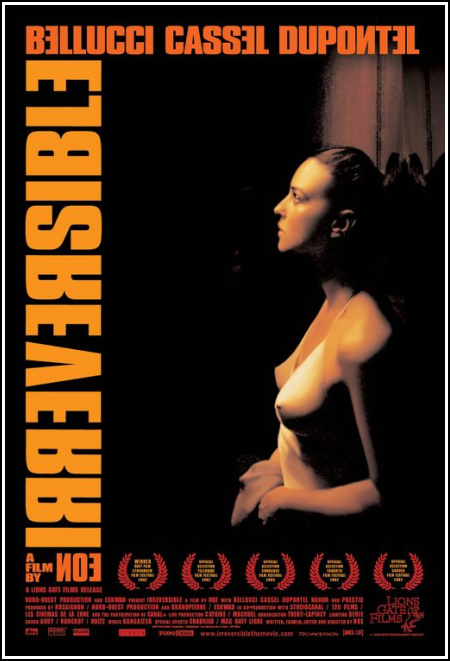
Gaspar Noe’s Irreversible is filmed in the same style as Christopher Nolan’s excellent Memento. With the story unfolding in reverse sequence, the audience’s first impression of the story doesn’t end up being the same once it finishes.
Everyone has made it a point to mention the disturbing and hard-to-watch sodomizing that Monica Bellucci’s character goes through at the hands of a random, strung-out stranger. This 10-minute sequence is as disturbing as any film sequence I have ever had the chance to watch. There is absolutely no feeling of lust or sexiness this scene brings up. A sense of shock, disgust and pain is more appropriate reaction to seeing the lovely Ms. Bellucci’s character go through a very inhumane experience. This scene goes a long way to explaining the film’s beginning where a brutal and equally inhumane murder takes place inside a murky, red-lit, underground gay S&M club.
As the film continues to move backwards in time and shows the viewer the earlier and happier time of Bellucci’s and Vincent Cassel’s characters, the earlier scenes of violence take on a more poignant and sad note. In a space of a day many lives are broken and destroyed, and in the end all because of a random night occurrence in an dingy, lit underpass.
Gaspar Noe’s film is not for everyone and even those daring enough to take a chance to view it will have a hard time sitting through the first half of the film. The film itself takes on a dream-like quality as it begins to unfold. From its nightmarish tone and look to a dreamy last reel. I have heard people call Noe’s film as exploitive and misogynistic in its treatment of its main female character. In the end, Noe’s choice to shoot the rape scene in a realistic fashion and have it linger and linger shows the viewer that evil and ugly things do happen in real life. One either takes it and learn from it or turn away and pretend it never happened.
Irreversible is a film that people will either love or hate. This film doesn’t straddle the center when it comes to viewers reaction to it. Gaspar Noe’s film is not perfect, but overall it provokes the viewer to think on what they’ve seen and felt as the story unfolded.

 Through the Shattered Lens
I have seen this film. Your review perfectly outlines the construct of the film, as well as its effect on viewers.
It is a very unpleasant experience. Though this movie is sometimes included on lists of horror films, it provides none of the “fun” of being scared or even disturbed that an effective horror film does. It just leaves you feeling very uncomfortable, probably for the reasons you cite – these things can and do actually happen. I see the film as more of an ostensible sociological study than a horror movie, but one could certainly perceive that which is portrayed as horrific.
I tend more toward the camp you reference of people who do not like this film. I see what we are supposed to think, but I think that “exploitive” is an appropriate term. “Irreversible” revels in its own ugliness. Such seedy environments and people may actually exist, and sadistic psycho-sexual assaults may actually occur, but director Noe is very heavy-handed in his presentation thereof. It looks as though he is using the premise – “Hey, this stuff really happens.” – as an excuse to titillate and shock the viewer. Just because such things happen doesn’t mean that they should be portrayed in this way, or at all. Such explicit depictions can inure people to violence, instead of making them sensitive to it, and thereby lessen sympathy for its victims. I’m not sure I am buying the façade of consciousness-raising or social commentary or whatever Noe is purporting to be doing with this film.
Also, once we have gone back in time, to the scenes before the assault, I found myself feeling guilty for being attracted to the amazingly beautiful Belluco, having witnessed the sexual brutalization to come. So this movie makes the (male, at least) viewer feel bad for having a natural and unavoidable reaction. That’s not a good thing.
Nonetheless, your conclusion is dead-on. This is a thought-provoking film. I wouldn’t want to watch it again, and would not recommend it to very many people. As for being able to learn anything from it, one could say that it shows the pitfalls of seeking revenge, or of acting impulsively (there was an issue of mistaken identity, which rendered the revenge attempt a complete failure, and led to the bad outcome for the flawed protagonists). And perhaps a more profound lesson – take no chances. Never let your girlfriend or wife go alone in a dangerous or unfamiliar place. Even if you’ve had an argument.
So maybe there is some value in seeing this film. But there sure isn’t much pleasure in it. Tough to recommend, but it can’t be completely dismissed, either.
LikeLike
I actually think that Noe shot this film very detached from the proceedings. I know some people think it’s exploitive and sensational, but that’s what Noe is looking for with this film. If one enjoyed the film and it’s disturbing sequences then it says a lot about that particular audience. If one was disturbed, sickened and turned-off by the film then that too is a valid reaction. Noe’s films have a tendency to seem heavy-handed when in reality it’s the baggage the audience brings with them when they watch his films that colors how the perceive the final product. He’s a very reactionary filmmaker who wants to pull genuine reactions from his audience. Remember that in the end the very final scenes is what really adds weight to the brutal scenes before it. Before the final sequence those violent scenes are primal and savage, but once you factor in the final sequence they take on more of an existential tone to the proceedings.
Where Nolan’s Memento was a study in the fluidity of reality and how we perceive it this film by Noe is more of a deconstruction of time itself when put in the context of people’s lives. Time when perceived in a certain way can either be a destructive force in an individual’s life or a nurturing one. The two scenes bookending the film, whether seen the way Noe filmed it or in reverse, speaks to this theme.
While the film is not horror the way we define horror, I do believe that it is horror at it’s most real and natural form.
LikeLike
What an interesting set of observations. I understand them and largely agree with them, but could not have made them. I especially liked your point about the analysis of the dynamics of time and the way it is perceived.
I think most people would have the second reaction you describe – disturbed, sickened, and turned off. The question is, among these people, how many think the film is a valuable cautionary tale, and how many think it is an exploitive, base film disguised as a cautionary tale? I think I am still on the fence on that issue. (With acknowledgement of your comment about the purpose and effect of the final scene.)
But you’ve made me rethink this film a bit. Maybe Noe is exploitive like a fox after all.
I must say, I liked “Memento” much more. That one is very clever, and a lot of fun. But Noe, as you said so well, had a different goal in mind. I’ll have to muse some more as to just what I think that was.
LikeLike