Retro Television Review: The American Short Story Episode 7: The Displaced Person


Welcome to Retro Television Reviews, a feature where we review some of our favorite and least favorite shows of the past!  On Saturdays, I will be reviewing The American Short Story, which ran semi-regularly on PBS in 1974 to 1981.  The entire show can be purchased on Prime and found on YouTube and Tubi.

This week, we have an adaptation of Flannery O’Connor’s longest short story.

Episode #7: “The Displaced Person”

(Dir by Glenn Jordan, originally aired in 1977)

Life at a Georgia farm is thrown into turmoil when the farm’s owner, widow Mrs. McIntyre (Irene Worth), agrees to give a job to a Polish refugee named Mr. Guizac (Noam Yerushalmi).  As World War II has just ended and Father Flynn (John Houseman) has assured Mrs. McIntyre that Guizac can drive a tractor, Mrs. McIntyre is happy to give Guizac a home in America.  Less happy are the people who already work at the farm, most of whom see the hard-working Guizac as being a threat.  Mrs. Shortley (Shirley Stoler) worries that her husband (Lane Smith) is going to lose his job to Guizac.  Meanwhile, a young farmhand named Sulk (Samuel L. Jackson) enters into a business arrangement with Guizac, one that causes Mrs. McIntyre to change her opinion of Guizac.  Needless to say, it all ends in tragedy.

This adaptation is based on a short story that Flannery O’Connor wrote after her own mother hired a family of Polish refugees to work at their family farm, Andalusia.  This adaptation was actually filmed at Andalusia, only a few months after Flannery O’Connor’s death.  The furniture seen in the house was O’Connor’s own furniture.  The peacocks the drive Mrs. McIntyre crazy and which cause Father Flynn to have a religious epiphany are the same peacocks that roamed the farm when Flanney O’Connor lived there.  The cemetery that Mrs. McIntyre visits is the O’Connor family cemetery.  It brings a sense of authenticity to the film, one that is often missing from films made about the South.

The adaptation moves at a deliberate pace but it’s well-acted and it stays true to O’Connor’s aesthetic.  Those who might complain that there are only two likable characters in the film — Mr. Guizac and Father Flynn — are missing the point of O’Connor’s story.  Even Mrs. McIntyre, who initially seems to be trying to do the right thing, is blinded by the prejudices of race and class.  Father Flynn never gives up on trying to redeem both Mrs. McIntyre and the rest of the world but one gets the feeling that he might be too late.

The cast is what truly makes this adaptation stand-out.  Irene Worth, John Houseman, Lane Smith, Robert Earl Jones, they all give excellent performances.  Samuel L. Jackson was very young when he appeared in The Displaced Person but he already had the screen presence that has since made him famous.  The best performance comes from Shirley Stoler, who plays Mrs. Shortley as being a master manipulator who, unfortunately, happens to be married to a worthless man.  Mrs. Shortley does what she does to protect her husband.  Mr. Shortley does what he does because he’s a loud mouth bigot.  Everyone has their own reasons, to paraphrase Jean Renoir’s The Rules of the Game.  In this story, those reasons lead to tragedy.
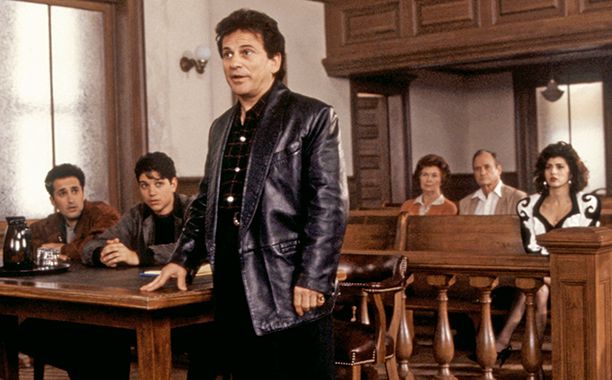
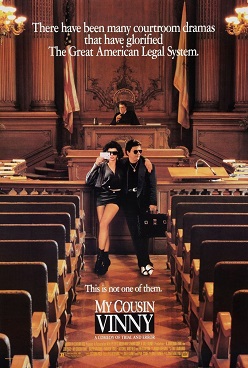
MY COUSIN VINNY (1992) – Joe Pesci heads way down south!


There are certain movies in my life that I consider “comfort movies.” These are the movies that I love so much that they always help me relax because I feel better just by watching them. I often turn on a comfort movie when I really need to fall asleep. Examples in my life include most of Charles Bronson’s filmography, RIO BRAVO, the ZATOICHI films, THE OTHER GUYS, and pretty much anything directed by Alex Kendrick. MY COUSIN VINNY fits comfortably under my categorization of a comfort movie.

The movie opens with friends Bill Gambini (Ralph Macchio) and Stanley Rothenstein (Mitchell Whitfield) taking the scenic route down south as part of a cross-country trip to attend college at UCLA. Unfortunately, while in Alabama, the two are arrested soon after leaving a convenience store. Thinking they are being charged for accidentally shoplifting a can of tuna, it turns out the actual charges are robbery and murder as the place was robbed and the clerk killed soon after they left. Knowing they are in big trouble, Bill calls his cousin Vinny Gambini (Joe Pesci), who’s pretty much the only lawyer that he knows. The problem, Vinny has never actually tried a murder case. Vinny heads down south with his fiance Mona Lisa Vito (Marisa Tomei) where he must contend with a judge (Fred Gwynne) who doesn’t like him, a prosecutor (Lane Smith) who has way more experience than him, and a mountain of circumstantial evidence that he has almost no hope of contradicting. Will Vinny be able to prove his cousin’s innocence before they end up with life in prison, or even worse?

There are many reasons that I love MY COUSIN VINNY. The cast consists of a couple of my personal favorite actors in Joe Pesci and Ralph Macchio. GOODFELLAS is certainly one of the best movies ever made, and Joe Pesci gives an unbelievably powerful performance, a performance that would win him the Academy Award. Pesci took a short break from filming MY COUSIN VINNY to attend the Acadamy Award ceremony and pick up the gold. He even took the statue to the set to show the cast and crew. Maybe that helped inspire Marisa Tomei to give her own Academy Award winning performance in this film. My favorite scene of the entire movie is when Vinny is treating Mona Lisa as a hostile witness on the stand, just before she proceeds to prove that nobody knows more about cars than she does. It’s such a satisfying scene as she makes the prosecutor’s “expert” look like a novice. As for Ralph Macchio, many times in my life I’ve made the statement that I wanted to be the karate kid when I was growing up. I think I was in the fifth grade when I saw the film for the very first time. I’ve been a fan of Ralph Macchio, and in love with Elisabeth Shue, ever since. It’s the kind of movie I’d just sit around thinking about when I was a kid. I even wanted to learn karate, but being just a little over 4 feet tall at the time, I didn’t need to be getting into any fights. I also like that MY COUSIN VINNY was partially filmed in the town of Covington, GA. My wife and I were driving from Arkansas to Myrtle Beach back in 2020 and we stayed the night in Covington. I had done a little research while I was looking for a place to stop for the night, and I found out that Covington is sometimes referred to the “Hollywood of the South” due to the large number of movies and TV shows that are filmed there. We snapped a couple of shots of the downtown before heading on down the road. But I think the thing I love most about MY COUSIN VINNY is also the reason I love movies like THE KARATE KID and ROCKY so much. I love movies where a person is completely underestimated, and rightfully so. But then, through some combination of intelligence, hard work, heart, and will, that same person is able to rise to the occasion and prevail against those very same people who underestimated them. Vinny has no business in the courtroom, but somehow, he’s able to win the case, and he does it in a smart, funny and exciting way. I love an underdog, and MY COUSIN VINNY just makes me feel good!  

Film Review: My Cousin Vinny (dir by Jonathan Lynn)


In the 1992 film, My Cousin Vinny, two college students from New York City, Bill Gambini (Ralph Macchio) and Stan Rothstein (Mitchell Whitfield), make the mistake of driving through Alabama.  The two students stop off at a convenience store.  When the clerk is subsequently shot dead during a robbery, Bill and Stan are arrested for the crime.  The viewers know they’re innocent.  Bill and Stan know they’re innocent.  But the entire state of Alabama seems to be determined to send Bill and Stan to prison for life.

Fortunately, Bill’s cousin, Vinny (Joe Pesci, star of Half Nelson), is a lawyer.  Unfortunately, he just recently passed the bar exam and he has yet to actually try a case.  Still, Vinny and his fiancée, Mona Lisa Vito (Marisa Tomei), come down to Alabama.  Vinny takes the case, lying to the judge (Fred Gwynne) about his qualification as a trial attorney.  Vinny is momentarily impressed when the prosecutor (Lane Smith) shares with him all of the files about the case.  “It’s called disclosure, dickhead!” Lisa snaps at him, revealing that she actually has more common sense than Vinny.  That becomes increasingly important as Vinny tries to keep Bill and Stan from spending the rest of their lives in prison.

To be honest, considering how much I complain about stereotypical portrayals of the South, I really shouldn’t like My Cousin Vinny as much as I do.  Almost every character in the film is a stereotype to some extent or another, from the farmers and rednecks who take the witness stand to Fred Gwynne’s no-nonsense judge who rules that Vinny is in contempt of court because he’s wearing a leather jacket.  Fortunately, though, the Southern stereotypes don’t bother me because both Vinny and Lisa are New York stereotypes.  Just as the judge and the townspeople seem to confirm every prejudice that someone like Vinny would have against the South, Vinny seems to be the epitome of everything that people in the South dislike about the North.  When Vinny first shows up on the scene, he’s loud and brash and obnoxious.  But, as the film progresses, Vinny reveals himself to not only be a better attorney than anyone was expecting but he also calms down and adjusts to the more relaxed pace of life in the country.  Just as Vinny reveals himself to be not as bad as everyone originally assumed, both the Judge and the prosecutor are also allowed to reveal some hidden depths.  Neither one is the cardboard authority figure that viewers might expect.  The Judge does sincerely want justice to be done and the prosecutor sincerely wants to keep the county safe, even if he is prosecuting two innocent men.  Just as Vinny learns not to be too quick to judge them, they learn not to be too quick to judge Vinny.  The end message is that everyone is innocent until proven guilty and deserves a fair hearing, whether in a court of law or just in the courts of public and private opinion.  It’s not a bad message.  In fact, it’s one that more than a few people could still stand to learn today.

Of course, the best thing about the film is Marisa Tomei, who not brings a lot of energy to the film but whose hair is amazing and whose clothes are to die for.  Tomei won an Oscar for her performance in My Cousin Vinny, a victory that was so controversial that there were unfounded rumors that presenter Jack Palance had read the wrong name by mistake.  (As we all learned a few years ago when Warren Beatty and Faye Dunaway actually did read the wrong winner, the accountants aren’t going to let anyone get away with that.)  Watching the film last night, it was obvious to me that Tomei deserved that Oscar because Lisa is the heart of the film.  Pesci, Gwynne, and Lane Smith are all give good performances but, without Marisa Tomei’s performance, My Cousin Vinny would ultimately just be another culture clash comedy.  A lesser actress would have just played Lisa as being a stereotype.  But Tomei turned Lisa into the most believable and sincere character in the film.  While Lisa won the case, Tomei saved the movie.

(And needless to say, I’m a fan of any movie that features a Lisa saving the day.)

My Cousin Vinny holds up as an enjoyable film.  Watch it the next time you’re losing faith in humanity.

Horror Film Review: Terror at London Bridge (dir by E.W. Swackhamer)


On a foggy London night in 1888, the shadowy killer known as Jack the Ripper is pursued by a combination of police and citizens.  Cornered and facing certain execution if captured, Jack jumps off of London Bridge and disappears into the murky waters of the Thames.

Jump forward to the late 80s.  London Bridge has been transported, brick-by-brick, to a town in Arizona and it now serves as a somewhat tacky tourist attraction.  Unfortunately, it turns out that Jack the Ripper’s spirt is inside in the bricks and transporting the bridge has also transported Jack.  Considering that Jack died in the Thames, I’m not really sure why his spirit will still be trapped in the bricks of the bridge.  It seems like his spirit should still be in the river but whatever.  Let’s just go with it.  One tourist accidentally cuts her finger while walking across the bridge.  Her blood hits the wrong brick and suddenly, Jack the Ripper is alive and killing in Arizona!  Can the murders be stopped before they interfere with the tourist season!?

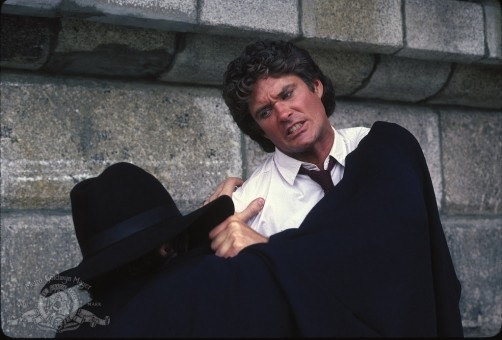
Only Detective Don Gregory (David “The Hoff” Hasselhoff) thinks that Jack the Ripper has returned to life.  His captain (Clu Gulager) doesn’t believe him.  The sleazy city councilamn (Lane Smith) doesn’t believe him.  His potential girlfriend, Angie (Stepfanie Kramer), has doubts about Don’s theory.  His own partner (Randolph Mantooth) doesn’t buy it.  Even Angie’s best friend, a librarian named Lynn (Adrienne Barbeau), doesn’t think that there’s any connection between Jack the Ripper and the handsome Englishman (Paul Rossilli) who has recently been stopping by the library and flirting with her.

And really, why would anyone believe Don?  His theory makes no sense, even if it does turn out to be true.  Indeed, Don is remarkably quick to accept the idea of Jack the Ripper traveling through time.  Of course, what also doesn’t make sense is the city council’s refusal to shut down the bridge until the killer’s been caught.  It’s the tourist season but seriously, it seems like a serial killer — whether he’s Jack the Ripper or not — would be bad for business!

This 1985 movie was made for television.  The premise is intriguing but the execution is a real let-down.  It’s a 90 minute film and the Hoff doesn’t really seem to get serious about trying to hunt down Jack the Ripper until 60 minutes in.  This is the odd Jack the Ripper film in which the Ripper is often treated as an afterthought.  Instead, the majority of the film is taken up with Don flirting with Angie and trying to come to terms with an accidental shooting that occurred when Don was a cop in Chicago.  The whole Jack the Ripper subplot is almost treated like a red herring, which is an odd way to treat a 19 century villain who can travel through time.  I mean, sometimes, romance has to wait until the time-traveling serial killer has been taken care of.  It’s all about priorities.

In the end, this one is for hardcore Hasselhoff fans only.  Those who want to watch a Jack the Ripper time traveling movie would be better served by watching Time After Time, featuring David Warner as the Ripper and Malcolm McDowell as H.G. Wells.

Disaster on the Coastliner (1980, directed by Richard C. Sarafian)


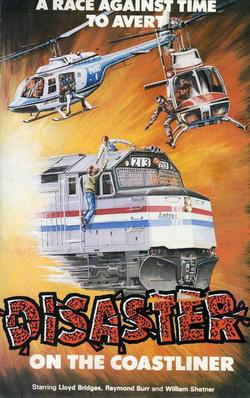
A completely computerized passenger train is traveling across the country, with the Vice President’s wife as one of the passengers.  When Jim Waterman (Paul L. Smith), a man who blames the railroad for the death of his family, manages to hijack the train he plans to ram into a locomotive until his demands a met.  He wants railroad president Estes Hill (Raymond Burr) to take responsibility for the crash that killed his wife and children.  With Waterman determined to crash the two trains, it falls to dispatchers Al Mitchell (Lloyd Bridges) and Roy Snyder (E.G. Marshall) to try to figure out a way to stop the collision.  Helping them out on the train is a con artist named Stuart Peters (William Shatner!) who may be wanted by the police but who is still willing to do whatever it takes to save his fellow passengers.

Disaster on the Coastliner is an above-average made-for-TV disaster movie.  Even though it was obviously made for a low-budget and that the majority of the money was probably spent on securing the B-list cast, there are enough shots of the train careening on the tracks to bring happiness to the hearts of most disaster movie fans.  The cast is full of the type of people who you would typically expect to find in a movie like this, people like Raymond Burr, Lloyd Bridges, and William Shatner.  Bridges, interestingly enough, gives the same performance here that he gave in Airplane! and when he starts ranting about how everything’s computerized, he sounds like he could be reciting dialogue from that film.  The only difference is that Airplane! was a comedy while Disaster On The Coastliner is meant to be a drama.  Raymond Burr also does a good job hamming it up as the president of the railroad.  He spends most of the movie sitting behind his desk and looking annoyed, which was pretty typical of Burr in the years after Perry Mason and Ironside. 

For a lot of people, the main appeal of this film will be seeing what William Shatner was doing in between Star Trek movies.  This is a typical early 80s Shatner performance, when he was still trying too hard to win that first Emmy but also when he had just starting to develop the self-awareness necessary to poke fun at his own image.  Shatner really digs into the role of a conman with a heart of gold.  He delivers his lines in his trademark overdramatic style but, in scenes like the one where he sheepishly discovers that a door that he’s been pounding on was unlocked all the time, Shatner actually seems to be in on the joke.  Shatner also did his own stunts in this film, including one where he had stand on top of a speeding train.  In his autobiography, Shatner wrote that he wasn’t even wearing a safety harness in the scene so give it up for Bill Shatner.  That took guts!

Fast-paced and agreeably unpretentious, Disaster On The Coastliner is an enjoyable runaway train movie.


Bubba’s Revenge: Dark Night of the Scarecrow (1981, directed by Frank De Felitta)


Dude, this movie.

Charles Durning plays Otis P. Hazelrigg, a postman in a small town who has an unhealthy interest in a ten year-old girl named Marylee (Tanya Crowe).  When Marylee is mauled and nearly killed by a dog, Otis decides that she was attacked by Bubba Ritter (Larry Drake), a mentally challenged man who has the mind of a child.  With Otis and his redneck friends looking to lynch him, Bubba’s mother disguises him as a scarecrow and tells him to stand out in a field and not move.  When Otis and his friends discover Bubba hiding, they all shoot him until he’s dead.  Otis puts a pitchfork in Bubba’s hands and tells the police that Bubba was attacking them and they didn’t have any choice but to shoot him.

Otis thinks that he’s gotten away with murder but he’s wrong.  After Marylee sings a song in the same field where Bubba was killed, Otis’s friends start dying.  One is suffocated in a grain silo.  Another falls into a thresher.  Before each one dies, they report seeing a scarecrow on their property.  Otis thinks that Bubba’s mother is behind the murders but what if Bubba has actually come back to life?

Dark Night of the Scarecrow will mess up your mind, give you bad dreams, and leave you with a lifelong phobia o scarecrows.  It’s that scary.  I remember that they used to frequently show this movie on TV when I was  growing up and even the commercials were scary.  (The part of the movie that always messed with me were the shots of Bubba’s frightened eyes darting around underneath the scarecrow mask.)  Scarecrows are naturally creepy and the movie’s atmosphere is unsettling but the most frightening thing about Dark Night of the Scarecrow is Otis and the redneck lynch mob that he puts together.  Otis is a thoroughly loathsome character and Charles Durning goes all out playing him.  Otis is a civil servant, which gives him some prestige in the town but he uses that prestige to bully Bubba and harass Marylee.  His concern with Marylee especially feels wrong and the movie does not shy away from the subtext of his interest.  The scarecrow might frighten you but you will absolutely loathe Otis and everyone who follows him.

Dark Night of the Scarecrow was made for television but it’s just as good as any theatrical release.   It is also might be the first movie to feature a killer scarecrow.  Several have been made in the years since but Dark Night of the Scarecrow was the first and it’s still the best.

A Movie A Day #270: Prison (1987, directed by Renny Harlin)


In 1964, the state of Wyoming executed Charles Forsythe (Viggo Mortensen) for killing another inmate at Creedmore State Prison.  Forsythe was innocent of the crime but the only other two people who knew, a prisoner named Cresus (Lincoln Kilpatrick) and a guard named Eaton Sharpe (Lane Smith), kept silent.  Twenty-three years later, Cresus is still an inmate and Sharpe has been named the new warden of Creedmore.  When a group of prisoner open up the old execution chamber, Forsythe’s electrified spirit escapes into the prison and starts to kill the prisoners and the guards, one-by-one.  A convict named Burke (also played by Mortensen) understands what is going on but can he get anyone to believe him?
If the idea of an executed murderer turning into an electrified spirit sounds familiar, that’s because the exact same idea was used in Destroyer, The Horror Show, and Wes Craven’s Shocker, all of which went into production and were released at roughly the same time.  Why did the late 80s see so many director making movies about convicts coming back to life after being sent to the electric chair?  We may never know.

Of the four electric ghosts movies, Prison is the best.  Lane Smith is a great villain and Prison makes good use of its claustrophobic setting.  Since Charlie is stalking inmates instead of horny teenagers, there literally is no way for anyone to escape him.  (It never makes sense, though, why Charlie is killing “innocent” prisoners when Sharpe, who hates all of this prisoners, is the one that Charlie is targeting for revenge.)  The best scenes are the ones where the warden desperately tries to force the inmates to confess to the murders so he won’t have to confront the truth about Charlie’s revenge.  Lane Smith, who would later be best known for playing Richard Nixon in The Final Days, acts the hell out of those scenes.

Prison was the first American film to be directed by Finnish director Renny Harlin and it is a hundred times better than many of the overproduced action films that Harlin would later be best known for.  Of course, it’s no Die Hard 2 but I would gladly watch Prison over Cutthroat Island.

A Movie A Day #234: The Final Days (1989, directed by Richard Pearce)


Since yesterday’s entry in movie a day featured Philip Baker Hall playing Richard Nixon in Secret Honor, I decided to use today’s entry to talk about a movie that featured Lane Smith in the same role.
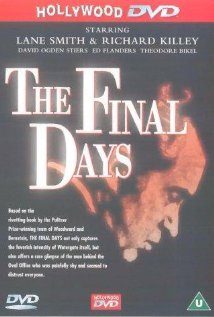
Based on Bob Woodward and Carl Bernstein’s follow-up to All The President’s Men, The Final Days is about the final months of the Nixon presidency.  The movie begins shortly after the resignations of Nixon aides John Ehrlichman and H.R. Haldeman and follows Nixon (Lane Smith) as he grows increasingly more isolated and reclusive in the White House.  All the familiar moments are here, Nixon ranting against the Kennedys and the establishment, Kennedy talking about his difficult childhood, and, most famously, Nixon asking Henry Kissinger (Theodore Bikel) to pray with him on the night before his resignation.  The Final Days also focuses on the ambitious men who surrounded Nixon during his downfall and who helped to engineer his eventual resignation, especially Al Haig (David Ogden Stiers).

A lot of very good actors have played Richard Nixon.  Anthony Hopkins and Frank Langella both received Oscar nominations for playing him and Philip Baker Hall probably should have.  Rip Torn, John Cusack, Kevin Spacey, Dan Hedaya, and Bob Gunton have all taken a shot at the role.  But, in my opinion, no one has done a better job as the 37th president than Lane Smith, who bore about as close a resemblance to Nixon as anyone could without a prosthetic nose.  Even more than Anthony Hopkins did in Oliver Stone’s Nixon, Lane Smith captured not only Nixon’s insecurity and paranoia but also his provides hints of the great leader that Nixon could have been if not for his own self-destructiveness.


A Movie A Day #153: Blue Collar (1978, directed by Paul Schrader)


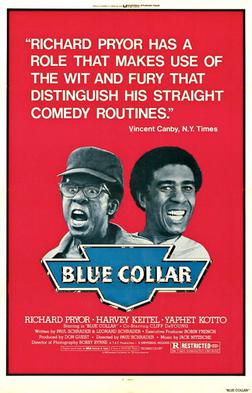
Three Detroit auto workers (played by Harvey Keitel, Yaphet Kotto, and Richard Pryor) are fed up.
It’s not just that management is constantly overworking them and trying to cheat them out of their money.  That’s what management does, after all.  What really upsets them is that their union is not doing anything to help.  While the head of the union is getting rich off of their dues and spending time at the White House, Keitel is struggling to pay for his daughter’s braces, Kotto is in debt to a loan shark, and Pryor is lying to the IRS about the number of children that he has.  (When a social worker shows up unexpectedly, Pryor’s wife recruits neighborhood children to pretend to be their’s.)  Kotto, Pryor, and Keitel plot to rob the union but instead, they just discover evidence of the union’s ties to the mob.  The union bosses will do anything to keep that information from being revealed, from trying to turn the friends against one another to committing murder.

Blue Collar was the directorial debut of screenwriter Paul Schrader.  Schrader has said that the three main cast members did not get along during the filming, with Richard Pryor apparently bringing a gun to the set and announcing that there was no way he was going to do more than three takes of any scene.  The tension between the lead actors is visible in the film, with all three of them giving edgy and angry performances.  That anger is appropriate because Blue Collar is one of the few films to try to honestly tackle what it’s like to be a member of the “working class” in America.  While management is presented as being a bunch of clowns, Blue Collar reserves its greatest fury for the corrupt union bosses who claim to represent the workers but who, instead, are just exploiting them.  The characters in Blue Collar are pissed off because they know that nobody’s got their back.  To both management and the union, the workers are worth less than the cars that they spend all day putting together and the money that can be subtracted from all their already meager pay checks.

Since it’s a Paul Schrader film from 1978, the action in Blue Collar does come to a halt, 40 minutes in, for a cocaine-fueled orgy that feels out of place.  While Keitel and especially Kotto give believable performances, Pryor sometimes seems to be struggling to keep up.  Still, flaws and all, Blue Collar has a raw and authentic feel to it, something that few other movies about the working class have been able to capture.  Perhaps because it never sentimentalizes its characters or their situation, Blue Collar was not a box office success but it has stood the test of time better than many of the other films that were released that same year.  Sadly overlooked, Blue Collar is a classic American movie.


The TSL’s Grindhouse: Night Game (dir by Peter Masterson)


Apparently, today is the opening day of the 2017 baseball season.  The only reason that I know that is because of my sister Erin.  I don’t know much about baseball, to be honest.  I know that my city’s team is the Texas Rangers and they were once owned by George W. Bush.  I know that Houston has a team called the Astros.  But, really, the main thing that I know about baseball is that my sister absolutely loves it.

So, when Erin asked me to review a baseball movie today, how could I say no?  I mean, I may know next to nothing about baseball but I certainly know something about movies!

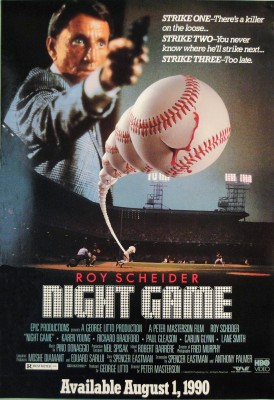
For that reason, I’m going to take a few minutes to tell you about a 1989 film called Night Game.  Night Game is many things.  It’s a movies that features a lot of baseball, even though it’s not really a sports film per se.  It’s a police procedural, though the film itself suggests that the police often don’t have the slightest idea what they’re actually doing.  It’s a serial killer film, though its killer is never quite as loquacious as we’ve come to expect in this age of Hannibal Lecter and Dexter Morgan.  At times, it’s a slasher film, though it’s never particularly graphic.  Mostly, Night Game is a Texas film.

Directed by native Texan Peter Masterson, Night Game is like the original Texas Chainsaw Massacre in that it is one of those rare films that not only takes place in Texas but was actually filmed on location.  To be exact, Night Game was filmed in both Galveston and Houston.  The entire film has a friendly and quirky Texas feel to it.  Masterson may not have been a great visual director (If not for some language and nudity, Night Game could pass for a TV movie) but Night Game is a movie where the plot is less important than capturing the little details of a time. a location, and the people who lived there.  Though Night Game is 28 years old, it’s portrait of my home state still seemed very contemporary to me.  I guess Texas hasn’t really changed that much over the past few decades.

As for the film’s plot, someone is murdering young women in Galveston and leaving their bodies on the boardwalk.  Obviously, that’s not going to be good for attracting Spring Break revelers.  The film doesn’t make any effort to keep the murderer’s identity a secret.  We see his face fairly early on.  We also see that he has a hook for a hand.  Eventually, we do learn the murderer’s motives.  They’re pretty silly but then again, individual motives rarely make sense to anyone other than the guy with the hook for a hand.

Detective Mike Seaver (Roy Scheider) has been assigned to solve the case.  One thing that I really liked about Night Game was that Mike was pretty much just a normal guy with a job to do.  He wasn’t self-destructive.  He wasn’t always drunk.  He wasn’t suicidal.  He wasn’t always lighting a cigarette and staring at the world through bloodshot eyes while the lighting reflected off of his artful stubble.  He was just a detective trying to do his job and get home on time.  After sitting through countless films about self-destructive cops and criminal profilers, the normalcy of Mike was a nice change of pace.

Mike does have a backstory.  He used to play baseball and he still loves the game.  He goes to every Astros home game in Houston.  He’s in love with Roxy (Karen Young), who works at the stadium.  Things are only slightly complicated by the fact that Mike had a previous relationship with Roxy’s mother (Carlin Glynn).  Don’t worry, Mike’s not secretly Roxy’s father or anything like that.  It’s not that type of movie.

Anyway, Mike is such a fan of baseball that he realizes something.  The killer only strikes on nights that the Astros win a game.  And he only strikes if a certain pitcher was throwing the ball.  The obvious solution would be to shoot the pitcher in the arm and end his athletic career.  However, Mike’s too nice a guy to do that.  Instead, he just tries to track down the killer…

And, as I said, Night Game actually isn’t a bad little movie.  Make no mistake, it’s a very slight movie.  At no point are you going to say, “I’m going to remember that scene for the rest of my life!”  That said, it’s a surprisingly good-natured film and Roy Scheider’s performance is likable and unexpectedly warm.  With all that in mind, Night Game is an entertaining and (mildly) bloody valentine to my home state.

Plus, it’s a baseball movie!  I don’t know much about baseball but, if my sister loves it, it has to be a good thing!