When renowned radio psychiatrist George Matlin (Charles Grodin) has a nervous breakdown, he takes a trip to Europe with his wife (Mary Gross) to both recover and also work on his marriage. (Matlin’s breakdown was the result of an extramarital affair.) Needing someone to host Dr. Matlin’s radio show, his producers call Dr. Lawrence Baird (David Clennon), who oversees a mental facility in Chicago. They assume that Dr. Baird is just dumb enough that they won’t have to worry about him overshadowing Dr. Matlin while he’s guest-hosting. However, when they call, Dr. Baird is out of his office and the phone is answered by John Burns (Dan Aykroyd), a con artist who has been pretending to be insane so that he can avoid serving time in prison. Pretending to be Baird, Burns accepts their offer and then escapes from the asylum and heads to Beverly Hills. The real Dr. Baird, not knowing about the offer, goes on vacation in Europe. Though Burns had originally only been planning on doing the radio job long enough to get paid enough money to head to Mexico, he soon becomes a celebrity with his non-nonsense, blunt advice.
There’s a lot of talented people in TheCouchTrip, including Walter Matthau as a former priest-turned-kleptomaniac and Aykryod’s wife, Donna Dixon, as Matlin’s colleague and Burns’s eventual love interest. Director Michael Ritchie was responsible for some of the best films of the 70s and radio psychiatry is certainly a ripe subject for satire. Why, then does, The Couch Trip fall flat? Some of it is because the movie never seems to know if it wants to be wacky farce or a dramedy about a criminal who finds a new life helping people. The other big problem is that the talented Dan Aykroyd is miscast as the type of unapologetic smartass that Bill Murray could play in his sleep. (In a version where Murray played John Burns, Aykroyd would have been perfect casting as George Matlin.)
Aykroyd was one of the most talented members of the original Not Ready For Prime Time Players. (His impersonations of Nixon and Jimmy Carter were second-to-none.) Sadly, Hollywood has never figured out what to do with his off-center talent. The Couch Trip is a prime example of that.
Welcome to Late Night Retro Television Reviews, a feature where we review some of our favorite and least favorite shows of the past! On Thursdays, I will be reviewing Highway to Heaven, which aired on NBC from 1984 to 1989. The entire show is currently streaming on Tubi and several other services!
This week, a conman seeks refuge in a church.
Episode 3.14 “All that Glitters”
(Dir by Michael Landon, originally aired on January 7th, 1987)
There’s a fire raging in the city and elderly homeowners are being forced to evacuate. “Father” Jonathan and “Father” Mark open up an abandoned church so that the people have some place to stay while the fires are burning. Good for them and also good for this show for finally acknowledging Catholicism.
Also hiding out in the church and disguised as a priest is Charley Trapola (John Pleshette), a con artist who, despite his criminal profession, actually has a good heart. Charley has a briefcase with him, one that is full of money. A group of criminals want the briefcase back but, at least initially, they know better than to try anything in the church. Instead, they decide to wait for Charley to come out. Inside the church, Charley gets to know Wanda (Didi Conn), a shy but kind-hearted woman who goes to Confession every day.
This episode was okay. Usually, when Jonathan and Mark go undercover as clergyman, they’re portrayed as being wishy-washy Episcopalians or vaguely liberal Methodists so I was happy that they were Catholic for this episode. John Pleshette and Didi Conn were both well-cast as this episode’s guest stars. They eventually made for a very sweet and likable couple. My main issue with this episode is that it tried to do a bit too much. Not only did we have Charley being chased by the gangsters but we also had Wanda dealing with her shyness and Mark and Jonathan dealing with the people were seeking shelter and looking for their loved ones. This episode — and not that weird marriage counseling episode — would have benefitted from an extra hour. As it was, it just felt a bit overstuffed. As well, this is another episode in which Jonathan reveals early on that he’s angel and, oddly enough, Charley has no hesitation about believing him. I always prefer the episodes where Jonathan doesn’t reveal who he really is. When Jonathan reveals that he’s an angel, it almost seems like cheating. The show is always more effective when people decide to open up their hearts on their own as opposed to doing so because they feel they’ve been ordered to.
There’s an odd scene where the three thugs break into the church and pull a gun on Jonathan. After Jonathan gives them fair warning about “the boss,” the main thug attempts to shoot Jonathan. Needless to say, the bullets don’t have any effect on an angel. However, a sudden blue lights fills the church and suddenly, the three men are apparently zapped out of existence. Jonathan later jokes that he’s not sure where the three men are but that they probably aren’t happy. So, did the three men go straight to Hell? Are they dead? I understand the logic behind the scene but it’s not really something you expect from a show where the main theme is usually that everyone has a chance for redemption.
Next week, Dick Van Dyke plays a homeless puppeteer …. uh oh. This sounds like it could a little bit cringey …. well, we’ll see.
As much as I enjoy writing about movies and talking about movies, I make a living by helping people with their annual income tax filings. That means from around January 15th through April 15th each year, almost every waking hour is spent focused on tax return preparation. While I’m working on these tax returns, I will often play movies or TV shows on one of my computer screens. These aren’t just any movies, though. These are movies or TV shows that make me feel good and help me relax while I’m working so many hours. Over the years, I’ve used movies like THE OTHER GUYS, THE HANGOVER, and ZOMBIELAND. A few years ago, THE ANDY GRIFFITH SHOW was on Prime, and I watched the entire 8 seasons through 3 times during tax season. One genre I hit hard this time of year is romantic films, both comedies and dramas. The main thing I’m looking for is happy endings. My favorite romantic films include NOTTING HILL, RETURN TO ME, HITCH, YOU’VE GOT MAIL, PERSUASION & SENSE AND SENSIBILITY. As a big fan of Nicolas Cage, IT COULD HAPPEN TO YOU, Cage’s 1994 romantic comedy with Bridget Fonda has joined that list over the years as well. Since today, January 7th, 2025, is Nicolas Cage’s 61st birthday, and tax season is coming, I thought I’d write about this charming film!
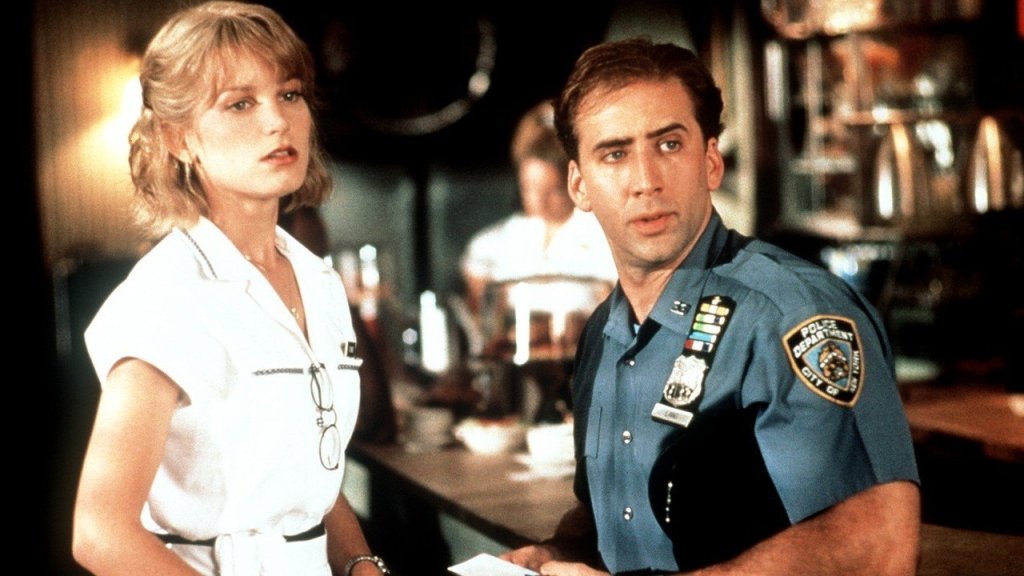
IT COULD HAPPEN TO YOU revolves around Charlie Lang (Nicolas Cage), a New York City cop who seems like an all-around good guy. One day he’s having coffee at a local diner with his partner Bo (Wendell Pierce), when they get a police call. Charlie finds himself without the money to give a proper tip to his waitress, Yvonne (Bridget Fonda), so he improvises on the spot and tells her he has a lottery ticket to be drawn on that very same night. Further, he goes on to tell her if he wins, he’ll split the winnings with her as a tip. The two cops head on out, Charlie happy that he gave her something, and Yvonne, who’s not having a good day anyway, just shakes it off knowing that it’s just another small tip she missed out on. But wouldn’t you know it, on this night the stars all align and Charlie’s number is drawn as a winner. Charlie and his wife Muriel (Rosie Perez) are ecstatic with their win, which amounts to around $4 million. In the middle of their celebration, Charlie remembers his promise to Yvonne and tells Muriel. To say she’s upset is an understatement, and she begs him to stiff the waitress. Charlie is just too honest for that, so he is able to convince Muriel that $2 Million is enough for them to live comfortably on. She begrudgingly agrees, but the fuse has been lit between Charlie and Muriel. The next day, Charlie goes back to the diner and tells Yvonne that they won. At first not believing it’s true, Charlie is able to convince Yvonne that he’s honoring his tip by giving her half of the winnings. We have found out that Yvonne is having severe financial problems, and this “tip” comes as a completely unexpected answer to her prayers. Alls well that ends well, right? As we all know, money can bring out the very best or the very worst in people and we see that play out throughout the rest of the movie. I’ll just put it this way, as Charlie and Muriel grow apart with their newfound money, Charlie and Yvonne grow closer together, bound by this amazing experience.
It’s all a pretty crazy setup, but IT COULD HAPPEN TO YOU is a movie that I relate to idealistically. I really like Cage and Fonda in their roles. I’d love to be as honest and likable as Nicolas Cage’s character Charlie Lang. He is just a good guy, way down deep. I want to be that kind of guy. And Bridget Fonda’s character Yvonne is also very appealing. She’s presented as a lady going through a lot of personal issues, but who somehow seems to always show a kind and compassionate spirit to everyone around her, especially to others who are struggling. The scene where Charlie convinces her that he really is giving her half the money is quite an uplifting scene. Both of these characters have an honesty and attitude about life that resonates with me. Some people might argue that their characters should have more depth to make them more realistic and less one-dimensional, and they might be right, but I personally enjoy seeing them as just really honest and kind people.
It should also be pointed out that you have to be able suspend your disbelief to enjoy IT COULD HAPPEN TO YOU. If your movies “have” to be realistic, this is not the movie for you. The entire premise is a fairytale, and the movie should be seen as such. For the movie to work, the good guys have to be really good guys, and the bad guys have to be really bad guys. I’ve mentioned earlier how kind both Charlie and Yvonne are throughout the film, with the money not changing their attitudes about life in any way. If anything, the money allows them to be even more kind and generous to others. Well, money has had the exact opposite effect on Muriel, and we soon learn that $2 Million isn’t enough for her and that the full $4 Million would not have been enough either. At this point, I’m not sure $100 Million would have been enough. In our fairytale story, she can’t be presented as a lady realistically struggling with her husband’s overly generous tip, she has to be presented as extremely selfish and cruel. I mean, how else is the story going to get Charlie and Yvonne together?!
All in all, IT COULD HAPPEN TO YOU works for me. I’ve said many times I’m a sucker for a good romance, and this film fits the bill for me. The main characters warm my heart as they are decent, kind and honest. I like a good fairytale. It’s one of the main reasons I enjoy the movies, and it doesn’t seem like we get enough good fairytales these days.
Check out the trailer for IT COULD HAPPEN TO YOU below!
And if you’re looking for more awesome information about Nicolas Cage, check out John Rieber’s latest post where he celebrates Cage’s birthday with a movie marathon!
It made me sad when I saw that writer/director Jim Abrahams had passed away on November 26, 2024 at 80 years of age. Growing up in the 1980’s, Mr. Abrahams is responsible for some of my favorite comedies. AIRPLANE, TOP SECRET, and THE NAKED GUN would not exist without Jim Abrahams. As much as I love all of those movies, my personal favorite film that Jim Abrahams co-directed is RUTHLESS PEOPLE. I remember when our family rented this film and watched it in the ‘80’s. We thought it was so funny. I specifically remember my mom laughing out loud on multiple occasions as the ridiculous scenario played out. That was a fun movie night in the Crain household.
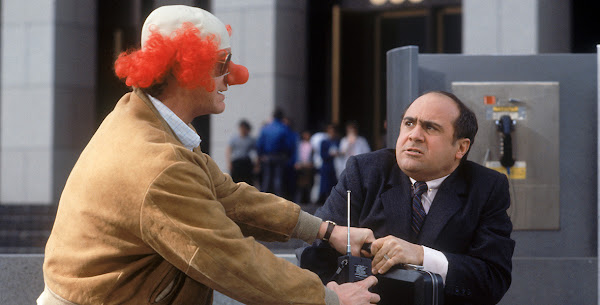
RUTHLESS PEOPLE is about a rich businessman named Sam Stone (Danny DeVito) who truly hates his wife Barbara (Bette Midler), and hatches a plan to kill her so he can inherit her money. Unfortunately he runs into a couple of problems. First, his mistress Carol (Anita Morris) knows about the plan, so she and her dimwitted boy toy Earl (Bill Pullman) want to film Sam dumping his wife’s body so they can blackmail him for millions. Second, before Sam can execute his plan, Barbara is kidnapped and held for a ransom of $500,000 by Ken and Sandy Kressler (Judge Reinhold and Helen Slater). It seems that Sam stole Sandy’s idea for the spandex miniskirt, screwed them out of millions with a handshake deal, and then kept the money for himself. This seems like an answer to prayer at first for Sam because they threaten to kill Barbara if he doesn’t meet their needs or if he calls the police or the media. After saying no to their demands, and then immediately calling the police and the news, Sam realizes that they don’t want to kill her when they keep coming back with lower demands. Sandy tells Barbara that Sam refuses to pay even $10,000 for her safe return. Eventually the kidnappers and Barbara join together to try to take the unfaithful and unethical Sam for everything he’s worth!!
RUTHLESS PEOPLE is one of my favorite comedies of the 1980’s. It has such a great cast. Danny DeVito and Bill Pullman are especially hilarious and have some of the film’s best lines. At the time the movie came out in 1986, DeVito was already established as a master of comedy, so Pullman’s performance as Earl, the dumbass Sonny Crockett wannabe, was the real revelation to me. Pullman made his film debut in RUTHLESS PEOPLE, and I never see him to this day that I don’t think of his character Earl’s excitement over the prospect of his newfound blackmail money:
“And then we’re off, to Haiti!”
“It’s Tahiti, you moron!”
One of the most interesting things about RUTHLESS PEOPLE is just how different it is from the directing trio’s (Zucker / Abrahams / Zucker) other popular films like THE KENTUCKY FRIED MOVIE and AIRPLANE. Those films are based on non-stop visual and verbal gags. I love those films, but this is quite different. The comedy of RUTHLESS PEOPLE is based on the story itself, which is a comedy of confusion, coincidence, and character. I know it’s awesome because I still think of the film often. “Give the bag to bozo” and “a little poke in the whiskers” are phrases I’ll remember up to the point I go to my grave.
Even though the film is almost 40 years old, if you’re looking for a laugh, I don’t think you can do much better than RUTHLESS PEOPLE.
As seen in the 1993 made-for-TV movie Casualties of Love, Joey is a saintly, salt-of-the-Earth blue collar guy who works as an auto mechanic on Long Island. He’s also an aspiring drummer, one who struggles with a major cocaine addiction. When his loving wife, Mary Jo (Phyllis Lyons), threatens to leave him and take the kids unless he cleans up his act, Joey checks into rehab. Six months later, he leaves rehab clean and sober and dedicated to his family. All of the other patients lean out of their windows and wish Joey well. Everyone loves Joey!
Joey, the most handsome and sweetest auto mechanic in the state of New York, does have a problem, though. A sociopathic teenager named Amy Fisher (Alyssa Milano) has grown obsessed with him and keeps intentionally damaging her car so that she can come hang out at the garage. When the other mechanics say that Amy is hot, Joey agrees but that’s all he does. Joey loves his wife. When Amy tries to kiss him at a carnival, he shoves her away and then kisses his wife to make sure that everyone understand that Joey Buttafuoco is the best guy ever. When Amy accuses Joey of giving her a STD, everyone realizes she’s lying because Joey would never have an STD in the first place.
And when Amy shoots Mary Jo in the face, the media and the police try to make it seem like Joey is somehow to blame but again, we know that he’s not. Joey Buttafuoco is a name that means honor and respect.
Uhmm …. yeah.
So, this is story is very loosely based on a true story and by that, I mean that there was a teenager named Amy Fisher who shot a woman named Mary Jo in the face and later said that she was having an affair with her husband, Joey. Apparently, there were three made-for-TV movies made about the case, all of which premiered in the same month. Casualties of Love is told from the point of view of Joey and Mary Jo and it fully supports Joey’s initial claim that he never slept with Amy and she was just some obsessed psycho.
While watching this film, I got bored enough to look up the case on Wikipedia and I learned that, after this movie aired, Joey admitted that he did have an affair with 16 year-old Amy Fisher and he subsequently went to jail for statutory rape. After getting out of jail, Joey divorced his wife and has subsequently been in and out of trouble with the law. He also become a regular on TV court shows, where he would sue people who failed to pay him for fixing their cars. My point is, Joey Buttafuoco sounds like a bit of a sleaze in real life. That makes this film’s portrayal of him as being some sort of Saint of Long Island feel rather dumb.
Actually, it would feel dumb even if the real Joey Buttafuoco was a solid citizen. Casualties of Love is one of the silliest films that I’ve ever seen, portraying Joey as being a streetwise former cocaine addict who was somehow too naive to realize that it would look bad to spend time in his office alone with Amy. As Joey, Jack Scalia is very handsome and very sincere and he feels totally miscast as someone who spends hours working underneath the hood of other people’s cars. Leo Rossi and Lawrence Tierney both show up, mostly so they can say, “Oh, what were you thinking!?” to Joey. As Amy Fisher, Alyssa Milano gives an amazingly lifeless performance. Occasionally she talk fast and plays with her hair. This is the film’s way of letting us know that she’s supposed to be unhinged. I mean, I do the same thing. If you’ve got long hair, you’re going to play with it whenever you got bored. It doesn’t make you crazy.
Unfortunately, though the film may be silly, it’s not much fun. The direction is workmanlike and the film’s portrayal of Joey and Mary Jo’s marriage is so earnestly bland that the film never even rises to the level of camp. The film ends with a warning that Amy would soon be eligible for parole. (Oddly, it also points out that Amy could take college courses in jail, as if that was a bad thing.) Meanwhile, “Mary Jo is taking it one day at a time.” Fortunately, Mary Jo eventually took herself out of Joey’s life and filed for divorce. That’s the happy ending this film lacks.
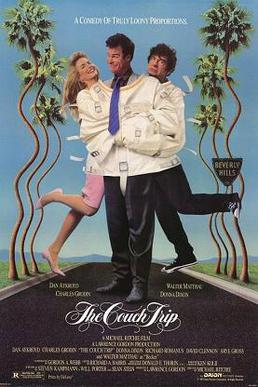 When renowned radio psychiatrist George Matlin (Charles Grodin) has a nervous breakdown, he takes a trip to Europe with his wife (Mary Gross) to both recover and also work on his marriage. (Matlin’s breakdown was the result of an extramarital affair.) Needing someone to host Dr. Matlin’s radio show, his producers call Dr. Lawrence Baird (David Clennon), who oversees a mental facility in Chicago. They assume that Dr. Baird is just dumb enough that they won’t have to worry about him overshadowing Dr. Matlin while he’s guest-hosting. However, when they call, Dr. Baird is out of his office and the phone is answered by John Burns (Dan Aykroyd), a con artist who has been pretending to be insane so that he can avoid serving time in prison. Pretending to be Baird, Burns accepts their offer and then escapes from the asylum and heads to Beverly Hills. The real Dr. Baird, not knowing about the offer, goes on vacation in Europe. Though Burns had originally only been planning on doing the radio job long enough to get paid enough money to head to Mexico, he soon becomes a celebrity with his non-nonsense, blunt advice.

 Through the Shattered Lens