Playing Catch-Up With The Films of 2017: Marshall (dir by Reginald Hudlin)


So, here I am.  January is nearly over.  The Oscar nominations have already been announced.  2018 is well under way and yet, I still have 158 films on the DVR that I need to watch and a few 2017 releases that I still need to catch up on.  At this point, I’ve accepted that I’ll probably never truly be “caught up” when it comes to watching movies.  But, that’s okay.  I love movies too much to ever regret having an excuse to watch more.

On Wednesday night, I watched Marshall, which came out last October.  A film about the early life of civil rights activist and future Supreme Court justice Thurgood Marshall, Marshall seemed like a movie that would perfectly capitalize on the current political atmosphere.  The film starred Josh Gad and Chadwick Boseman and a lot of people — including me — assumed that the excitement over Boseman as Black Panther would also translate into excitement over a chance to see him in this film.  (For that matter, Josh Gad has also recently been proving himself to be a far better actor than I originally believed him to be.  Never again will I refer to Gad as being the poor man’s Jonah Hill.)  The film’s reviews were respectable.  Quite a few sites, including this one, listed Marshall as being a potential Oscar nominee.

And yet, when the movie was released, it fell flat at the box office.  On the week of its release, it finished in 11th place.  I guess there’s a lot of reasons for that.  Personally, I think it would have done better if the film had been released in November or December.  In a month that is traditionally dominated by horror movies and the last gasps of a few summer blockbusters, Marshall seemed somewhat out-of-place.  Perhaps Marshall would have stood a better chance if it had been given a limited release in December, with a big awards push for Chadwick Boseman.  Who knows?  As it is, it ended up losing money and it only received one Oscar nomination, for best original song.

Having now watched Marshall, I can say it’s a good movie, though perhaps never quite as good as you want it to be.  It takes place in 1940.  After making a name for himself defending blacks in the South, attorney Thurgood Marshall travels to Connecticut to defend a black chauffeur (Sterling K. Brown) who has been accused of raping a white woman (Kate Hudson).  It soon becomes obvious that Northern justice is just as corrupted by bigotry as Southern justice.  A racist judge (James Cromwell) rules that Marshall will not be allowed to even speak in court.  Marshall ends up advising the chauffeur’s attorney, an insurance lawyer named Sam Friedman (Josh Gad).  All of Sam’s friends expect him to just make a deal with the smug prosecutor (Dan Stevens) and move on.  However, Sam believe his client to be not guilty and, with Marshall’s help, is determined to win an acquittal.

Director Reginald Hudlin never seems to be quite what type of movie he’s trying to make.  Sometimes, the film feels like a reverent biopic.  Other time, it’s an old-fashioned courtroom drama, complete with different flashbacks depending on who is doing the testifying.  And then other times, Marshall is an extremely stylish film that almost turns Thurgood Marshall into a comic book super hero.  Fortunately, Chadwick Boseman is such a talented and charismatic actor that he holds all of the disparate elements of the film together.  Not only does Boseman bring intelligence and righteous anger to the role, he also brings a sense of fun.  As played by Boseman, Marshall isn’t just outsmarting a prejudiced system and putting racists in their place.  He’s also having a good time while he’s doing it.  Boseman is a lot of fun to watch and he gets good support from Josh Gad and Sterling K. Brown.

Marshall may not be a perfect film but Chadwick Boseman is always watchable.  The excitement over Black Panther has proven that Boseman is a star but Marshall shows that he’s a pretty good actor as well.

Film Review: Maze Runner: The Death Cure (dir by Wes Ball)


Here are a few good things about Maze Runner: The Death Cure.

First off, and most importantly, Dylan O’Brien is still alive.  When The Death Cure first went into production way back in 2016, O’Brien was seriously injured on the set.  While it’s never really been disclosed just how serious the injuries were, they were bad enough that it took O’Brien several months to recover.  There was even some speculation that his career might be over.  Fortunately, that wasn’t the case.  Last year, O’Brien returned to the screen and gave a superior performance as the lead in American Assassin.  In The Death Cure, O’Brien returns as Thomas and even if the character is still a bit of cipher, O’Brien does a good job playing him.

Secondly, Gally lives!  In the first Maze Runner, Gally was a villain but, because he was played by Will Poulter, he was also strangely likable.  Maze Runner was the first film in which I ever noticed Will Poulter and I have to admit that I’ve always felt that both the actor and the character deserved better than to be casually killed off at the end of the first movie.  Since Maze Runner, Poulter has given great performances in both The Revenant and Detroit.  (He was also briefly cast as Pennywise in It, though the role was ultimately played by Bill Skarsgard.)  In The Death Cure, it is not only revealed that Gally is still alive but he also finally gets to be one of the good guys.

Third, the Death Cure confirms what I felt when I first saw The Maze Runner.  Wes Ball is a talented director.  Despite whatever narrative flaws that the Maze Runner films may have, they’re always watchable.  Death Cure opens with a genuinely exciting action sequence and there are more than a few visually striking shots.

Fourth, Death Cure actually ends the Maze Runner saga.  That may sound like a strange or back-handed compliment but it’s not.  Death Cure resists the temptation to try to milk more money out of the franchise by unnecessarily splitting the finale in two.  I’ve always felt that The Hunger Games made a huge mistake with its two-part finale.  (The first part was good but the second part dragged.)  Divergent appears to be destined to be forever unfinished because the first part of it’s two-part finale bombed at the box office.  Death Cure refuses to indulge in any of that nonsense.  Unfortunately, this also means that Death Cure ends up lasting an unwieldy 142 minutes but still, that’s better than forcing the film into two parts.  With the current YA dysptopia cycle winding down, now is the right time to end things.

Finally, I appreciated the fact that the bad guys in Death Cure were named WCKD.  There’s nothing subtle about that but this isn’t a movie the demands subtlety.  As opposed to many other films based on dystopian YA fiction, The Maze Runner films have always been aware of just how ludicrous they often are.  Unlike the Divergent films or The Fifth Wave, the Maze Runner films have always been smart enough not to take themselves too seriously.

Anyway, as for Death Cure itself, it’s big and noisy and your enjoyment will largely depend on how much you remember about the first two films.  It’s been nearly three years since The Scorch Trials came out, which is an eternity when it comes to a franchise like Maze Runner.  Death Cure pretty much jumps right into the action and if you don’t remember all of the details from the first two films … well, good luck getting caught up!  (Unfortunately, it doesn’t help that, while the first movie was fun, Scorch Trials was a lot easier to forget.)  It’s pretty much a typical tale of YA dystopia, complete with tragic deaths, shocking betrayal, and a chosen one.  If you’re a fan of the previous two films or the books, you’ll probably enjoy Death Cure.  For the rest of us, it’s a bit of a confusing ride but at least there’s a lot of up-and-coming talent on display.

Film Review: Pride and Prejudice (dir by Robert Z. Leonard)


On this date, in 1813, Jane Austen’s Pride and Prejudice was first published.  The book was published Thomas Egerton, who bought the rights for £110.  Apparently, Austen didn’t expect the book to become the success that it did.  As a result, she ultimately only made  £140 off of the book.  (Egerton made considerably more.)  When the book was originally published, Austen’s name was nowhere to be found on the manuscript.  Instead, it was credited to “the author of Sense and Sensibility.”

(When Sense and Sensibility was originally released, it was simply credited to “A Lady.”)

The rest, of course, is history.  205 years after it was first published, Pride and Prejudice remains one of the most popular and influential novels ever written.  Every year, new readers discover and fall in love with the story of outspoken Elizabeth Bennet, the proud Mr. Darcy, the pompous Mr. Collins, and the rather sleazy George Wickham.  There have been countless film and television adaptations.  My personal favorite is Joe Wright’s 2005 version, with Keira Knightley as Elizabeth.  My least favorite would have to be Pride and Prejudice and Zombies.

The very first film adaptation of Pride and Prejudice was released in 1940.  Originally, the movie was envisioned as being a George Cukor film that would star Norma Shearer and Clark Gable.  However, the film’s production was put on hold after the death of Shearer’s husband, the legendary Irving Thalberg.  When the film finally resumed pre-production in 1939, Gable was now busy with Gone With The Wind.  Cast in his place was Robert Donat (who, interestingly enough, would have played Rhett Butler if Gable had refused the role).  With the film originally meant to be filmed in Europe, the outbreak of World War II led to yet another delay.  By the time production resumed, Cukor had been replaced by Robert Z. Leonard and Norma Shearer had also left the project.  With Gone With The Wind breaking box office records, MGM came up with the idea of once again casting Vivien Leigh opposite of Clark Gable.  However, Gable eventually left the film and Laurence Olivier, looking for a chance to act opposite Leigh, agreed to play Darcy.  However, the studio worried that casting Olivier and Leigh opposite each other would lead to negative stories about the two of them having an affair despite both being married to other people.  So, Leigh was removed from the project and Greer Garson was cast.  Olivier was so annoyed with the decision that, after Pride and Prejudice, it would be eleven years before he would work with another American studio.

Despite all of the drama behind-the-scenes, MGM’s version of Pride and Prejudice is a thoroughly delightful film, one full of charming performances and witty lines.  Though she was 36 when she made Pride and Prejudice, Garson is still the perfect Elizabeth, giving a lively and intelligent performance that stands in stark contrast to the somewhat staid films that she was making at the same time with Walter Pidgeon.  As for Olivier, from the first minute he appears, he simply is Darcy.  That said, my favorite performance in the film was Edmund Gwenn’s.  Cast as Mr. Bennet,  Gwenn brought the same warmth and gentle humor to the role that he would later bring to Kris Kringle in Miracle on 34th Street.  I also liked the performances of Maureen O’Sullivan as Jane and Edward Ashley as disreputable Mr. Wickham.

Pride and Prejudice is not an exact adaptation.  For one thing, the movie takes place in the early Victoria era, supposedly because MGM wanted to cut costs by reusing some of the same costumes that were previously used in Gone With The Wind.  As well, Lady Catherine (Edna May Oliver) is no longer as evil as she was in the novel.  Finally, because the production code forbid ridicule of religion, the theological career of Mr. Collins (Melville Cooper) was considerably downplayed.  Not even Jane Austen (or, more specifically, the film’s screenwriter, Aldous Huxley) could defy the Code.

Seventy-eight years after it was first released, the 1940 version of Pride and Prejudice holds up surprisingly well.  It’s an enjoyable film and one that, despite a few plot changes, remains true to the spirit of Austen.

4 Shots From 4 Films: The Creation of the Humanoids, Award Presentation to Andy Warhol, Vinyl, Basquiat


4 Shots from 4 Films is just what it says it is, 4 shots from 4 of our favorite films. As opposed to the reviews and recaps that we usually post, 4 Shots from 4 Films lets the visuals do the talking!

Happy Pop Art Day!

4 Shot From 4 Films

The Creation of the Humanoids (1962, dir by Wesley Barry)

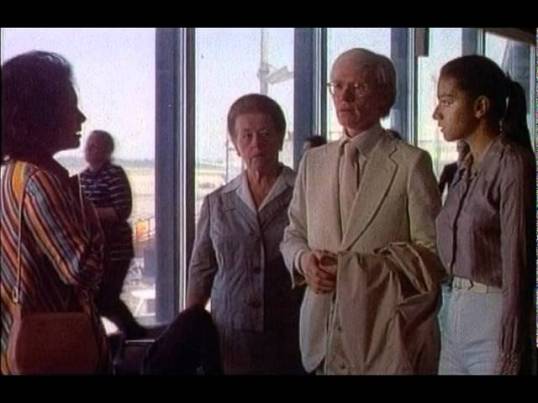
Award Presentation to Andy Warhol (1964, dir by Jonas Mekas)

Vinyl (1965, dir by Andy Warhol)

Basquiat (1996, dir by Julian Schnabel)


A Blast From The Past: You Are The One (dir by Andy Warhol)


Pop artist Andy Warhol wasn’t just a painter and a celebrity.  He was also a filmmaker.

Below, you’ll find Warhol’s final film.  In 1985, using a type of early computer known as an Amiga, Warhol made a 2 and a half-minute movies called You Are The One.  It’s a strange little movie, one that features Marilyn Monroe and a disembodied voice repeating, “You are the one.”  It’s atmospheric and, when viewed under the right circumstances, kind of creepy.

This movie was believed to be lost until 2007, when it was found hidden away in Warhol’s studio.

Here is Andy Warhol’s final film:

Film Review: Empire (dir by Andy Warhol and John Palmer)


“The Empire State Building is a star!” 

— Andy Warhol, reportedly on the night of filming Empire (1964)

On the night of July 24th, 1964, Andy Warhol, John Palmer, Jonas Mekas, Gerald Malanga, Marie Desert, and Henry Romeny gathered in an office on the 41st floor of the Time-Life Building in New York City.

As the sun went down, they pointed a camera out a window and at the Empire State Building, which was the tallest building in the world at that time.  As they filmed, the upper 30 floors of the building were lit up in honor of the opening of the 1964 World’s Fair.  Behind the Empire State Building, the beacon atop the Metropolitan Life Insurance Company tower blinked on and off.  Otherwise, the entire skyline was invisible in the night.

They started filming at 8:06 pm and stopped at 2:42 am.  Projected in slow motion (which was either per Warhol’s specifications or the result of an error on the part of the projectionist, depending on which source you read), the final film — entitled Empire — lasted for 8 hours and five minutes.  Originally, Warhol planned to have voices in the background but ultimately, Empire would be a silent film.  Three times you can very briefly spot the faces of Warhol and the crew reflected in the window of the office.  When the tower’s skylights were eventually switched off, Warhol filmed darkness.

Believe it or not, Empire is available, in its entirety, on YouTube.  I watched about two and a half uninterrupted hours of it, along with skipping to the brief glimpses of Warhol and to the film’s end.  Believe it or not, Empire does have a definite hypnotic power.  When you spend hours staring at the same image, you do start to become fascinated by things like a blinking beacon or the occasional bird flying by the Empire State Building.  (The film was so grainy that I assumed it was a bird.  It could have just as easily been a speck of dust.)  You find yourself thinking about what it would have been like to be in New York in 1964 and to see that one brilliantly lit tower rising high above the city.  The tower does take on a life of its own.

On that night in 1964, there was no bigger star in New York City than the Empire State Building.


Here’s What Won At The 2018 Sundance Film Festival!


Compared to previous years, the buzz around this year’s Sundance Film Festival has felt pretty subdued.  There haven’t been any headlines about any huge distribution deals.  I haven’t seen many articles declaring that “Next year’s Oscar race has already begun at Sundance!” this year.

That said, Sundance remains the first big event of the film year.  Even if the coverage was unusually subdued this year, it still appears that there were some intriguing films at this year’s festival.  Myself, I’m definitely planning on making the time to see Burden, Blaze, Lizzie, Colette, Eighth Grade, and The Tale.

On Saturday night, the following films won awards at the Sundance Film Festival:

U.S. DRAMATIC COMPETITION

Grand Jury Prize: “The Miseducation of Cameron Post”

Audience Award: “Burden”

Directing: Sara Colangelo, “The Kindergarten Teacher”

Waldo Salt Screenwriting Award: Christina Choe, “Nancy”

Special Jury Award for Outstanding First Feature: Reinaldo Marcus Green, “Monsters and Men”

Special Jury Award for Excellence in Filmmaking: “I Think We’re Alone Now”

Special Jury Award for Acting: Benjamin Dickey, “Blaze”

U.S. DOCUMENTARY COMPETITION

Grand Jury Prize: “Kailash”

Directing: Alexandria Bombach, “On Her Shoulders”

Audience Award: “The Sentence”

Special Jury Award for Social Impact: “Crime + Punishment”

Special Jury Award for Creative Vision: “Hale County This Morning, This Evening”

Special Jury Award for Breakthrough Filmmaking: “Minding the Gap”

Special Jury Award for Storytelling: “Three Identical Strangers”

WORLD CINEMA DRAMATIC COMPETITION

Grand Jury Prize: “Butterflies”

Audience Award: “The Guilty”

Directing Award: Ísold Uggadóttir, “And Breathe Normally”

Special Jury Award for Acting: Valeria Bertucecelli, “The Queen of Fear,”

Special Jury Award for Screenwriting: Julio Chavezmontes & Sebastián Hofmann, “Time Share”

Special Jury Award for Ensemble Acting: “Dead Pigs”

WORLD CINEMA DOCUMENTARY COMPETITION

Grand Jury Prize: “Of Fathers and Sons”

Audience Award: “This Is Home”

Directing Award: Sandi Tan, “Shirkers”

Special Jury Award: Steven Loveridge, “Matangi/Maya/M.I.A.”

Special Jury Award for Cinematography: Maxim Arbugaev, Peter Indergand “Genesis 2.0”

Special Jury Award for Editing: Maxim Pozdorovkin & Matvey Kulakov, “Our New President”

OTHER AWARDS

NEXT Audience Award: “Search”

NEXT Innovator Award: “Night Comes On” AND “We the Animals”

Alfred P. Sloan Feature Film Prize: “Search”

Sundance Institute NHK Award: Remi Weekes, “His House”

Sundance Institute/Amazon Studios Producers Awards: Katy Chevingy & Marilyn Ness (“Dark Money”) AND Sev Ohanian (“Search”)

Sundance Open Borders Fellowship Presented by Netflix: Talal Derki (“Of Fathers and Sons”) AND Chaitanya Tamhane AND Tatiana Huezo (“Night on Fire”)

Previous Sundance Film Reviews:

  1. Blood Simple
  2. I Don’t Feel At Home In This World Anymore
  3. Circle of Power
  4. Old Enough
  5. Blue Caprice
  6. The Big Sick
  7. Alpha Dog
  8. Stranger Than Paradise
  9. sex, lies, and videotape
  10. Reservoir Dogs

Film Review: Cherry 2000 (dir by Steve De Jarnatt)


Okay, so this one is kind of weird.

Remember how, a few nights ago, I watched and reviewed something called Prison Planet?  No?  Well, I don’t blame you.  I wish I could forget about it too.  Anyway, the movie that aired right before Prison Planet was yet another futuristic tale that was largely set in a desert wasteland.  This movie was originally released in 1988 and the title was Cherry 2000.

Cherry 2000 takes place in 2017, or perhaps I should say that it takes place in 2017 as imagined by someone in 1988.  In this film’s version of 2017, both the economy and the environment are a mess, America is divided into warring urban and rural zones, and all human emotion and creativity is being stifled by government bureaucracy.  In short, Cherry 2000‘s version of 2017 is a lot like the real world’s version of 2017…

In the future, everyone’s still obsessed with getting laid but all of the bureaucratic red tape has made things difficult.  Having sex now means first getting a lawyer to draw up a contract.  In order to avoid all of the legal complications, men are now marrying specially designed sex robots.  Again, this probably seemed way out there in 1988 but, in the current world, it just looks like my twitter timeline.

(Do they have sex robots for women in the world of Cherry 2000?  As far as I could tell, all of the sex robots in the film were designed for men’s pleasure, which doesn’t seem quite fair.)

Anyway, Sam Treadwell (David Andrews) is a business executive who thinks that he is deeply in love with his robot wife, Cherry 2000 (Pamela Gidley).  However, a mix of sex and a broken washing machine causes Cherry to short-circuit.  When Sam tries to get her repaired, he’s told that it’s a lost cause.  Cherry is beyond repair.  Add to that, apparently the Cherry 2000 model is no longer being manufactured.  If Sam wants a new Cherry, he’s going to have to go into Zone 7 and get one out of an abandoned factory.

So, of course, that’s what Sam does.  The only problem is that Sam is a business guy and Zone 7 is the most dangerous place in the world.  Why is it so dangerous?  Because it’s ruled by a warlord named …. Lester.  (No offense meant to anyone named Lester but that’s not exactly the most intimidating name in the world.)  Lester is played by B-movie mainstay Tim Thomerson, who appears to be having fun whenever he appears on-screen.

To help guide him through Zone 7, Sam hires E (Melanie Griffith).  E is the film’s saving grace, largely because she kicks everyone’s ass.  The great thing about E is that, from the minute she first appears, she makes no secret of the fact that she finds Sam and his sex robot to be just as pathetic and ridiculous as we do.  Griffith plays the role with just the right mix of humor and annoyance.  If I ever have to guide anyone through a desert wasteland to a sex robot factory, I hope that I can do it with half as much style and panache as E.

Anyway, Cherry 2000 is a weird little mix of the western and science fiction genres.  For a film about sex robots, it actually has a rather goofy and almost innocent feel to it.  It’s a film that raises a lot of issues but which is also smart enough not to spend too much time on any of them.  Director Steve De Jarnatt also directed one of my favorite 80s movies, the charming apocalyptic love story Miracle Mile.  Cherry 2000 may be a mess but it’s definitely a watchable mess.

Sundance Film Review: Reservoir Dogs (dir by Quentin Tarantino)


The Sundance Film Festival is currently taking place in Utah so, for this week, I’m reviewing films that either premiered, won awards at, or otherwise made a splash at Sundance!  Today, I take a look at 1992’s Reservoir Dogs, which premiered at that year’s Sundance Film Festival.

Technically, I guess I’m obligated to start this review with a spoiler alert.  Though, seriously, is there anyone out there who hasn’t seen Reservoir Dogs?  I guess that there may be.  But surely, even if you haven’t seen it, you know everything that happens in the movie.  You know about the Like A Virgin conversation at the start of the movie.  You know about the ear scene.  You’ve seen countless parodies of that scene where the cast walks down the street in slow motion.  I find it hard to believe that there are people who don’t know everything about this film but still, I guess it’s always a possibility.

Reservoir Dogs is a challenging film to review, though not because it’s overly complicated or difficult to follow.  Instead, the problem is that it’s hard to know what’s left to say about Reservoir Dogs.  Just about every crime film that has come out in my lifetime has owed an obvious debt to Reservoir Dogs.  It’s the film that launched the directorial career of Quentin Tarantino.  It’s also features one of the greatest acting ensembles in the history of American film: Harvey Keitel, Tim Roth, Michael Madsen, Steve Buscemi, Chris Penn, Kirk Baltz, and Lawrence Tierney.  Tierney’s presence was especially important.  By appearing in the film, the veteran tough guy actor passed on the torch of hard-boiled crime to a new generation.

At its most basic, Reservoir Dogs is a heist film.  It employs the type of jumbled timeline that has become a Tarantino trademark.  The film starts with a group of 8 criminals eating breakfast and preparing to rob a jewelry store.  Then it jumps forward to immediately after the crime, with Mr. Orange (Tim Roth) shot in the gut and Mr. White (Harvey Keitel) desperately trying to get them both to the safety of a warehouse.  That’s where they are joined by Mr. Pink (Steve Buscemi).  Mr. Pink is convinced that they were set up.  He rants about being a professional.  He asks if Mr. White had to shoot anyone during his escape.

“A few cops,” Mr. White says.

“No real people?” Mr. Pink replies.

Eventually, Mr. Blonde (Michael Madsen) shows up.  We already know, from the film’s first scene, that Mr. Blonde strongly feels that everyone should tip their waitress.  After he arrives at the warehouse, we discover that he also likes good music and torturing hostages.  Meanwhile, the robbery’s mastermind, Joe Cabot (Lawrence Tierney) and his son, Eddie (Chris Penn), are also on their way to the warehouse.  Neither one is happy about how things are going.

And while all this goes on, Mr. Orange continues to bleed in the background…

Reservoir Dogs is known for being a violent film and, even though the movie is 26 years old, some of the violence can still catch you off-guard and make you flinch.  The scene where Mr. Blonde chops off the cop’s ear is still not easy to watch.  However, the scene that always freaks me out is when Mr. White starts shooting at a police car and the windshield is suddenly smeared with blood.  Mr. White is one of the film’s more sympathetic characters but he doesn’t hesitate to kill.

Of course, I think it could also be argued that Reservoir Dogs is actually as close as Tarantino has come to making a film that condemns violence.  Not counting the flashbacks, the story largely plays out in real time, which means that we basically spend the entire movie watching and listening as Mr. Orange slowly bleeds to death in front of us.

I rewatched Reservoir Dogs for this review and I have to say that I was really surprised to see how well the film holds up.  I was honestly expecting to be a little bit bored with it, just because I’d already seen it multiple times and I knew who the cop would turn out to be.  I already had all of the film’s great lines memorized.  But, as soon as the film started with everyone arguing about Like A Virgin and whether or not to tip their waitress, I was sucked back into Tarantino’s world.  Once again, I found myself laughing at Steve Buscemi’s brilliant delivery of the line: “Why am I Mr. Pink?”  I was enthralled all over again by Tim Roth’s nervous intensity and Harvey Keitel’s weary integrity.  Even Michael Madsen’s psycho routine felt fresh, despite the fact that he’s played numerous cool-as-ice psychos over the course of his career.  Even the way Chris Penn told the story about Lady E still made me laugh.

(To be honest, the line that makes me laugh the most in Reservoir Dogs — and don’t ask me why because I’m not sure of the exact reason — is when the unseen cop who is heard to say, “Yeah, give me the bearclaw,” while following Eddie’s car.)

It’s just a cool movie.  How can you resist this?

What happen at the end of the film?  Well, we all know the basics.  (And here’s where that probably unnecessary spoiler alert comes into play.)  Mr. White kills Joe and Eddie, all to protect Mr. Orange.  Mr. Pink runs from the warehouse.  The seriously wounded Mr. White cradles the dying Orange in his arms.  Orange confesses to being a cop.  Mr. White lets out a wail of both physical and emotional pain.  The police enter the warehouse and order Mr. White to drop his gun.  Mr. White shoots Orange in the head and is then gunned down by the police.

But what happened to Mr. Pink?

That’s a serious question because Mr. Pink is my favorite member of this band of robbers.  (He gets all the best lines, probably because Tarantino was planning on playing the role himself before Steve Buscemi auditioned.)  A lot of people will tell you that they can hear Mr. Pink being arrested outside of the warehouse, shortly before the cops come in and kill Mr. White.  And yes, I realize that, in at least one draft of the script, that’s exactly what happened.

Well, I don’t care.  We don’t actually see Mr. Pink getting arrested.  We don’t hear him getting shot.  As far as I’m concerned, Mr. Pink made it out of there alive and managed to escape with the diamonds.  The police may have yelled at him to stop but, in the end, they were too busy killing Mr. White to keep an eye on him.  Mr. Pink escaped and is currently living on the beach somewhere.  As a result of selling the diamonds, he’s now financially comfortable but he still doesn’t tip his waitress.  That’s just the way Mr. Pink is.

Finally, one little bit of trivia: Reservoir Dogs may have premiered at the 1992 Sundance Film Festival but it didn’t win any awards at the end of it.  Instead, the big winner that year was a comedy called In The Soup.  The star of that film?  Steve Buscemi.

Previous Sundance Film Reviews:

  1. Blood Simple
  2. I Don’t Feel At Home In This World Anymore
  3. Circle of Power
  4. Old Enough
  5. Blue Caprice
  6. The Big Sick
  7. Alpha Dog
  8. Stranger Than Paradise
  9. sex, lies, and videotape

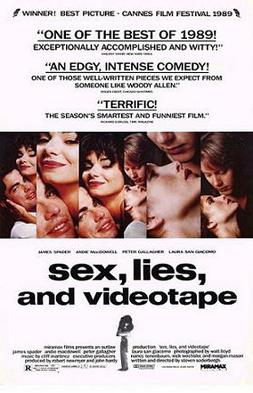
Sundance Film Review: sex, lies, and videotape (dir by Steven Soderbergh)


The Sundance Film Festival is currently taking place in Utah so, for this week, I’m reviewing films that either premiered, won awards at, or otherwise made a splash at Sundance!  Today, I take a look at 1989’s sex, lies, and videotape, which won both the Audience Award at the 1989 Sundance Film Festival and the Palme d’Or at Cannes!

The directorial debut of Steven Soderbergh, sex, lies, and videotape is considered by many to be one of the most important independent American films ever made.  Not only was it a  success at the box office and nominated for an Oscar but it also won the Palme d’Or at Cannes.  According to Peter Biskind’s Down and Dirty Pictures, the success of sex, lies, and videotape is what convinced Hollywood that independent films could be big business.  The marketing of the film would set the template for almost every independent release that followed.

(One person who was definitely not a fan of sex, lies, and videotape was director Spike Lee.  When Lee’s Do The Right Thing lost the Palme to Soderbergh’s film, Lee was informed that the Canne jury felt Lee’s film wasn’t “socially responsible.”  “What’s so socially responsible about a pervert filming women!?” Lee reportedly responded.)

sex, lies, and videotape tells the story of four people in Baton Rouge, Louisiana.

Ann (Andie MacDowell) has a nice house, a successful husband, and an absolutely miserable marriage.  When the film opens, she’s having a session with her therapist (Ron Vawter) and talking about how unfulfilled she feels.  When the therapist asks her questions about her sex life, Ann laughs nervously.  She says that she likes sex but she doesn’t like to think about it.  She says she doesn’t see what the big deal is.  Later, she reveals that she’s never had an orgasm.

John (Peter Gallagher) is Ann’s husband.  He’s a lawyer.  He’s also a materialistic jerk and … well, that’s pretty much the sum total of John’s entire personality.

Cynthia (Laura San Giacomo) is John’s mistress.  She’s a bartender at a rather sleazy little establishment, where she apparently spends all of her time listening to a local drunk (Steven Brill) do a Marlon Brando impersonation.  She is uninhibited and fiercely sexual.  She’s the opposite of Ann, which is why John likes her.  Of course, she’s also Ann’s sister.  Cynthia and Ann have a strained relationship.  Ann describes Cynthia as being “loud.”  Cynthia views Anne as being judgmental.  Secretly, both wish that they could be more like the other.

And then there’s Graham (James Spader).  Graham was John’s friend in college, though it’s difficult to understand why.  Graham has recently returned to Baton Rouge and John, without talking to Ann, has invited Graham to visit them.  Graham is apparently a drifter.  (Ann describes him as being “arty.”)  While Ann is helping him find an apartment, Graham informs her that he’s impotent.  He can’t get an erection if anyone else in the room.

Ann subsequently discovers that Graham deals with his impotence by videotaping women discussing their sex lives.  The video camera allows Graham to keep his distance and not get emotionally involved.  (Of course, it also serves as a metaphor for directing a movie.)  Ann is freaked out by all of Graham’s tapes.  Cynthia is intrigued.  And John … well, John’s just a jerk.

sex, lies, and videotape is a film that’s largely saved by its cast.  Graham is a role that literally only James Spader could make intriguing.  Meanwhile, Peter Gallagher actually manages to bring some charm to John, who is the least developed character and who gets all of the script’s worst lines.  That said, the film really belongs to MacDowell and San Giacomo, who are totally believable as sisters and who, again, bring some needed depth to characters that, as written, could have been reduced to being mere clichés.  (In the scenes between MacDowell and San Giacomo, it was less about what they said than how they said it.)

As I already stated, this was Steven Soderbergh’s feature debut.  Soderbergh was 26 years old when he made this.  Seen today, it’s an uneven but ultimately intriguing film.  There are a few scenes where Soderbergh’s inexperience as a filmmaker comes through.  For instance, John is written as being such a complete heel (and, in his final scene, he wears a ludicrous bow tie that practically screams, “EVIL,”) that it occasionally throws the film off-balance.  You never believe that Graham would have been his friend, nor do you believe that Ann would have spent years putting up with his crap.  The film’s final scene between Cynthia and Ann also feels a bit rushed and perfunctory.  That said, this film shows that, from the start, Soderbergh was good with actors.  Visually, Soderbergh takes a low-key approach and allows the cast to be the center of attention.  It’s an actor’s film and Soderbergh wisely gets out of their way.  In particular, Spader and San Giacomo have a way of making the most heavy-handed dialogue sound totally and completely natural.

It’s hard to imagine Soderbergh directing something like sex, lies, and videotape today.  If the film were made today, Soderbergh wouldn’t be able to resist the temptation to use overexposed film stock and to give cameos to George Clooney as Ann’s therapist and Matt Damon as the drunk.  sex, lies, and videotape is a film that Soderbergh could only have made when he was young and still struggling to make his voice heard.  It’s a flawed by intriguing film.  If just for its historical significance, it’s a film that every lover of independent cinema should see at least once.

Previous Sundance Film Reviews:

  1. Blood Simple
  2. I Don’t Feel At Home In This World Anymore
  3. Circle of Power
  4. Old Enough
  5. Blue Caprice
  6. The Big Sick
  7. Alpha Dog
  8. Stranger Than Paradise