“Blue!”
As long as Chris Pratt is back, I’m happy.
“Blue!”
As long as Chris Pratt is back, I’m happy.
Seriously, this one freaked me out!
(There was some speculation that A Quiet Place may be part of the Cloverfield franchise but, judging from this commercial, I don’t think so. It looks really good, though.)
It’s Super Bowl Sunday and you know what that means! Commercials, commercials, and more commercials.
(And, apparently, some football game.)
As I did last year, I’m going to do my best to post every movie teaser that airs during the Super Bowl. Things started off tonight with this intriguing teaser for Red Sparrow! Jennifer Lawrence plays a Russian agent in this movie, which has been rated R for torture, violence, sex, language, drugs, and everything else that can win a film an R-rating.
Remember that sweet song your Mother sang to you as a child?
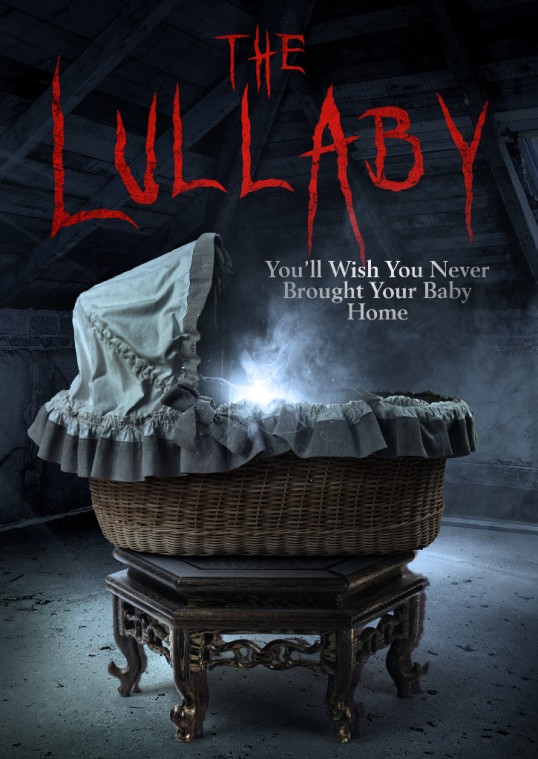
Cast:
Reine Swart as Chloe van Heerdon
Brandon Aruret as Dr. Timothy Reed
Shayla-Rae McFarlane as young Chloe
Preview:
Chloe is overwhelmed by the birth of her first child. The incessant crying of her baby, the growing sense of guilt and paranoia sends her into depression. With a heightened urge to protect her son, Chloe sees danger in every situation. She starts to hear voices, the humming of a childhood lullaby and sees flashes of a strange entity around her child. Convinced that the entity is real, Chloe will do everything in her power to protect her son. Is she haunted by evil or is it just the baby blues?
Review:
 Oh, Child, we got so much to talk about! Your Mama is not crazy, you are! Or are you? Or was you just twisting my mind?

Or is your Mom really crazy!
 Or your Grandma?
That sweet little song you Mom sang to you as a child… you know… that comforting song that always puts you into dream land… yeah, this movie might make you sleep different tonight!
Credits:
Uncork’d Entertainment presents a Phoenix Film with Valhalla Productions Directed by Darrell James Roodt
Trailer:
Would I recommend this movie:
Yep, absolutely! One of the best horror/thriller movies I have seen this year!
Where can you see it?
The Lullaby is opening in theaters and on VOD March 2, 2018
Oh, BTW:
No Spoilers, but Chloe is back….

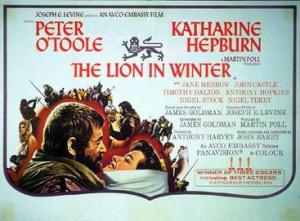
(With the Oscars scheduled to be awarded on March 4th, I have decided to review at least one Oscar-nominated film a day. These films could be nominees or they could be winners. They could be from this year’s Oscars or they could be a previous year’s nominee! We’ll see how things play out. Today, I take a look at the 1968 best picture nominee, The Lion in Winter!)
“I don’t much like our children.”
— Eleanor of Aquitaine (Katharine Hepburn)
“Oh God, but I do love being king.”
— King Henry II (Peter O’Toole)
“What family doesn’t have its up and down?”
— Eleanor of Aquitaine
To be honest, it’s tempting to just spend this entire review offering up quotes from this film. Based on a play by James Goldman and featuring a cast of actors who all specialized in delivering the most snarky of lines with style, The Lion In Winter is a film that is in love with the English language. As visually impressive as the film and its recreation of the 12th Century is, it’s tempting to close your eyes while watching The Lion In Winter and just listen to the dialogue.
The year is 1183. England has a king. His name is Henry II (Peter O’Toole) and he’s held power for a long time, through a combination of willpower and political manipulation. He’s married to Eleanor of Aquitaine (Katharine Hepburn), though he long since had her imprisoned. Before marrying Henry, Eleanor was the wife of Louis VII. Now, Henry’s mistress is Alais (Jane Merrow), the daughter of Louis and his second wife. In order to get Alais’s dowry, Henry has promised her half-brother, Philip II (Timothy Dalton), that she will be married to the next king of England. Philip, incidentally, is the son of Louis’s third wife. To be honest, it’s confusing as Hell to try to keep up with all of it but that’s medieval politics for you.
Of course, everyone knows that Henry II will not be king forever. He’s already 50 years old, which is quite an advanced age for 1183. Being king means that everyone, even his own family, is plotting against him. It also means living in a remarkably dirty and drafty castle. (If you’re looking for a film that celebrates the splendor of royalty, this is probably not the film to watch.) Henry has three sons, all of whom feel that he should be the rightful heir.
For instance, there’s Richard (a young Anthony Hopkins). Richard is Henry and Eleanor’s eldest son. He is a fierce, outspoken, and judgemental man. He describes himself as being a legend and a poet. He looks and acts like a future king. Of course, he’s also a bit of a pompous ass. Richard is Eleanor’s pick to be king, though Richard is always quick to equally condemn both of his parents.
And then there’s John (Nigel Terry). Early on, John is described as being “pimply and smelling of compost.” For some reason, John is Henry’s favorite. He’s also a sniveling weakling, the type who is never smart enough to know when his father is being honest or when his father is bluffing. Halfway through the film, he comes close to accidentally starting a civil war.
And finally, there’s Geoffrey (John Castle). Geoffrey is the smartest of the princes and the most manipulative. Of the three princes, he’s the only one who is as smart as both Henry and Eleanor. However, whereas Henry and Eleanor enjoy their complicated lives and manage to maintain a sense of (very dark) humor about it all, Geoffrey is bitter about his place as the middle child.
Christmas has arrived and Henry has temporarily released Eleanor from prison so that she can spend the holidays with him, his sons, and his mistress. Also coming over for the holiday is King Phillip II, eager to either take back his sister’s dowry or to attend her wedding to the next King of England. What follows is a holiday of politics, manipulation, and shouting. In fact, there’s lots and lots of shouting.
It’s a thoroughly enjoyable film, one that expertly mixes British history with domestic drama and dark comedy. Obviously, the film’s main appeal comes from watching two screen icons, Peter O’Toole and Katharine Hepburn, exchanging snappy dialogue. Hepburn deservedly won an Oscar for her performance as Eleanor. O’Toole should have won an Oscar as well but he lost to Cliff Robertson for Charly. In fact, O’Toole and Hepburn are so good that they occasionally overshadow the rest of the very talented cast. Anthony Hopkins and Nigel Terry both make indelible impressions as Richard and John but my favorite princely performance came from John Castle, who is a malicious wonder as Geoffrey. As easy as it is to dislike Geoffrey, it’s hard not to feel that he does have a point.
(Of course, in real life, both Richard and John would eventually serve as king while Geoffrey would die, under mysterious circumstances, in France. Reportedly, Philip II was so distraught over Geoffrey’s death that he attempted to jump on the coffin as it was being lowered into the ground.)
The Lion In Winter was nominated for seven Oscars and won three, for Best Actress (Katharine Hepburn), Best Adapted Screenplay (James Goldman), and Best Music Score (John Barry). It lost best picture to Oliver!
(With the Oscars scheduled to be awarded on March 4th, I have decided to review at least one Oscar-nominated film a day. These films could be nominees or they could be winners. They could be from this year’s Oscars or they could be a previous year’s nominee! We’ll see how things play out. Today, I take a look at the 1937 best picture nominee, Grand Illusion!)
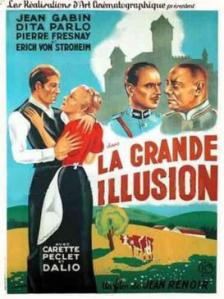
A few things to consider when watching Jean Renoir’s La Grande Illusion:
It is considered to be one of the greatest French films of all time and yet, at the outbreak of World War II, it was banned by France pour la durée des hostilités. It was also banned by Nazi Germany, with Joseph Goebbles declaring it to be “Cinematic Public Enemy No, 1.” Italy followed suit, banning the film as well.
It’s a pacifist film but all of the main characters are soldiers.
It’s a war film but we never see any battles. We hear about them, of course. Characters cheer when they hear that their country has taken another town. Towards the end of the film, when a gun finally is fired, it’s jarring because it’s the first gunshot that we’ve heard throughout the entire film.
It’s a film about change, specifically the change brought about by the First World War. Captain de Boeldieu (Pierre Fresnay) may be French and Major von Rauffenstein (Erich van Stroheim) may be German but they both share the bond of being aristocrats. (After Rauffenstein captures Boeldieu, the two of them have a friendly conversation about their shared acquaintances.) Both of them serve in the army, not for ideological reasons but because they consider themselves to be patriots and tradition holds that aristocrats go to war for their countries. At the start of the film, both Boeldieu and Rauffenstein seem to be above the fighting but, in the end, both realize that the old ways — their ways — will not survive in the new world that’s being created by the Great War.
(In another scene, a group of Russian soldiers are excited to receive a care package from “the Czarina,” just to open up the box and discover that, instead of Vodka, they’ve been sent used textbooks. The soldiers respond by setting the box on fire. For audiences in 1937, it would be impossible to watch this scene without reflecting on the fact that the Czarina herself would soon be dead, executed by revolutionaries.)
Grand Illusion tells the story of three French officers, prisoners of war who hope to somehow escape and make their way to neutral Switzerland. Unlike the aristocratic Boeldieu, Marechal (Jean Gabin) is a member of the working class, a mechanic. Lt. Rosnethal (Marcel Dalio) comes from a wealthy family but, as a Jew, he is still viewed as an outsider. (Reportedly, Renoir specifically made Grand Illusion‘s most sympathetic and generous character Jewish as a specific rebuke to Nazi Germany and their policies.) It’s Rosenthal who gives meaning to the film’s title when he says, regarding the belief that the great war will end all other wars, “That’s just an illusion.”
All three of them are moved from prison camp to prison camp, until they eventually find themselves at the camp commanded by the man who first captured both Boeldieu and Marechal, Major van Rauffenstein. Rauffenstein explains that he was given his new post after being seriously wounded in combat and his movements are sometimes so stiff that he almost resembles a marionette, suggesting that war has reduced this proud man to merely being a puppet for his government’s war machine.
Grand Illusion is a film about the forgotten people who get caught up in the madness of war. The French POWs may say they want to return to the front but, when they meet a woman who has lost her husband and three brothers to the war, they are reminded that even “victory” comes with a steep price. Rauffenstein and Boeldiue may share much in common but ultimately, the only thing that the world cares about is that one is French and one is German. Grand Illusion was Jean Renoir’s eloquent plea for peace, issued a mere two years before Europe plunged into World War II.
In 1938, Grand Illusion was the first foreign-language film to receive an Oscar nomination for best picture. However, it lost to Frank Capra’s You Can’t Take It With You.
(With the Oscars scheduled to be awarded on March 4th, I have decided to review at least one Oscar-nominated film a day. These films could be nominees or they could be winners. They could be from this year’s Oscars or they could be a previous year’s nominee! We’ll see how things play out. Today, I take a look at the 1955 best picture nominee, Love Is A Many-Splendored Thing!)
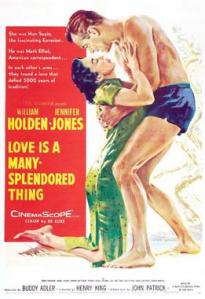
Before I talk about Love Is A Many-Splendored Thing, let’s play a little trivia game.
I’m going to list ten films. Your job is to guess what they all have in common:
Did you guess? All ten of these films came out in 1955 and not a single one of them was nominated for best picture. That’s something that I found myself thinking about quite a bit as I watched Love Is A Many-Splendored Thing on TCM last night. Of course, at this point, everyone knows that deserving films are often ignored by the Academy and that what seems like a great film during one year can often seem to be rather forgettable in subsequent years.
So, you can probably guess that I wasn’t terribly impressed with Love Is A Many-Splendored Thing but, before I get too critical, I want to start things off on a positive note. William Holden was, without a doubt, one of the best actors to ever appear in the movies. He started his film career in the 1930s and worked regularly until his death in 1981. Just consider some of the films in which Holden appeared: Golden Boy, Our Town, Sunset Boulevard, Stalag 17, Sabrina, Picnic, Network, and so many others. Of course, not every film in which Holden appeared was a masterpiece. He made his share of films like Damien: Omen II and When Time Ran Out. But the thing is that, regardless of the film, Holden was always good.
That’s certainly the case with Love Is A Many-Splendored Thing. It’s not one of Holden’s better films but William Holden is his usual dependable self. He plays Mark Elliott, a rugged American correspondent who is living in Hong Kong in the 1940s. While the Chinese Civil War rages nearby, Mark deals with his failing marriage. His wife is back in the States. They’re separated but not quite divorced. Mark owns a really nice car and, since he’s played by William Holden, he delivers the most world-weary of lines with an undeniable panache. He also appears shirtless for a good deal of the film. Between this and Picnic, 1955 was the year of the shirtless Holden.
The problem with Love Is A Many-Splendored Thing is not with William Holden. Instead, the problem is with the miscasting of Jennifer Jones as Han Suyin, the woman with whom Mark Elliott falls in love. Han Suyin was a real-life person, a doctor who wrote the autobiographical novel on which Love Is A Many-Splendored Thing was based. Han Suyin was Eurasian. Jennifer Jones most definitely was not. Throughout the film, Han Suyin and Mark often discuss what it’s like to be Eurasian and to be in the middle of two very different cultures. There’s even a discussion about whether Han Suying should try to pass as European. It all has the potential to be very interesting except for the fact that Jennifer Jones, who was so good in so many films, is in no way convincing in her role. Whenever she mentions being Eurasian, which she does frequently, the film come to a halt as we all stare at Jennifer Jones, one of the first film stars to ever come out of Tulsa, Oklahoma.
It all leads to a rather strained movie, one that never really drew me into its cinematic world or story. (For the record, a lot of people on twitter disagreed with me on this point.) Ultimately, the main reason to watch it was for William Holden. According to the film’s Wikipedia entry (how’s that for in-depth research), Holden and Jones reportedly did not get along during filming, with Jones apparently chewing garlic before their love scenes and there was a definite lack of chemistry between them. Maybe I got spoiled by William Holden and Kim Novak dancing in Picnic but I never believed that Mark and Han Suyin were attracted to each other. Interestingly, Jones and Holden would later both appear in another best picture nominee, 1974’s The Towering Inferno. However, they didn’t share any scenes.
Love Is A Many-Splendored Thing was nominated for best picture but it lost to a far different love story, Marty. This was also the final film directed by Henry King to be nominated for best picture. Previous King films to be nominated included State Fair, In Old Chicago, Alexander’s Ragtime Band, The Song of Bernadette, Wilson, and Twelve O’Clock High.
(With the Oscars scheduled to be awarded on March 4th, I have decided to review at least one Oscar-nominated film a day. These films could be nominees or they could be winners. They could be from this year’s Oscars or or they could be a previous year’s nominee! We’ll see how things play out. Today, I take a look at the 1938 best picture nominee, Test Pilot!)
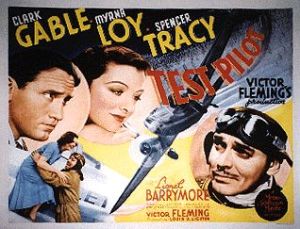
Test Pilot is all about charisma.
It tells a fairly simple story. I imagine that the plot seemed just as familiar in 1938 as it does in 2018. Jim Lane (Clark Gable) is a test pilot. In the early days of aviation, long before people took the idea of flight for granted, Jim Lane is a hero and celebrity. Whenever a new aviation technique is developed, Jim is the one who tests it. He’s the one who makes sure that it’s safe. Every day, when Jim goes to work for Mr. Drake (Lionel Barrymore), there’s a chance that he might not make it home. Not surprisingly, he’s cocky, reckless, and not prone to commitment. He’s also handsome, charming, manly, and quick with a quip. In short, he’s Clark Gable.
When the movie starts, Jim has only one real friend. Gunner (Spencer Tracy) is his mechanic. Gunner is a by-the-book, no-nonsense professional. He might enjoy a drink every now and then but Gunner knows his job and he knows his planes and, even more importantly, he knows Jim. Gunner’s a man of unimpeachable integrity, the type who will always call things as he sees them. In short, he’s Spencer Tracy.
One day, while on a test flight, Jim is forced to make an emergency landing on a farm in Kansas. That’s where he meets Ann Barton (Myrna Loy). Ann is beautiful and outspoken. She quickly proves that she can keep up with Jim, quip-for-quip. In short, she’s Myrna Loy and, before you know it, she and Jim are in love. Just as quickly, Jim and Ann are married.
The movie starts out as a bit of domestic comedy. Jim may know how to fly a plane but it quickly becomes obvious that he doesn’t know much about commitment or being a husband. When Jim attempts to buy his wife a nightgown, he doesn’t even know how to pronounce the word lingerie. (He asks a store clerk for help in finding the “lonjur department.”) However, Jim soon starts to find that married life agrees with him.
Of course, that’s a problem when your job requires you to defy death on a daily basis. Ann worries that Jim is going to go to work and never come home, fears that are intensified after a race with another airplane ends in a terrible and (for the other pilot) fatal crash. Gunner, meanwhile, starts to fear that there’s only so many times that Jim can cheat fate. Both Ann and Gunner promise that they will never leave Jim’s side.
Well, you can probably already guess everything that’s going to happen. Test Pilot is not exactly the most narratively adventurous movie ever made but, when you’ve got Gable, Tracy, Loy, and Barrymore all in the same film, you don’t really need to break any new ground, storywise. Test Pilot is an example of the power of pure movie star charisma. It’s watchable because the performances are just as entertaining today as they were in 1938. The film features Gable doing what he did best and Tracy doing what he did best and Loy and Barrymore all doing what they did best. In this case, that’s more than enough.
When it comes to the film’s numerous flight sequences, it’s perhaps best to try to put yourself in the shoes of someone seeing the film in 1938. Today, of course, we’ve been spoiled by CGI. We tend to assume that literally anything can happen in a movie. In the 30s, however, people couldn’t take special effects for granted. When they watched the flight footage in Test Pilot, they did it with the knowledge that it was filmed by people who actually were putting their lives at risk to get it. At a time when commercial aviation was considered to be a luxury, Test Pilot provided audiences with a view of the world in the sky and of the world below, a view that they probably wouldn’t have gotten a chance to see otherwise.
A huge box office success, Test Pilot was nominated for best picture but lost to another film featuring Lionel Barrymore, Frank Capra’s You Can’t Take It With You.
Last week, I watched six films on This TV.
Which TV? No, This TV! It’s one of my favorite channels. It’s not just that they show a lot of movies. It’s also that they frequently show movies that are new to me. For instance, last week, This TV introduced me to both Prison Planet and Cherry 2000.
Here are four other films, two good and two not so good, that This TV introduced to me last week.
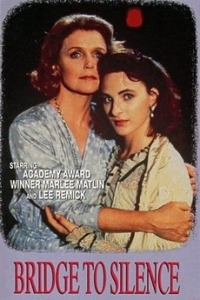
First up, we have 1989’s Bridge to Silence.
Directed by Karen Arthur, Bridge To Silence was a made-for-TV movie. Lee Remick plays Marge Duffield, who has a strained relationship with her deaf daughter, Peggy (Marlee Matlin). After Peggy’s husband is killed in a traffic accident, Peggy has a nervous breakdown. Marge and her husband, Al (Josef Sommer) take care of Peggy’s daughter, Lisa, while Peggy is recovering. However, even as Peggy gets better, Marge still doesn’t feel that she can raise her daughter so Marge files a lawsuit to be named Lisa’s legal guardian. While all of this is going on, Peggy is starring in a college production of The Glass Menagerie and pursuing a tentative romance with the play’s director (Michael O’Keefe).
Bridge to Silence is one of those overwritten but heartfelt melodramas that just doesn’t work. With the exception of Marlee Matlin, the cast struggles with the overwrought script. (Michael O’Keefe, in particular, appears to be miserable.) The film’s biggest mistake is that it relies too much on that production of The Glass Menagerie, which is Tennessee Williams’s worst play and tends to be annoying even when it’s merely used as a plot device. There’s only so many times that you can hear the play’s director refer to Peggy as being “Blue Roses” before you just want rip your hair out.
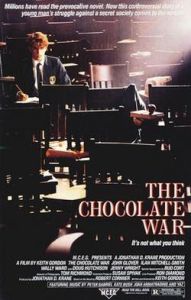
Far more enjoyable was 1988’s The Chocolate War.
Directed by Keith Gordon, The Chocolate War is a satirical look at conformity, popularity, rebellion, and chocolate at a Catholic boys school. After the manipulative Brother Leon accidentally purchases too much chocolate for the school’s annual sale, he appeals to one of his students, Archie Costello (Wallace Langham), to help him make the money back. Archie, who is just as manipulative as Leon, is the leader of a secret society known as the Vigils. However, Archie and Leon’s attempt to manipulate the students runs into a roadblack when a new student, Jerry Renault (Illan Mitchell-Smith) refuses to sell any chocolates at all. From there, things get progressively more complicated as Archie tries to break Jerry, Jerry continues to stand up for his freedom, and Leon … well, who knows what Leon is thinking?
The Chocolate War was an enjoyable and stylish film, one that featured a great soundtrack and a subtext about rebellion and conformity that still feels relevant. John Glover and Wallace Langham both gave great performances as two master manipulators.
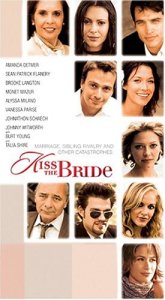 I also enjoyed the 2002 film, Kiss The Bride.
Kiss The Bride tells the story of a big Italian family, four sisters, and a wedding. Everyone brings their own personal drama to the big day but ultimately, what matters is that family sticks together. Directed by Vanessa Parise, Kiss The Bride featured believable and naturalistic performances from Amanda Detmer, Talia Shire, Burt Young, Brooke Langton, Monet Mazur, and Parise herself.
I have to admit that one reason why I liked this film is because it was about a big Italian family and it featured four sisters. I’m the youngest of four sisters and, watching the film, I was reminded of my own big Irish-Italian family. The movie just got everything right.
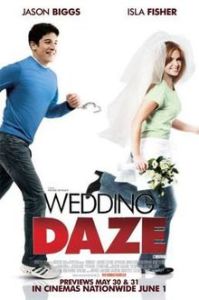
And then finally, there was 2006’s Wedding Daze.
Wedding Daze is a romantic “comedy.” Anderson (Jason Biggs) asks his girlfriend to marry him, just to have her drop dead from shock. Anderson’s best friend is afraid that Anderson will never get over his dead girlfriend and begs Anderson to not give up on love. Anderson attempts to humor his friend by asking a complete stranger, a waitress named Katie (Isla Fisher), to marry him. To everyone’s shock, Katie says yes.
From the get go, there are some obvious problems with this film’s problem. Even if you accept that idea that Katie would say yes to Anderson, you also have to be willing to accept the idea that Anderson wouldn’t just say, “No, I was just joking.” That said, the idea does have some comic potential. You could imagine an actor like Cary Grant doing wonders with this premise in the 30s. Unfortunately, Jason Biggs is no Cary Grant and the film’s director, comedian Michael Ian Black, is no Leo McCarey. In the end, the entire film is such a misjudged failure that you can’t help but feel that Anderson’s ex was lucky to die before getting too involved in any of it.
 You don’t necessarily have to be from a Catholic background to find The Little Hours to be hilarious but it probably helps. You also don’t have to be an expert in satirical Italian literature from the Medieval era but, again, it probably helps. Of course, what helps the most is to have a good sense of humor.
Technically, The Little Hours is based on The Decameron, though not even that famously bawdy book featured dialogue like, “Don’t fucking talk to us!” and “Stop fucking looking at us!” Both of those lines are delivered by Aubrey Plaza, who plays a nun in a medieval convent. The fact that Plaza is playing a nun tells you a lot about the humor in The Little Hours. The sets and the costumes are meticulously accurate. It’s easy to imagine that, if you got your hands on a time machine and traveled back to the Fourteenth Century, what you would see would look a lot like The Little Hours. But the dialogue and the attitudes are all straight from the 21st century.
The Little Hours tells the story of three nuns and the people who get in their way. Aubrey Plaza plays Sister Fernanda, the sarcastic nun who is willing to beat up anyone who looks at her for too long. Ginerva (Kate Micucci) is the repressed nun who can’t wait to get everyone else in trouble. Alessandra (Alison Brie) is the nun who is only a nun because her father (Paul Reiser) is making her.
When you’re bored and stuck in a convent, you find interesting ways to keep yourself amused. For instance, gossip is always a fun way to pass the time. Or you can get drunk on communion wine. If you get really bored, you can always join the local coven and dance around a fire. Or you can lust after the new handyman, a handsome deaf-mute named Massetto (Dave Franco). Of course, Massetto isn’t really a deaf-mute. He’s just pretending because he doesn’t want to be executed for having sex with his former master’s wife. Life was never easy in medieval Italy.
The film may be based on The Decameron but all of the dialogue was improved. Whenever I hear that anything’s been improvised, I always know that the end result is either going to be hilarious or it’s simply going to be unbearable. Fortunately, the cast of The Little Hours is full of comedic pros. They all play off of each other well. Each line of dialogue seems like a challenge being delivered by both the character and the performer. Behind every joke is a subtext of “Try to top this.” Supporting roles are played by everyone from Molly Shannon to Nick Offerman to John C. Reilly. Fred Armisen plays the Bishop who has the unenviable task of trying to keep straight everything that’s happened and his display of exasperation is absolutely brilliant.
As you can probably guess, I enjoyed The Little Hours. It’s probably not a film for everyone. As I said, it helps to not only have a Catholic background but to also have a sense of humor about it. But, for those in the right mood, it’s a hilarious film.
 Through the Shattered Lens