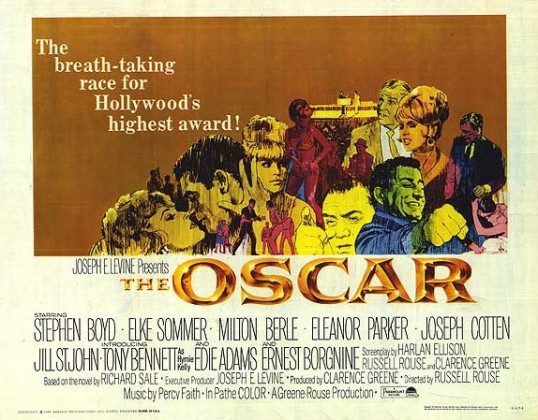
Have you ever wondered what it takes to win an Oscar? The 1966 film, The Oscar, revealed to audiences just how sleazy a world Hollywood can be. Frankie Fane (Stephen Boyd) does everything he can to win an Oscar and he doesn’t care who he hurts!
But fear not — Hollywood may not be perfect but it has no room for someone like Frankie Fane! At the end of the movie, a man named Frank does win the Oscar but his last name is Sinatra and Frankie Fane is left humiliated. That’ll teach him to try to take advantage of Hollywood!
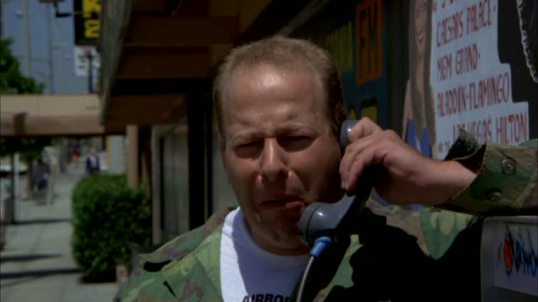
Yes, The Oscar is an incredibly silly film but it’s also a lot of fun. In this scene that I love, Frankie’s best friend — played by Tony Bennett of all people — confronts Frankie about the type of star that he’s become.
An hour ago, I told you about the only Oscar nomination that was ever received by Crown International Pictures, one of the most prolific B-movie distributors of the 70s and 80s. That nomination was for Best Original Song for Crown’s 1972 film, The Stepmother.
Here are 6 more films from Crown International Pictures that I think deserved some Oscar consideration:
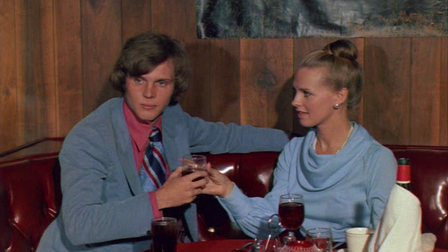
“She corrupted the youthful morality of the entire school!” the poster screamed but actually, The Teacher was a surprisingly sensitive coming-of-age story about a relationship between a younger man and an older woman. Jay North and Angel Tompkins both give excellent performances and Anthony James shows why he was one of the busiest character actors of the 70s.
John Savage has been acting for several decades. He’s appeared in a number of acclaimed films but he’s never received an Oscar nomination. One of his best performances was in this melancholy look at love, betrayal, and ennui in the early 70s.
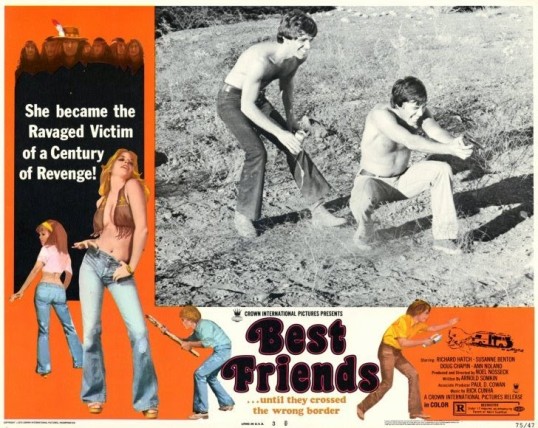
One of the strangest films ever released by Crown International, Best Friends is also one of the best. A road trip between two old friends goes terribly wrong when one of the friends turns out to be a total psycho. This well-acted and rather sad film definitely deserves to be better-known than it is.
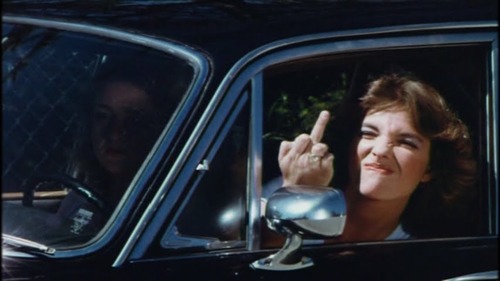
Don’t Answer The Phone is not a particularly good movie but it certainly is effective. It made me want to go out and get a derringer or some other cute little gun that I could carry in my purse. That’s largely because of the performance of Nicholas Worth. Worth plays one of the most perverse and frightening murderers of all time and Worth throws himself into the role. It’s one of the best psycho performances of all time and certainly worthy of a Best Supporting Actor nomination.
Crown International Pictures was founded in 1959 and ceased operations in 1992. Over the course of 43 years, the studio only received one Oscar nomination. That was in 1972, for Best Original Song. Written by Sammy Fain and Paul Francis Webster, Strange Are The Ways Of Love played over the credits for The Stepmother.
In honor of both the Oscars and Crown International Picture, here is Strange Are The Ways Of Love…
Last night, I turned over to the Lifetime Movie Network and I watched Devious Nanny!
Why Was I Watching It?
I’ve got a long history with Lifetime nanny films. I’ve watched films about Bad Nannys, Betrayed Nannys, Nightmare Nannys, Evil Nannys, Killer Nannys, and Dangerous Nannys. So, how could I resist something called Devious Nanny?
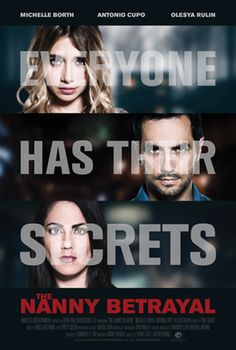
(Actually, it was apparently also called both The Nanny Betrayal and The Au Pair. Devious Nanny, though is an improvement on both of those.)
What Was It About?
Elise (Michelle Borth) and Brian (Antonio Cupo) have it all. Elise works at an art gallery. Brian works in … well, I think it was advertising but I could be wrong. All I know is that he worked in an office and he was worried about landing a big account and he wore a suit to work. Isn’t that what they do in advertising? Anyway, it’s a good job. Brian and Elise have a nice house and an adorable son. All they need to complete the picture is … an au pair!
Enter Amber (Olesya Rulin), who appears to be the perfect nanny. She loves kids and she’s even okay with cleaning up around the house! Of course, Amber did lie a little to get her job. And she didn’t tell her new employers that she grew up in the foster system and that she has a history of mental instability. Soon, Brian and Amber are exchanging lustful glances and people are turning up dead.
But here’s the thing. I’ve seen enough killer nanny films that I immediately realized that it was probably significant that the film never actually showed Amber killing anyone. So, is Amber the murderer or is it someone else? The film is full of suspects!
What Worked?
It all worked. This was the type of Lifetime movie that made me fall in love with the unique Lifetime aesthetic in the first place. Well-acted and full of snarky lines, Devious Nanny also featured a rather clever last-minute plot twist. The end of the film also features a line of dialogue that is perhaps the coldest sentiment over to be offered up in a Lifetime film.
Needless to say, this was a fun movie to live tweet. Those of us on twitter last night had a blast trying to figure out who the killer was and who was going to be the next victim.
All in all, it was a very entertaining movie.
What Did Not Work?
It all worked! At first, I was worried that the film would turn out to be just another Lifetime Nanny film but the script, by Adam Rockoff, was full of unexpected plot twists. I’m going to guess that Rockoff has seen enough nanny films that he knew exactly what most people would be expecting and he very skillfully manipulated those expectations.
In fact, my only issue is that Lifetime aired this on Friday night and it didn’t really seem like they made much of an effort to publicize it. Sometimes, I think Lifetime doesn’t truly understand just how many people love watching their movies. They’ll promote the Hell out of some forgettable (and often regrettable) celebrity biopic but entertaining thrillers, like this one, rarely get the fanfare that they deserve.
“Oh my God! Just like me!” Moments
I’ve been lucky, in that I’ve never had to work as an au pair. I’ve also never been suspected of murder. I guess I’ve just lived a sheltered life. However, if any of that did happen to me, I would hope, when it was all over, that I could be as snarky about it as Amber.
(With the Oscars scheduled to be awarded on March 4th, I have decided to review at least one Oscar-nominated film a day. These films could be nominees or they could be winners. They could be from this year’s Oscars or they could be a previous year’s nominee! We’ll see how things play out. Today, I take a look at the 1931 best picture winner, Cimarron!)
“Be careful, Hank! Alabaster may be a little dude but he’ll mess you up.”
“No offense … but he’s from Oklahoma.”
— King of the Hill Episode 5.13 “Ho Yeah”
Some best picture winners are better remembered than others. Some, like The Godfather, are films that will be watched and rewatched until the end of time. Others, like Crash, seems to be destined to be continually cited as proof that the Academy often picks the wrong movie. And then you have other films that were apparently a big deal when they were first released but which, in the decades to follow, have fallen into obscurity.
1931’s Cimarron would appear to be a perfect example of the third type of best picture winner.
Based on a novel by Edna Ferber (who would later write another book, Giant, that would be adapted into an Oscar-nominated film), Cimarron is an epic about Oklahoma. The film opens in 1889 with the Oklahoma land rush. Settlers from all across America rush into Oklahoma, searching for a new beginning. Among them is Yancey Cravat (Richard Dix) and his wife, Sabra (Irene Dunne). Yancey is hoping to become a rancher but, upon arriving at the settlement of Osage, he discovers that the land he wanted has already been claimed by Dixie Lee (Estelle Taylor).
So, Yancey gives up on becoming a rancher. Instead, he becomes a newspaper publisher and an occasional outlaw killer. Soon, Yancey and Sabra are two of the most prominent citizens in Osage. Under the guidance of Yancey, Osage goes from being a wild outpost to being a respectable community. It’s not always easy, of course. Criminals like The Kid (William Collier, Jr.) still prey on the weak. As the town grows more respectable, some citizens try to force out people like Dixie Lee. Struck by a combination of personal tragedy and wanderlust, Yancey occasionally leaves Osage but he always seems to return in time to make sure that people do the right thing. When even his wife reveals that she’s prejudiced against Native Americans, Yancey writes a vehement editorial demanding that they be granted full American citizenship.
The film follows Sabra and Yancey all the way to the late 1920s. Oklahoma becomes a state. Sabra becomes a congresswoman. Oil is discovered. Throughout it all, Yancey remains a firm voice in support of always doing the right thing. In fact, he’s such a firm voice that you actually start to get tired of listening to him. Yancey may be a great man but he’s not a particularly interesting one.
By today’s standards, Cimarron is a painfully slow movie. The opening land rush is handled well but once Yancey and Sabra settle down in Osage, the film becomes a bit of a chore to sit through. Richard Dix is a dull lead and the old age makeup that’s put on Dix and Dunne towards the end of the movie is notably unconvincing. Considering some of the other films that were eligible for Best Picture that year — The Front Page, The Public Enemy, Little Caesar, Frankenstein — Cimarron seems even more out-of-place as an Oscar winner.
And yet, back in 1931, it would appear the Cimarron was a really big deal. Consider this:
Cimarron was not only well-reviewed but also a considerable box office success.
Cimarron was the first film to ever receive more than 6 Academy Award nominations. (It received seven and won 3 — Picture, Screenplay, and Art Direction.)
Cimarron was the first film to be nominated in all of the Big Five categories (Picture, Actor, Actress, Director, and Screenplay).
Cimarron was the first film to be nominated in every category for which it was eligible.
Cimarron was the first RKO film to win Best Picture. The second and last RKO film to win would be The Best Years of Our Lives, a film that has held up considerably better than Cimarron.
Cimarron was the first Western to win Best Picture. In fact, it would be 59 years before another western took the top award.
Though Cimarron may now be best known to those of us who watch TCM, it’s apparent that it was a pretty big deal when it was first released. Though it seems pretty creaky by today’s standards, they loved it in 1931.
(With the Oscars scheduled to be awarded on March 4th, I have decided to review at least one Oscar-nominated film a day. These films could be nominees or they could be winners. They could be from this year’s Oscars or they could be a previous year’s nominee! We’ll see how things play out. Today, I take a look at the 1948 best picture winner, Hamlet!)
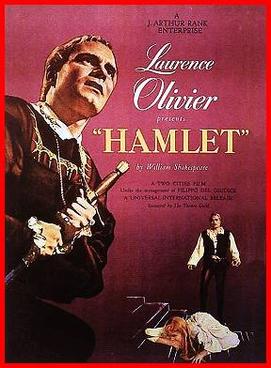
Hamlet is a film of firsts.
It was the first British production to win the Oscar for Best Picture. In winning, it beat out three American films (Johnny Belinda, The Snake Pit, and The Treasure of the Sierra Madre) and one other British film (The Red Shoes).
It was also the first adaptation of Shakespeare to win Best Picture. Of course, it wasn’t the first Shakespeare adaptation to be nominated. That honor would go to 1935’s A Midsummer Night’s Dream. Adaptations of Romeo and Juliet would be nominated in 1936, 1961, and 1968. Henry V (which, like Hamlet, was directed by and starred Laurence Olivier) was a 1946 nominee. Then there was 1953’s Julius Caesar.The Dresser featured scenes from Shakespeare. Shakespeare in Love imagined the circumstances behind the writing of Romeo and Juliet. However, Hamlet was the first to win.
It also remains the only traditional Shakespearean adaptation to win. West Side Story updated Romeo and Juliet while Shakespeare in Love … well, let’s just not get into it.
It was the first Best Picture winner to be directed by the man starring in the movie. Laurence Olivier was nominated for both Best Director and Best Actor. He lost the directing Oscar to John Huston but he won for his performance as Hamlet. In winning, he became the first actor to direct himself to an Oscar.
Finally, Hamlet was the first of 24 films to feature both Peter Cushing and Christopher Lee! In fact, this was Lee’s film debut. Now, before anyone gets too excited, I should point out that Cushing and Lee don’t actually interact. In fact, Lee doesn’t even speak in the film. He appears in the background as a Spear Carrier and it’s pretty much impossible to spot him. He has no dialogue and wasn’t even listed in the final credits. From what I’ve read, I don’t think Lee and Cushing even knew each other at the time and, when they later met, they were surprised to learn that they had both appeared in the film. For his part, Cushing plays Osiric, the courtier who everyone remembers because he had such a cool name.
It’s always fun to play “what if.” Rosencrantz and Guildenstern do not appear in Olivier’s adaptation of the play. To modern audiences, that might seem strange but, really, that’s just because we’re all familiar with the two characters from Tom Stoppard’s Rosencrantz and Guildenstern Are Dead. When Olivier filmed Hamlet, he excised portions of the play in the interest of time. (Hamlet uncut runs over four hours. Olivier’s version clocks in at nearly three.) Rosencrantz, Guildenstern, Fortinbras, and the second gravedigger are all dropped from Olivier’s version and, to be honest, none of them are particularly missed.
And yet … as I watched Hamlet, I found myself wondering what would have happened if Olivier had kept Rosencrantz and Guildenstern around and had cast Cushing and Lee in those roles. It probably wouldn’t have happened, of course. Cushing maybe but Lee was a total unknown at the time. Still, how amazing would that have been?
As for the actual film, Olivier’s Hamlet turned out to be far more cinematic than I was anticipating. Olivier’s camera snakes through the darkened hallways of Elsinore Castle while Olivier’s Hamlet veers between self-righteous fury and apparent madness as he seeks revenge on his Uncle Claudius (Basil Sydney). As Hamlet grows more obsessed with death and vengeance, the castle seems to grow darker and the hallways even more maze-like, as if the castle’s changing shape to conform with the turmoil in Hamlet’s mind. Among the cast, Jean Simmons is poignantly fragile as Ophelia while Eileen Herlie is the perfect Gertrude, despite being 12 years younger than the actor playing her son. Olivier gives a wonderfully physical performance as Hamlet, killing Polonious with a demented gleam in his eye and literally leaping towards his uncle at the end of the film.
If you’re one of those people who thinks that Shakespeare is boring … well, Olivier’s Hamlet probably won’t change your mind. One thing I’ve noticed about the “Shakespeare is boring” crowd is that nothing can change their minds. But, for the rest of us, Olivier’s Hamlet is an exciting adaptation of Shakespeare’s more difficult play.
You won’t miss Rosencrantz and Guildenstern at all. And seriously, Fortinbras who?
Could Black Panther be the first comic book movie to receive an Oscar nomination?
Last year, around this time, we were asking the exact same question about Logan. Logan didn’t pick up a Best Picture nomination but it was nominated for Best Adapted Screenplay, which would seem to suggest that the Academy is slowly coming around to accepting that so-called “Super Hero Films” can also be legitimate Oscar contenders.
As for Black Panther, it is currently the most critically acclaimed and financially successful film of 2018. For those who say that there’s no way the Academy will ever nominate a comic book film for best picture, it should be remembered that there was a time when people said that Academy would never nominate a horror comedy for Best Picture. Much like Get Out, Black Panther could prove the naysayers wrong.
Anyway, here are my Oscar predictions for February. As always, it ‘s really way too early to be making these predictions. Usually, Sundance provides at least a little bit of a guide but this year, Sundance was pretty low-key. The most obvious Sundance Oscar contender — Burden — doesn’t even have a release date yet.
Also, the uncertain status of The Weinstein Company has thrown a lot of films into limbo. Some of the unreleased TWC films might find homes with other studios. Others will probably be left in limbo. Then again, even if those films do get a release, I doubt the Academy is going to nominate any films stained with the noxious fingerprints of the Weinsteins.
Even more than usual, the guesses below are random. At this time next year, we’ll probably look at this list and laugh. Some of you might laugh today.
(With the Oscars scheduled to be awarded on March 4th, I have decided to review at least one Oscar-nominated film a day. These films could be nominees or they could be winners. They could be from this year’s Oscars or they could be a previous year’s nominee! We’ll see how things play out. Today, I take a look at the 1994 best picture nominee, Four Weddings and a Funeral!)
(SPOILERS)
Four Weddings and a Funeral is truly an oddity. It’s a romantic comedy that works wonderfully well, despite the fact that there’s next to no chemistry between the two leads.
Hugh Grant plays Charles, a neurotic bachelor who lives in London and who, despite having been in several relationships, has yet to marry. As he’s explains it, he’s spent his life expecting love to hit him like a thunderbolt and it hasn’t happened yet. Andie MacDowell plays Carrie, an American who has one of those vaguely defined magazine jobs that are so popular in romantic comedies. Carrie and Charles meet over the course of … well, four weddings and a funeral. From the minute they first meet, they are attracted to one another but the path of true love is never an easy one. After spending the night with him, Carrie leaves for America. When Charles meet her for a second time, she’s now engaged to Sir Hamish Banks (Corin Redgrave), a rather boring politician.
Hugh Grant is perfectly cast as Charles. It can be easy to make fun of an actor like Grant, what with all the stammering and the carefully calculated charm. But it works perfectly in Four Weddings and a Funeral, in which Grant manages to believable as both a hopeless romantic and a committed cynic. Within moments of his first scene (in which Charles wakes up and realizes he’s late for a friend’s wedding), you forget that you’re watching Hugh Grant. He is Charles.
On the other hand, Andie MacDowell never convinces us that she’s Carrie. That’s not totally MacDowell’s fault, of course. Carrie is an underwritten character, one who serves more as a plot device than anything else. We’re never quite sure how she feels about Charles. For that matter, we never understand why she’s marrying Hamish. When she shows up at the film’s funeral, we’re left wondering if she’s really mourning or if she’s just showing up to be polite. Carrie never comes to life and MacDowell never feels comfortable in the role. When she gives a warmly received speech at her own wedding reception, the scene feels false because you never feel as if the words are coming from Carrie.
The film ends with Charles and Carrie finally getting together. Charles both swears his love for her and asks if she’ll agree to never marry him. We later see them in a snapshot, with a child. But, despite all of that, you never believe that Charles and Carrie are going to stay together. There’s just not enough chemistry between Grant and MacDowell to convince you that Carrie isn’t going to get bored and run off with whoever it is she meets at the next wedding she attends.
So, why does this film work so well? It works because it’s a love story. However, it’s not about the love between Charles and Carrie. Not really. Instead, it’s about the love between Charles and his friends. Because of the way the film is structured, we only get to see how these people behave at weddings and a funeral. We never really get to see what these people do for a living or what they’re like during the week. In fact, we don’t even find out how they all became friends in the first place.
But it doesn’t matter. The friendships feels real. The friendships feels authentic. You might not know how they all became friends but that doesn’t matter. By the end of the movie, you feel as if you could go to London and possibly run into any of these people going about their daily lives. They become real in a way that Carrie never does.
There’s Scarlett (Charlotte Coleman), who is Charles’s roommate and who gets flirty when she has too much to drink.
And then there’s David (David Bower), who is Charles’s younger brother. Both the actor and the character are deaf. One of the sweetest scenes in the film is when a woman who has been crushing on David attempts to show off her sign language skills. Everything she signs is wrong but David’s sweet smile tells us all we need to know about how he feels towards her.
Fiona (Kristin Scott Thomas) and Tom (James Fleet) are siblings. Fiona, who dresses in black, presents a hard exterior but, in one of the film’s more poignant scenes, she admits that the reason she’s never gotten married is because she’s been in love with Charles for ten years. Tom is a goofy optimist, the type who never doubts that he’s going to find happiness no matter what.
Gareth (Simon Callow) and Matthew (John Hannah) are as close to being married as anyone within Charles’s clique of friends. (Four Weddings and a Funeral was released twenty years before the legalization of same-sex marriage in the UK. If someone views the film 50 years from now, they’ll probably wonder why, exactly, Matthew is always described, by those outside of his central group of friends, as merely being a “close friend” of Garth’s.) Sadly, the funeral of the title is for the fun-loving Gareth.
It’s during the funeral, when Matthew reads a poem from Auden, that it becomes apparent that the heart of this film belongs not to Charles and Carrie but to their friends. Ultimately, Four Weddings and a Funeral is a celebration of the bonds of friendship. At the end of the movie, you’re happy, not because Charles and Carrie are finally together but because this unique and wonderful group of friends have all found each other. Everyone should be so lucky.
Four Weddings and a Funeral was nominated for best picture but lost to Forrest Gump.






 Through the Shattered Lens