Film Review: Savage Beach (dir by Andy Sidaris)


1989’s Savage Beach is yet another Andy Sidaris film that doesn’t make a damn bit of sense.

This time, Donna (Dona Speir) and Taryn (Hope Marie Carlton) have been hired to perform a very important mission.  You may remember that Donna works for a super secret government agency while, at one point, Taryn was in the witness protection program.  As a part of their cover, they fly a plane in Hawaii, making deliveries and giving tours.

(To be honest, you would think that, after everything that happened in Hard Ticket To Hawaii and Picasso Trigger, their cover would have blown but apparently not.)

Anyway, this time, they’ve been hired to fly a very important vaccine to a nearby island.  They manage to deliver the vaccine but a huge storm has come up.  As soon as they get back in their plane and start back towards Hawaii, Donna says, “Shouldn’t we get out of these wet clothes?”  While usually I roll my eyes at all of the nudity in Sidaris’s films, I have to admit that line made me laugh out loud.  Maybe it was just the sincerity with which Dona Speir delivered it.  Or maybe it’s just the fact that Andy Sidaris actually sat down, thought up that line, wrote it down, and then directed someone saying it.  One thing that can definitely be said for Andy Sidaris: as a filmmaker, he was totally without shame.

Anyway, the storm gets really bad and Donna and Taryn end up crashing on what they think is a deserted island.  Neither of them appear to be too upset about being stranded on that island, perhaps because Savage Beach was filmed nearly two decade before Lost.  Make no doubt about it, Donna and Taryn are optimists!

It turns out that they’re not alone.  Apparently, there’s treasure buried on the island and, as a result, all sorts of people are showing up.  Most of them are villainous.  Some of them are heroic.  There’s even another Abilene cousin, Shane Abilene (Michael J. Shane).  Everyone wants that treasure.  Everyone except for … THE WARRIOR!

Who is the Warrior (Michael Mikasa)?  He was a soldier in the Japanese army during World War II.  Left behind on the island, he’s still fighting the war.  Or something.  Actually, it’s not always easy to understand what the Warrior or anyone else is doing on the island.  The Warrior does decide to protect Donna and Taryn and both of them try to keep his existence a secret from the rest of the people on the island but that doesn’t really work out.

Honestly, Savage Beach should not have been as complicated as it was.  It should have been a simple story where Donna and Taryn outwitted a bunch of pirates on a desert island.  Instead, more and more people just keep showing up on that beach.  Good luck trying to keep them all straight.

It’s probably unnecessary to say that Savage Beach was a mess.  I think “mess” is probably one of the words most commonly used in any review of an Andy Sidaris film.  However, like most Sidaris films, the whole thing is too good-natured to really dislike.  In fact, the plot is so incoherent that it actually becomes strangely fascinating.

Add to that, as a result of watching Savage Beach, I now know that you can safely undress and fly a plane at the same time.  If I ever get my pilot’s license, I’ll be sure to remember that!

Film Review: Picasso Trigger (dir by Andy Sidaris)


Just from hearing the plot description, you would probably think that Picasso Trigger is a fairly straight forward film.

Basically, Picasso Trigger (John Aprea) is an international criminal mastermind and a lover of the arts.  After he drops a painting of a Picasso Trigger (the fish, not the character) off at the Louvre,  he is promptly blown up by an assassin.  The assassin was sent by one of his rivals, the evil Miguel Ortiz (Robert Obergon).  So now, Picasso is dead and Ortiz is now even more powerful than he was before.

Make sense so far?

It turns out that Picasso Trigger was not the only person that Ortiz hates.  Ortiz also has a vendetta against the secret American law enforcement agency that Ortiz blames for the death of his brother.  So, Ortiz decides that the time is right to start assassinating all of the members of that agency.  The surviving members of the agency have to stop Ortiz before he kills them all.

That wasn’t hard to follow, right?

Now, just try watching the movie.

Seriously, even by the standards of Andy Sidaris, Picasso Trigger is a total mess.  It’s a follow-up to Malibu Express and Hard Ticket To Hawaii, which means that Dona Speir and Hope Marie Carlton are back and flying around Hawaii in their airplane.  There’s also two more Abilenes to deal with, L.G. Abilene (Guich Kook) and his nephew, Travis (Steve Bond).

For some reason, L.G. sends Travis on a mission to Dallas.  It has something to do with what’s going on with Picasso Trigger and Miguel Ortiz but I was never sure what.  But the important thing is that Picasso Trigger‘s Dallas scenes were actually shot in Dallas.  (I always like seeing my hometown in the movies.)  Once Travis arrives in Dallas, he meets another agent named Pantera (Roberta Vasquez).  Apparently, Travis and Pantera went to high school together.  The mission in Dallas leads to Travis stealing a boat.  I’m not sure why.

Anyway, eventually, we get back to Ortiz trying to kill agents and the question of whether Picasso Trigger was actually blown up or not.  To be honest, so many people get blown up over the course of the movie that I’m not surprised that even a super secret government agency had a hard time keeping up with who was still around.  It turns out that there’s a double agent within the agency.  Who could it be!?

One thing that about Picasso Trigger that made a huge impression on me was just how nonchalant everyone was about being targeted for assassination. No one seemed to be too upset about any of it.  Travis, for his part, just seemed to be hanging out.

The other interesting thing about Picasso Trigger is that it featured an explosive boomerang.  Here’s the thing, though,  What if you threw the boomerang and it missed its target?  Wouldn’t it come flying back and blow you up?  Seriously, I don’t think the government really thought that weapon through.

Anyway, Picasso Trigger is a total mess but it’s likable in its silly way.  The film doesn’t take itself seriously, which helps.  And hey, it’s a chance to see what Dallas looked like in 1988!

Film Review: Hard Ticket To Hawaii (dir by Andy Sidaris)


I absolutely love Hawaii.

Years ago, my family spent a wonderful summer in Hawaii.  I’m not a swimmer and I have a morbid fear of drowning but oh my God, I loved walking along the Hawaiian beach.  It was the most incredibly beautiful place that I had ever seen.  The water was so blue.  The trees were so green.  And the people … oh my God, the people were so friendly and generous!  I have never had more drugs randomly offered to me than when I was walking on the back in Hawaii.  Even the screaming homeless people in Hawaii seemed nicer than the screaming homeless people on the mainland.

Of course, the truth is that no place is perfect.  Undoubtedly, Hawaii had its dark side.  I mean, just look at the 1987 film, Hard Ticket to Hawaii.

Directed by Andy Sidaris and officially the second film in his Triple B (Bullets, Bombs, and Babes) franchise, Hard Ticket To Hawaii has been described as being the greatest B-movie ever move.  I don’t know if I’d go that far but it’s certainly the only Andy Sidaris film to ever air on TCM.

Hard Ticket To Hawaii tells the story about … well, actually, it tells a lot of stories.  This is a Sidaris film, which means that it’s collection of bad puns, double entendres, cartoonish violence, and totally random scenes that don’t really link up to anything else in the film.

For instance, there’s a scene where a sportscaster interviews two former football players and has a panic attack when he thinks that the N-word has been broadcast on national television.  But then it turns out that the feed went out before the word was uttered so … hey, problem solved.  And it’s never spoken of again.

And then there’s an aging actress and a sleazy producer and they have a few scenes before they vanish from the film.  I’m not sure why they were in the film in the first place.  Maybe they were friends of Andy Sidaris.

And then there’s the giant mutant snake.  It says something about the narrative strangeness of Hard Ticket To Hawaii that the giant mutant snake is just a relatively minor subplot.

The actual plot begins when two innocent Molokai cops are executed by some smug drug dealers.  “Ah!” you say, “it’s going to be a film about drug runners!”  No, actually it’s a film about diamond smugglers because the whole drug things get abandoned fairly quickly.

A stash of stolen diamonds is accidentally recovered by Donna (Dona Speir) and Taryn (Hope Marie Carlton).  Donna and Taryn work for Molokai Cargo.  They transport packages and they take tourists around the island.  Except, Donna is also a secret government agent and apparently, Taryn is in the witness protection program.

Anyway, they not only find the stolen diamonds but they also lose the aforementioned mutant snake.  With the smugglers determined to get the diamonds, Dona calls in Rowdy Abeline (Ronn Mass), cousin of Cody Abeline who was the lead character in Malibu Express.  As soon as Rowdy arrives on the island, he is targeted by an assassin on a skateboard.  The assassin is carrying a gun and sex doll but he didn’t consider that Rowdy would have a bazooka in the back of his jeep.

Meanwhile, there’s a guy named Shades who just hangs out on the beach while holding a submachine gun.  He’s guarding something and Rowdy knows that he needs to get by Shades.  Fortunately, a local woman always play frisbee with Shades.

“Good,” Rowdy says, “I can use that.”

And use that he does.

Now, this may all seem incredibly stupid but last year, the Alamo Drafthouse showed the frisbee scene before a showing of Free Fire and the audience went crazy.  Seriously, it’s an iconic scene, even if it doesn’t make any sense.  And hey, now I know what to say that next time a total stranger tells me that I have a nice ass.

You too, Pilgrim!

Hard Ticket To Hawaii is insane.  (I haven’t even mentioned half of the crazy stuff that happens in this movie.)  It makes absolutely no sense but it’s so quickly paced that it doesn’t matter.  Hard Ticket To Hawaii cheerfully embraces its weirdness.  It may not be any good but it is a lot of fun.

Add to that, Hawaii, as always, looks great!

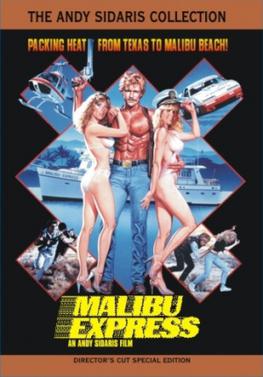
Film Review: Malibu Express (dir by Andy Sidaris)


Other than being the protagonist of the 1985 film Malibu Express, just who is Cody Abilene (played, in the film, by Darby Hilton)?

He’s a private investigator.  Judging from his accent, he’s from Texas.  He drives a red sports car and he lives on a houseboat that he’s named the Malibu Express.  He’s even got a painting of a caboose that stands on the docks next to his boat.  (It all goes back to an old friend of his and how he wanted to “remember her caboose.”)  He’s got nice hair and mustache and he looks like he could have had a career in 70s porn.  Literally everyone that he meets wants to have sex with him.  His best friend is a cop named Beverly (Lori Sutton).  His girlfriend is a race car driver named Judy Khnockers (Lynda Wiesmier).  “Khnockers … with an H.”  Cody says that about a thousand times over the course of the film.

Cody loves his cars.  Of course, it seems like he can’t go anywhere without running into three obsese rednecks who always demand that he race their son.  (Their son is apparently a mechanical genius.)  Cody always gives into their racing demands and he loses almost every time.

Cody also spends a lot of time talking to himself.  Nothing he says is that interesting.  I spent the entire movie waiting for him to say, “I hate pigs but yet I love bacon, what’s all that about?”  He never did.  I think the film would have been better if he had.

I should also mention that Cody is remarkably incompetent at his job.  The movie opens with him at the shooting range, firing his gun and continually missing the target.  Later on in the film, Cody’s accuracy will get better but he still always seem to be shocked whenever he actually hits his target.  From what we hear in the film, it appears that Cody has the respect of his peers but I’m really not sure why.  While he does solve the case, it’s mostly through dumb luck.  Cody doesn’t find clues through detective work.  Instead, he just kind of stumbles across them.

As for the case that Cody is investigating in Malibu Express … well, honestly, your guess is as good as mine.  I watched the film and I could hardly follow the plot.  Some of that is because this is one of those films that appears to have been edited with a chainsaw.  But a lot of it is because the film’s plot has a make-it-up-as-you-go-along feel to it.

It starts with Cody being hired by the mysterious Contessa Luciana (Sybil Danning) to investigate who has been selling computer secrets to the Russians.  Luciana has figured out that it has to be someone in the household of her friend, Lady Lillian Chamberlain (Niki Dantine).  (Apparently, every aristocrat in Europe has relocated to Bel Air.)  It doesn’t take long for Cody to discover that everyone in the house has a secret.  For instance, one daughter is having an affair with a butler.  A son-in-law is actually a drag queen.  Another daughter has gotten involved with a sinister computer mogul.

The computer mogul sounds like a good lead to pursue but, before it occurs to Cody to do that, there’s a murder and Cody shifts his attention to trying to figure out who did the killing.  But then suddenly, Cody’s being chased by three armed men so Cody shifts his attention yet again to trying to escape from them.  Fortunately, the actual murderer doesn’t really seem to care that much about remaining undetected, which certainly works out well for Cody…

Malibu Express is an Andy Sidaris film.  If you’ve ever seen a Sidaris film, you know better than to expect a nuanced or even narratively coherent film.  Sidaris specialized in over-the-top B-movies with nonsensical plots, frequent nudity, and dialogue that was heavy on groan-worthy double entendres.  Malibu Express was the first of his so-called triple “B” films (that stood for either Bullets, Bombs, and Babes or Bullets, Bombs, and Boobs, depending on who you ask).  It’s definitely a flawed film.  The plot makes no sense.  The dialogue is often cringe worthy.  The acting ranges from competent to awful.  The editing … oh my God, don’t even get me started on how messy this film is.

And yet, it’s also an oddly likable film.  If nothing else, the film seems to be aware of its flaws.  It knows that it makes no sense and that Cody is incompetent and no one in real life would ever say 75% of the lines that are uttered in Malibu Express.  It knows all of this but the film is determined to have fun and it’s hard to admire the film’s determination to full embrace the exploitation aesthetic.  Watching Malibu Express, you can tell that Sidaris probably enjoyed himself will directing it.  How much fun you have will depend on how much patience you have for Sidaris’s style of filmmaking.

Myself, I love over-the-top B-movies so I enjoyed it even if I couldn’t follow the plot.


Here Are Your 2017 Oscar Winners!


Here are the winners of the 90th annual Academy Awards!

Best Picture — The Shape of Water

Best Director — Guillermo Del Toro for The Shape Of Water

Best Actor — Gary Oldman, Darkest Hour

Best Actress — Frances McDormand, Three Billboards Outside Ebbing, Missouri

Best Supporting Actor — Sam Rockwell, Three Billboards Outside Ebbing, Missouri

Best Supporting Actress — Allison Janney, I, Tonya

Best Original Screenplay– Jordan Peele, Get Out

Best Adapted Screenplay — James Ivory, Call Me By Your Name

Best Animated Feature — Coco

Best Production Design — The Shape of Water

Best Cinematography — Blade Runner 2049

Best Costume Design — Phantom Thread

Best Film Editing — Dunkirk

Best Hair and Makeup — Darkest Hour

Best Sound Mixing — Dunkirk

Best Sound Editing — Dunkirk

Best Visual Effects — Blade Runner 2049

Best Original Score — The Shape of Water

Best Original Song — “Remember Me” from Coco

Best Foreign Language Film — A Fantastic Woman

Best Documentary Feature — Icarus

Best Animated Short — Dear Basketball

Best Live Action Short — The Silent Child

Best Documentary Short — Heaven is a Traffic Jam on the 405

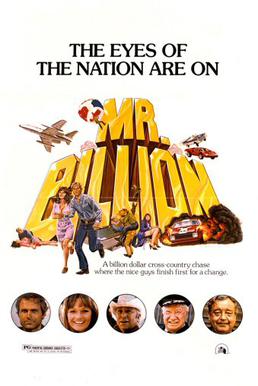
Lisa Reviews A Film That Was Not Nominated For Any Oscars: Mr. Billion (dir by Jonathan Kaplan)


The 1977 film Mr. Billion tells the story of Gudio Falcone (played by Terence Hill, whose real name is Mario Girotti).  Guido has got a pretty good life going in Italy.  Everyone in his village loves him.  He works as an auto mechanic.  When we first see him, he speeding around in a red sportscar.  When he returns to the garage, he smiles and says, in Italian, “Just like Steve McQueen.”  Guido may not be rich but he’s happy.

But that’s all about change!

Well, not the happy part.  Guido is pretty much always happy.  But he’s about to get rich.  It turns out that Guido is the last surviving relative of Antonio Falcone.  Years ago, Antonio immigrated to America and founded Falcon Motors.  The company eventually made Antonio one of the richest men in the world.  Unfortunately, the big Falcon Motors sign eventually fell off the company’s headquarters and it landed right on top of Antonio.

Everyone’s upset about Antonio’s death.  Well, everyone but the company’s vice president, John Cutler (Jackie Gleason).  John was naturally expecting that he would be named Antonio’s successor and that he would also inherit all of Antonio’s money.  Instead, Antonio’s will leaves everything to Guido!

Why?

Because, apparently, Guido never asked Antonio for anything more than a “pair of American cowboy boots.”

Cutler and his sleazy attorney (William Redfield) are soon on the next flight to Italy.  When they find Guido, they make sure to compliment him on his cowboy boots.  They explain to Guido that he has twenty days to go San Francisco and sign the proper papers.  If he’s any later than 20 days he’ll lose the money.  Of course, that shouldn’t be a problem since Guido can fly over anytime that he wants…

Except Guido refuses to fly!  No, he says that if he’s going to go to America, he’s going to arrive there the same way that Antonio did.  He is going to take a boat to New York City and then ride a train all the way to California.

Did you guess that the very next scene would be Guido standing on the dock of a cruise ship, staring at the Statue of Liberty?  And did you also also guess that, upon disembarking, he would immediately find himself besieged by reporters, one of whom declares him to now be the world’s most eligible bachelor?  If so, good work.

But here’s the big question.  Did you also predict that John Cutler would attempt to sabotage Guido’s trip to California and that the sabotage would involve hiring a private detective (Valerie Perrine)?  Even more importantly, did you predict that the detective would eventually end up falling in love with simple but honest Guido?

Because that’s totally what happens!

At the time that Mr. Billion was made, Terence Hill was a huge star in Europe but was barely known in the United States.  He was best known for appearing in a series of comedic Spaghetti Westerns with Bud Spencer, the majority of which featured Hill as a lazy but likable ne’er do well.  In Mr. Billion, Hill is cast as the exact opposite, as an earnest man-of-the-people who is so nice that it’s almost painful.  Add to that some major tone problems (the film cannot make up its mind if it wants to be a comedy, an action film, or a romance) and you have a pretty forgettable movie.

And that’s kind of a shame because Terence Hill showed some legitimate charm in the lead role.  The role may have been underwritten but all Hill had to do is flash that winning smile and it didn’t matter.  It’s unfortunate that Hill didn’t get a more appropriate vehicle for his American debut.

Sick of Reading About The Oscars? Here’s the Son of Godzilla (dir by Jun Fukuda)


Hi!  Are y’all sick of reading about the Oscars yet?  I mean, here at the Shattered Lens, we love the Oscars but I’m sure, by this point, some of our readers are ready to move on.  Well, don’t worry!  We haven’t forgotten about you!

And neither has … Minya, the son of Godzilla!

Oh my God, it’s Minya!

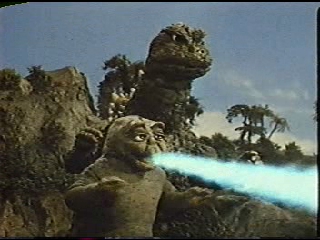
Now, as you can probably tell from this picture above, Minya doesn’t bear that much of a resemblance to his father.  I’m going to guess that he got his looks from the mother’s side of the family.  We really can’t say for sure because we don’t really get the exact details of how Minya came to be.  We get to watch as Minya hatches out of an egg but we’re never sure who laid the egg.  For all we know Godzilla laid the egg.

Then again, there’s also some debate as to whether or not Godzilla is actually Minya’s father.  When Minya hatches out of the egg, Godzilla shows up on the island to protect him but, before that, it’s not like we ever saw Godzilla actually taking care of the egg or anything.  In fact, right before Minya hatched, a bunch of giant preying mantis things were on the verge of eating the egg…

That means that Godzilla is either a really crappy father or this movie is about Godzilla kidnapping a baby monster.

Oh well, it’s probably best not to think too much about it because Minya is absolutely adorable!  He can’t really roar that well.  And when he tries to breathe atomic fire, he just ends up producing some atomic smoke rings instead.  Fortunately, Godzilla does get off his lazy ass long enough to teach Minya how to create flame.

It’s a pretty good thing that Godzilla shows up because remember those giant preying mantises that I mentioned earlier?  Well, they are literally everywhere.  Minya is definitely going to need Godzilla’s help if he’s going to defeat those things!

Now, admittedly, 1967’s Son of Godzilla may be fun and cute but it shares a flaw in common with a lot of Godzilla movies.  There’s way too many humans involved!  Seriously, when you watch a movie like this, you’re watching because you want to watch the monsters go at each other.  No one cares if Tokyo gets leveled as a result.  You just want to see a rubber monster fight.

But these later Godzilla films always seem to make the mistake of bringing in a bunch of humans who act shocked whenever the monsters show up.  With the number of times that Godzilla’s destroyed Japan, I would think that people would start taking a more nonchalant attitude towards him.  “Oh, it’s Godzilla again.  I’ll lock the door.  What’s for dinner?”  In this case, the humans are a bunch of weather scientists who are hanging out on the island.  There’s also a mysterious woman, a native of the island, who shows up because almost every Japanese monster movie made in the 60s and 70s had a mysterious woman living on an island.

Anyway, the humans aren’t important.  What’s important is the bond between Godzilla and his son, Minya!  Just check these two out!

Awwwwww!

Lisa Reviews An Oscar Nominee: Zorba The Greek (dir by Michael Cacoyannis)


The 1964 film, Zorba the Greek, tells the story of two very different friends.

Basil (Alan Bates) is a writer.  (“Poetry, essays,” he diffidently says when asked what he writes.)  Basil is British-Greek but, having been raised in the UK, he allows his British side to dominate.  In this film, that means that Basil is very polite and very reserved.  He’s not the type to attempt to flirt with someone who he doesn’t know.  He has never spontaneously broken into dance.  When he is offered a drink, he asks for tea and is shocked to receive rum instead.  If the film was taking place a few decades later, one gets the feeling that Basil would describe Love, Actually as being an okay movie “for people who like that sort of thing.”

And then there’s Zorba (Anthony Quinn).  Unlike the wealthy and well-educated Basil, Zorba is a peasant and he’s proud of it.  He works hard but he plays hard too and there’s nothing that Zorba loves more than the sound of good music.  Zorba not only drinks rum but makes sure that everyone else gets their fill as well.  Zorba dances whenever he feels like it.  Zorba is larger than life, an unfailingly enthusiastic man who is determined to enjoy whatever time he has left in his life.

When Zorba and Basil first meet, Basil is heading to Crete where he’ll be trying to reopoen a mine that was left to him by his father.  As for Zorba, he’s looking for work and, as he explains it, he has tons of experience working as a miner.  Though Basil is, at first, reluctant to hire someone who he’s just met, Zorba talks him into it.  As quickly becomes apparent, the exuberant Zorba can talk people into almost anything.

You can probably guess where all of this is going.  Zorba teaches Basil how to embrace life, which in this film means embracing the Greek side of his heritage.  It takes a while, of course.  Basil is an extremely reluctant protegé and a good deal of the film’s humor comes from just how uncomfortable Basil occasionally gets with his newfound friend.  That said, you don’t have to be a psychic to guess that eventually, the two of them will share a dance on the beach.  It may be predictable but that’s not to say that Zorba the Greek isn’t a good film.  It’s a very good and entertaining movie, featuring a justifiably famous soundtrack and also one of Anthony Quinn’s best and most exuberant performances.

In fact, Quinn is so perfectly cast as Zorba that he occasionally tends to overshadow Alan Bates, who is equally good but in a different way.  In fact, I would say that Bates probably had the more difficult role.  Whereas Zorba (and Quinn) spends the entire movie instigating, Basil (and Bates) spends the entire movie reacting.  It’s difficult to make passivity watchable but Bates manages to do it.

Of course, Zorba isn’t just a comedy about an unlikely friendship.  About halfway through the film, there’s a moment of shocking brutality involving a young widow played by Irene Pappas.  It took me totally by surprise and it left me a bit shaken.  (It also reminded me a bit of another European film featuring Irene Pappas, Lucio Fulci’s Don’t Torture A Duckling.)  It’s a scene that serves as a reminder that 1) not every peasant is Zorba the Greek and 2) friendship and love cannot end darkness but it can make it all a little more bearable.

Zorba the Greek was nominated for Best Picture but it lost to My Fair Lady.

Lisa Reviews An Oscar Nominee: Lost Horizon (dir by Frank Capra)


Long before there was Lost, there was Lost Horizon!

Much like the famous television show, the 1937 film Lost Horizon begins with a group of strangers on an airplane.  They’re people from all walks of life, all with their separate hopes and dreams.  When the plane crashes, they find themselves stranded in an uncharted land and, much like the Lost castaways, they are shocked to discover that they are not alone.  Instead, they’ve found a semi-legendary place that is ruled over by a man who has lived for centuries.  Much as in Lost, some want to return to civilization while others want to remain in their new home.  Both Lost and Lost Horizon even feature a terminally ill woman who starts to recover her health after becoming stranded.

Of course, in Lost, everyone was just flying from Australia to America.  In Lost Horizon, everyone is trying to escape the Chinese revolution.  Among the passengers on the plane: diplomat Robert Conway (Ronald Colman), his irresponsible brother, George (John Howard), a con artist named Henry (Thomas Mitchell), a paleontologist (Edward Everett Horton), and the very ill Gloria (Isabel Jewell).

While Lost featured a plane crash on a tropical island, Lost Horizon features a plane crash in the Himalayas.  In Lost, the sinister Others sent spies to infiltrate the survivors.  In Lost Horizon, the mysterious Chang (H.B. Warner) appears and leads the survivors to a place called Shangri-La.

Shangi-La is a lush and idyllic valley that has somehow flourished in one of the most inhospitable places on Earth.  The happy inhabitants inform the survivors that they never get sick and they never fight.  They’re led by the High Lama (Sam Jaffe), a philosopher who explains that he is several hundred years old.  The valley is full of magic and the Lama tells the survivors that Shangri-La is their new home.

Now, I’ve seen enough horror movies that I spent most of Lost Horizon waiting for the Lama to suddenly reveal that he was a vampire or an alien or something.  Whenever anyone in a movie seems to be too good to be true, that usually means that he’s going to end up killing someone about an hour into the story.  But that didn’t happen in Lost Horizon.  Instead, the Lama is just as wise and benevolent as he claims to be and Shangri-La is as much of a paradise as everyone assumes.  I guess we’re just naturally more cynical in 2018 than people were in 1937.

Of course, the Lama isn’t immortal.  Not even the magic of Shangri-La can prevent the inevitably of death.  The Lama is looking for a successor.  Could one of the survivors be that successor?  Perhaps.  For instance, Robert absolutely loves Shangri-La.  Of course, his brother George is determined to return to the real world.  He has fallen in love with one of the inhabitants of Shagri-La and plans to take her with him, despite the Lama’s warning about trying to leave…

Frank Capra was a huge fan of James Hilton’s book, Lost Horizon, and he spent three years trying to bring it to the big screen.  Based on Capra’s previous box office successes, Colombia’s Harry Cohn gave Capra a budget of $1.25 million to bring his vision of Shangri-La to life.  That may not sound like much today but, at the time, that made Lost Horizon the most expensive movie ever made.  The production was a notoriously difficult one.  (The original actor cast as the elderly Lama was so excited to learn he had been selected that he dropped dead of a heart attack.)  As a result of both its ornate sets and Capra’s perfectionism, the film soon went overbudget.  When Capra finally delivered a first cut, it was over 6 hours long.  Capra eventually managed to edit it down to 210 minutes, just to then have Harry Cohn order another hour taken out of the film.  When Lost Horizon was finally released, it had a running time of 132 minutes.

Seen today, Lost Horizon is definitely an uneven work.  With all the cutting and editing that went on, it’s hard to guess what Capra’s original vision may have been but, in the final version, much more time is devoted to the characters discussing the philosophy of Shangri-La than to the characters themselves.  (It’s always good to see Thomas Mitchell but he really doesn’t get much to do.)  Since you never really feel like you know what any of these characters were like outside of Shangi-La, it’s hard to see how being in Shagri-La has changed them.  You just have to take their word for it.  That said, it’s a visually stunning film.  Capra may have gone over budget creating the look of Shangri-La but it was money well-spent.  If I ever find myself in a magic village, I hope it looks half as nice as the one in Lost Horizon.

Despite all of the drama that went on behind the scenes and a rather anemic box office reception, Lost Horizon was nominated for best picture.  However, it lost to The Life of Emile Zola.

What Lisa Watched Last Night #176: Bad Tutor (dir by Jeff Hare)


Last night, I watched the latest Lifetime film, Bad Tutor!

Why Was I Watching It?

After you watch enough Lifetime films, you come to learn a few things.  For instance, any film that’s called Bad Something is probably going to be worth watching.  Over the years, there have been Bad Students, Bad Teachers, Bad Doctors, Bad Husbands, Bad Assistants, and Bad Realtors.  Really, it was only a matter of time until they got around to a Bad Tutor.

(My hope is that they will follow this up with a film called Bad Tudor, just because I assume all sorts of crazy stuff was going on with the court of Henry VIII.)

What Was It About?

It’s a simple film about three people who have hopes and problems.

For instance, Kelly (Vanessa Marcil) is a widow who is hoping to find a new husband but who also has a rebellious teenage daughter.

Emily (Alex Frnka) is Kelly’s daughter.  She hopes to become a famous singer but first, she has to pass her chemistry midterm.  When the movie starts, she’s currently on the road to getting a D in that class.  Emily says that people are going to be too busy responding to her music to care if she passed chemistry.  Kelly worries that Emily won’t be able to get into a good college with that D following her around.

Devon (Charles Hittinger) is a chemist who claims to be a former teacher.  Devon hopes that he’ll be able to get Emily to fall in love with him, largely because Emily looks just like his dead girlfriend.  Devon’s problem is that he’s batshit insane and the only reason his girlfriend is dead is because he pushed her off of a cliff.

When Kelly meets Devon, she decides that he would be the perfect tutor for Emily.  Little does she suspect that Devon is actually … a bad tutor!

What Worked?

Vanessa Marcil gave a pretty good performance as Kelly.  I liked the fact that, as opposed to the typical perfect Lifetime mother, Kelly not only made mistakes but also owned up to them.

The film’s opening, which started with Devon proposing to his girlfriend and ended with him pushing her off of a cliff, was well-handled.

What Did Not Work?

Here’s the thing: when it comes to Lifetime movies, we all agree, to an extent, to suspend our disbelief.  We accept the fact that characters will sometimes act stupidly and we try not to hold that against them.

But, sometimes, you run into a character who is just so utterly stupid that, try as you may, you just can’t forgive them.  That was the case with Emily in Bad Tutor.  Not only was Emily something of a spoiled brat but she also turned out to be amazingly gullible.  After spending the first half of the movie making fun of the nerdy Devon, Emily changed her tune when Devon claimed to have a friend in the recording industry.  Never did Emily ask for any proof or anything.  Instead, she just ran away from home with Devon.  Looking over her actions, I have to say I’m surprised that she was only failing one class.

Finally, Emily did sing a few times and … well, let’s just hope that she gets into a good college.

“Oh my God!  Just like me!” Moments

I related to Emily, largely because I too was a rebellious teenager who couldn’t sing.

Lessons Learned

I didn’t learn anything because he was a bad tutor.