The TSL’s Grindhouse: Blind Fury (dir by Philip Noyce)


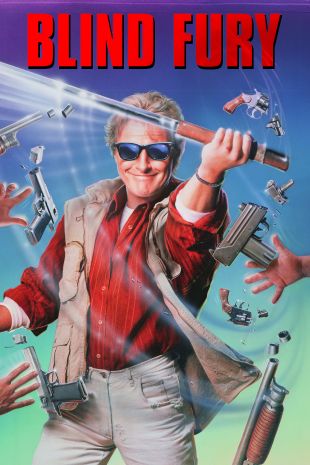
Nick Parker (Rutger Hauer) may have lost his sight in Vietnam but he gained something else.  With the help of surprisingly friendly villagers, Nick learned how to master his other senses.  He also became a proficient and deadly swordsmen.  Why would the villagers go out of their way to help an American soldier who, in all probability, they viewed as an intruder?

Does it matter?

Of course not!  All that matters is that 1990’s Blind Fury features Rutger Hauer as a blind swordsman who, 20 years after returning home from Vietnam, decides to to go to Florida to pay a visit on his old service buddy, Frank (Terry O’Quinn).  Frank, however, has developed a gambling problem and is currently in Reno, Nevada.  While Nick is getting to know Frank’s ex-wife, Lynne (Meg Foster), and Frank’s bratty son, Billy (Brandon Call), Slag (Randall “Tex” Cobb) shows up with two corrupt cops.  As you can probably guess from his name, Slag is a bad guy.  He’s looking for Frank.  Nick manages to kill the cops and run off Slag but, in the process, Lynne is killed.  With her dying breath, Lynne asks Nick to take Billy to his father.  Nick, of course, agrees.

The rest of this fast-paced film follows Nick and Billy as they head across the country.  Following them along the way is Slag and his men.  Frank has obviously made some pretty big mistakes and gotten on the bad side of some pretty dangerous people and it’s now up to Nick to save Frank, if just so Billy doesn’t end up an orphan.  At first, Billy is resentful and does things like demanding a window seat on the bus that they’re taking to Nevada.  (As Billy rather rudely puts it, it’s not like Nick has any use for the window.)  Billy also laughs when Nick trips in a puddle and then tries to trick Nick into eating a rock.  However, Nick soon proves himself to be more than capable of defending both himself and Billy.  Soon, Billy is calling him “Uncle Nick” and Nick …. well, Nick still seems to be wondering what he ever did that was so wrong that a part of his punishment was to get stuck with such a little brat.  But, that is a part of Nick’s charm.

And, indeed, Nick has a lot of charm.  That’s not particularly surprising, given that he’s played by the charismatic Rutger Hauer.  Hauer is convincing as both a blind man and a fighter and he bring a lot of sly humor to the role.  Nick may be a warrior but he’s definitely a warrior with a certain joie de vivre.  Beyond his own talents as an actor, Hauer was just one of those performers who had enough natural athleticism to look totally credible while swinging a sword at his enemies. One of the things that makes Blind Fury so enjoyable is that you never doubt that Hauer could actually do all of the things that we see him do.

Blind Fury is a fast-paced and entertaining film.  Director Philip Noyce keeps the action moving quickly and he’s smart enough to avoid getting bogged down with trying to convince the audience that film’s plot makes any more sense than it does.  Blind Fury is a B-action movie that’s proud to be a B-action movie and, as a result, it’s a lot of fun.  The film ends with a battle between Hauer and Sho Kosugi that is genuinely exciting to watch.  It also ends with the promise of a sequel, one that was sadly never made.

As I watched the film tonight (and, with the temperature currently being below freezing and a good deal of ice still being on the ground outside, I definitely enjoyed the escape that the film provided), it occurred to me that I’ve recently viewed many Rutger Hauer films.  I’ve seen a few bad films starring Rutger Hauer but I have never seen a bad Rutger Hauer performance.  Hauer always gave 100%, regardless of what else might be going on with the movie.  That’s why he was a great actor and one who is definitely missed today.

Blind Fury is definitely a very good Rutger Hauer film.  Watch it the next time you need to see that, with a little determination, anything is possible.
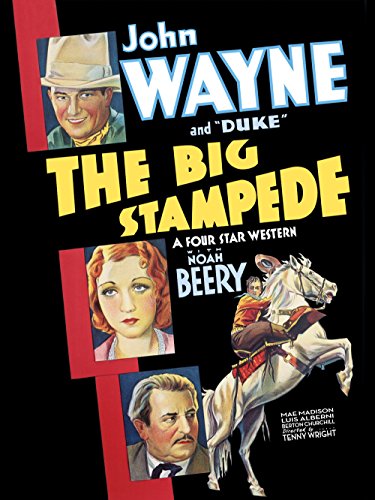
The Big Stampede (1932, directed by Tenny Wright)


On the New Mexico frontier, war is breaking out behind rancher Sam Chew (Noah Beery) and rustler Sonora Joe (Luis Alberni).  Both want to control the land and the cattle that graze upon it and innocent settlers are getting trapped in the middle!  The governor decides to send a young sheriff named John Steele to maintain order.  No sooner has Steele arrived then he meets a young woman (Mae Madison) and her father, who have both been attacked by and had their cattle stolen by Sam Chew.  After Sonora Joe and his gang save his life from Sam’s men, Steele realizes that Sam is more malicious and dangerous than Sonora Joe so he decides that the best way to handle the situation is to deputize Joe and team up with him to stop Sam and his men.  It’s a tall order but John Steele is just the man to handle it because John Steele is John Wayne!

This was one of the many B-westerns that the former Marion Morrison made in the decade before John Ford made him a star by casting him in Stagecoach.  Wayne was always a good hero, even in a 54-minute programmer like this one.  Though there is, as the title promises, an impressive stampede, Wayne is the main attraction here, with Noah Beery serving as a good heavy as always.  Perhaps the most interesting thing about this movie, if you’re a western or a John Wayne fan, is that Wayne’s horse is named Duke.  This was one of six films that Wayne made with Duke. Back in the 30s, the horses were often as a big a star as the men who rode them and, from the posters I’ve seen, it does appear that The Big Stampede was advertised as starring, “John Wayne and DUKE!”  At least Wayne was still able to get top billing.

The Big Stampede had previously been made as a silent film and the remake reuses a lot of old footage from the original.  John Wayne, needless to say, did not star in the original film, though he did wear the same costume that Ken Maynard wore in an attempt to keep people from noticing that the footage didn’t always match.  It’s not a totally successful ploy, though undemanding audiences in 1932 probably accepted it.  The Big Stampede would be remade one more time, in 1936, with Dick Foran taking the starring role.

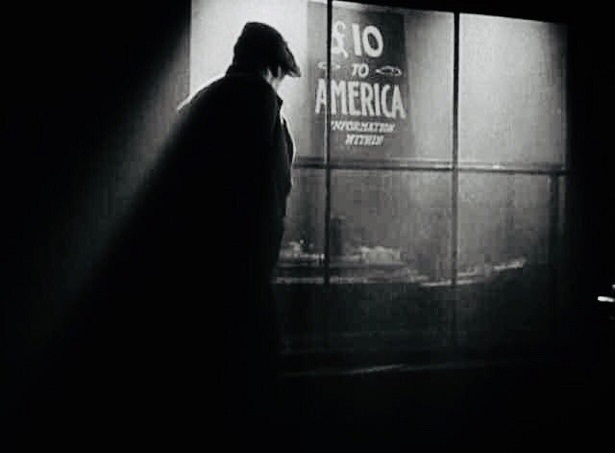
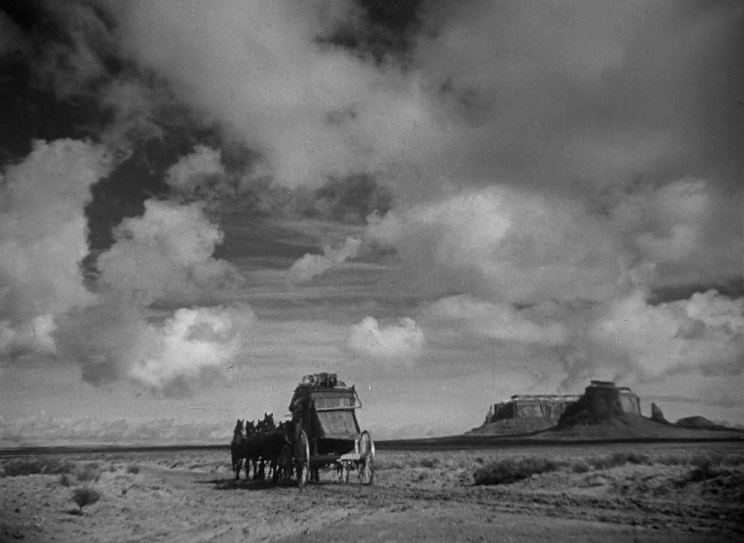
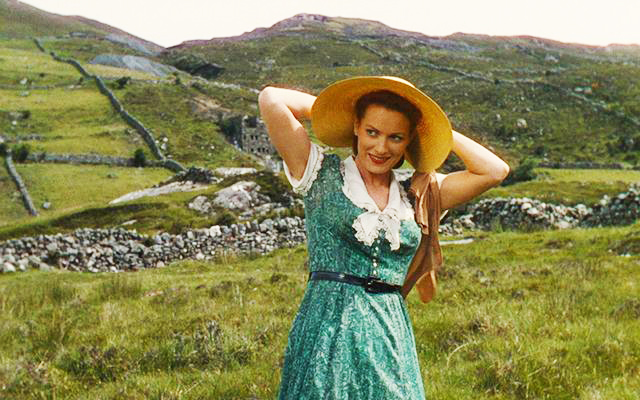
4 Shots From 4 John Ford Films: The Informer, Stagecoach, The Quiet Man, The Man Who Shot Liberty Valance


4 Or More Shots From 4 Or More Films is just what it says it is, 4 shots from 4 of our favorite films. As opposed to the reviews and recaps that we usually post, 4 Shots From 4 Films lets the visuals do the talking!

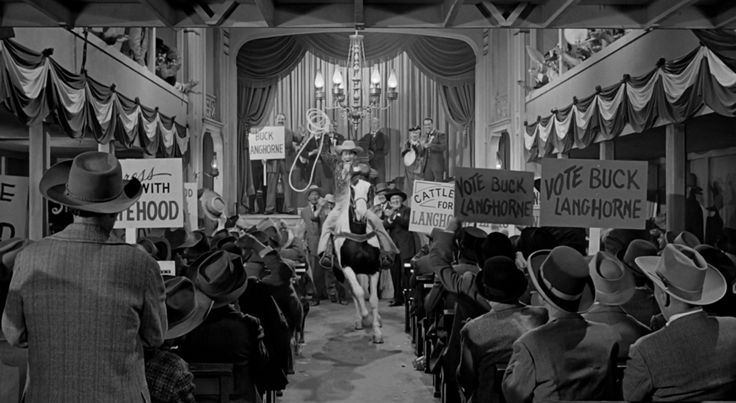
Yesterday was John Ford’s birthday.  Better late than never, here are four shots from four of my favorite John Ford films!

4 Shots From 4 John Ford Films

The Informer (1935, directed by John Ford. Cinematography by Joseph August)

Stagecoach (1939, directed by John Ford, Cinematography by Bert Glennon)

The Quiet Man (1952, directed by John Ford. Cinematography by Winton C. Hoch)

The Man Who Shot Liberty Valance (1962, directed by John Ford. Cinematography by William Clothier)

Ride Lonesome (1959, directed by Budd Boetticher)


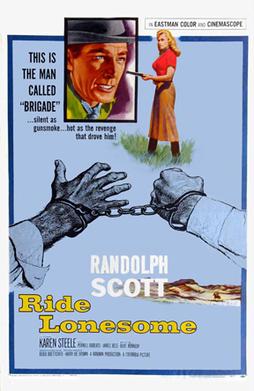
In the western Ride Lonesome, Randolph Scott plays Ben Brigade. Brigade is a bounty hunter. The only thing that really differentiates him from the outlaws that he captures is that he gets paid for what he does. When Brigade arrests a young outlaw named Billy John (James Best), he gives Billy just enough time to send word to his older brother, Frank (Lee Van Cleef). And when Brigade starts to lead Billy John back to the town of Santa Cruz, he takes his time and fails to cover his tracks, almost as if he is intentionally making time for Frank to eventually catch up to him. Along the way, Brigade meets up with three others, a woman named Carrie (Karen Steele) and two outlaws named Boone (Pernell Roberts) and Whit (James Coburn). Carrie is searching for her husband while Boone and Whit want to arrest Billy John themselves so that they can turn him in and get a pardon for their own crimes.

Ride Lonesome is one of the best of the many films that Randolph Scott made with director Budd Boetticher.  Boetticher specialized in making fast-paced westerns that had deceptively simple plots.  Nobody in a Boetticher western was totally good or totally bad and that’s certainly the case with Ride Lonesome, which may seem like a typical western but which is actually a character study of 6 very different people.  Brigade is often only the hero by default and his actions are often as ruthless as those of the men who are tracking him.  It’s only after he meets and gets to know Carrie that he starts to seriously consider that his plans could lead to innocent people getting hurt. Billy John may be a wanted killer but, underneath his bravado, he’s just someone trying to live up to his brother’s example.  Meanwhile, Boone and Whit may be outlaws but they turn out to be the most morally upright characters in the film.  Ride Lonesome takes a serious look at frontier justice and suggests that maybe black-and-white morality isn’t all that it’s cracked up to be.

Needless to say, the cast is great.  Randolph Scott was one of the great western heroes and Karen Steele, Pernell Roberts, Lee Van Cleef, and James Best all turn in memorable performances.  Best of all is James Coburn, making his film debut and showing that, even at the start of his career, he was already the epitome of cool.  Ride Lonesome is one of the best of of the Boetticher/Scott westerns and a true classic of the genre.


2021 In Review: Lisa Marie’s Picks For The 26 Best Films of 2021


Without further ado, here is the list that we’ve all been waiting for!  Here are my picks for the 26 best films of 2021!  Why 26?  Because Lisa doesn’t do odd numbers!

(Also, be sure to check out my picks for 201020112012201320142015201620172018, 2019, and 2020!  Wow, I’ve been doing this for a while!)


1. Nightmare Alley
2. Licorice Pizza
3. The Tragedy of Macbeth
4. Mass
5. Shiva Baby
6. Belfast
7. CODA
8. The Last Duel
9. The Power of the Dog
10. The French Dispatch
11. The Father
12. West Side Story
13. Pig
14. Dear Comrades
15. Another Round
16. Dune
17. Spider-Man: No Way Home
18. Val
19. Wild Indian
20. Romeo and Juliet
21. East of the Mountains
22. Summit of the Gods
23. A Quiet Place Part II
24. Passing
25. The Lost Daughter
26. Swan Song

Lisa Marie’s 2021 In Review:

  1. 10 Worst Films
  2. 10 Favorite Songs
  3. 10 Top Non-Fiction Books
  4. 10 Top Novels
  5. The Best of Lifetime
  6. 10 Good Things I Saw On Television

In The Line of Duty: Siege at Marion (1992, directed by Charles Haid)


After bombing several Mormon centers in Utah, religious extremist and polygamist Adam Swapp (Kyle Secord) has barricaded himself inside of a farm house with his wives and supporters. The FBI, led by Bob Bryant (Dennis Franz), have the house surrounded and are trying to convince Swapp to peacefully surrender. Swapp, however, has no intention of going down without a fight.

In the 1990s, NBC did a whole series of made-for-TV miniseries about real-life law enforcement operations that inevitably led to the death of at least one of the officers involved. They made so many of them and they churned them out so quickly that NBC even aired a movie about the Branch Davidian stand-off while it was still going on. Siege at Marion, the fourth of the In The Line of Duty films, feels like a precursor to what was eventually happen in Waco. Just as happened in Waco and with the attempts to arrest Randy Weaver at Ruby Ridge, critics claimed that the government came on too strong while the government claimed that they were merely enforcing the law.

Siege at Marion is the least interesting of all of the In The Line of Duty movies, mostly because the Marion siege was neither as mismanaged as what happened in Waco or as egregiously heavy-handed and disturbing as what happened in Ruby Ridge. Though based on a true story, Siege at Marion is a standard stand-off film with the only suspense coming from the film’s distasteful attempts to build up suspense as to whether it’ll be Dennis Franz, William H. Macy, or Ed Begley, Jr. who is killed in the line of duty. Since only one of them is given a backstory and a family, it’s easy to guess which one it will be.

The best thing about Siege of Marion is the cast. Dennis Franz was born to play cops and it’s interesting to see a pre-Fargo William H. Macy playing a non-nervous character. Kyle Secor is convincingly fanatical and unhinged as the messianic Adam Swapp. Secor would go on to star as Tim Bayliss on the much-missed Baltimore-set cop show, Homicide: Life on the Street. Speaking of classic cop shows, Siege at Marion was also directed by Charles Haid, who played Andy Renko on Hill Street Blues. As for the In The Line of Duty films, the last one was made in 1994 but they all live on in syndication.

2021 In Review: The Best of Lifetime


As chaotic as 2021 may have been, one thing remained unchanged!  Lifetime provided me with a lot of entertainment!  Below, you’ll find my picks for the best Lifetime films and performances of the past year!

(For my previous best of Lifetime picks, click on the links: 20142015201620172018, 2019, and 2020!)

Best Picture: Just What The Doctor Ordered

Best Director: Jeff Hare for Just What The Doctor Ordered

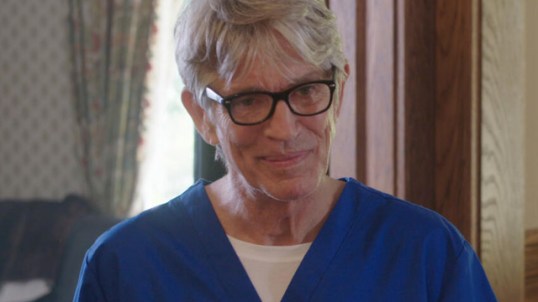
Best Actor: Eric Roberts in Just What The Doctor Ordered

Best Actress: Lauren Lee Smith in Doomsday Mom: The Lori Vallow Story

Best Supporting Actor: Jonathan Stoddard in The Wrong Prince Charming

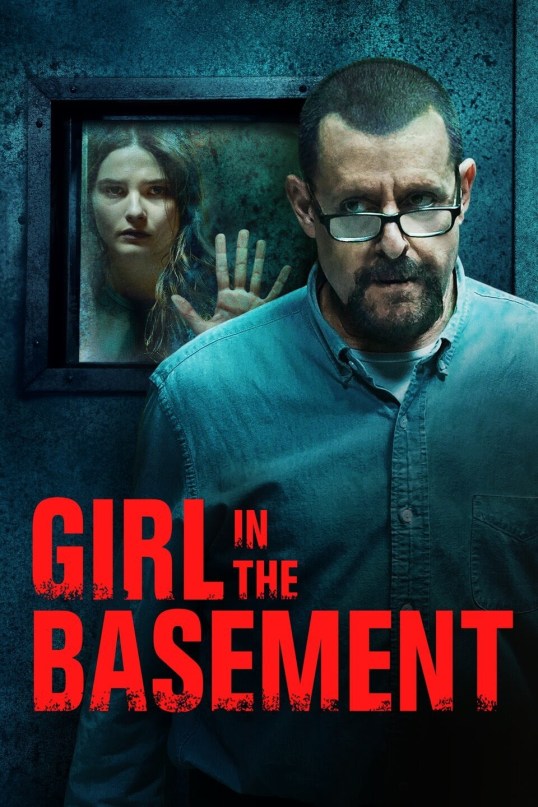
Best Supporting Actress: Joely Fisher in Girl In The Basement

Best Screenplay: Just What The Doctor Ordered

Lisa Marie’s 2021 In Review:

  1. 10 Worst Films
  2. 10 Favorite Songs
  3. 10 Top Non-Fiction Books
  4. 10 Top Novels

Lisa Marie’s Oscar Predictions for January


Well, here we are. Another awards season is wrapping up. Almost all of the regional critic groups have announced their picks for the best of 2021. The Guilds have spoken. The front runners have emerged. Both Don’t Look Up and Being the Ricardos have weathered bad reviews and become probable Oscar nominees. If nothing else, I’ll have something to complain about for the next three or four months. At the same time, Power of the Dog has emerged as the critical favorite. Belfast seems to be the populist favorite. West Side Story is the big production that has to be nominated, even though no one seems to feel particularly strongly about it one way or the other. Dune is the blockbuster that the Academy is hoping will cause people to tune into the ceremony, especially now that it appears that the Spider-Man Oscar campaign has fizzled. Don’t Look Up is the “Let’s piss off the cons” nominee. Being the Ricardos is this year’s “Wow, our industry really is the best” nominee. Personally, I’m going to view tick, tick….Boom! as being the most likely dark horse to pull off an upset.

So, with all that in mind, here’s my last set of 2021 Oscar predictions.

Looking at the list below, I have to say that we certainly have a good race this year. It’s interesting that, this year, only films that were released between March and the end of December were eligible for the Oscars. 2021 was a very good year for movies! Not only do we have the nominees below but we also had films like The Father and Judas and the Black Messiah, both of which are 2021 films as far as I’m concerned.

(Consider this. If the Oscars had kept the eligibility window the same last year instead of extending it to accommodate films delayed by the pandemic, Anthony Hopkins would probably be the Best Actor front runner right now and the Academy probably would have given Chadwick Boseman a posthumous Best Actor award last April. I also imagine that Jesse Plemons would have a better chance of picking up a supporting actor nomination if the members of the Academy were currently screening both The Power of the Dog and Judas and the Black Messiah at the same time.)

To see how my thinking has evolved,  check out my predictions for March and April and May and June and July and August and September and October and November and December!

The Oscar nominations will be announced on February 8th. Below are my predictions!

Best Picture

Being The Ricardos
Belfast
CODA
Don’t Look Up
Dune
King Richard
Licorice Pizza
The Power Of The Dog
Tick, Tick….Boom!
West Side Story

Best Director

Jane Campion for The Power of the Dog

Adam McKay for Don’t Look Up

Lin-Manuel Miranda for tick, tick …. Boom!

Steven Spielberg for West Side Story

Denis Villeneuve for Dune

Best Actor

Nicolas Cage in Pig

Benedict Cumberbatch in The Power of the Dog

Andrew Garfield in tick, tick….Boom!

Will Smith in King Richard

Denzel Washington in The Tragedy of Macbeth

Best Actress

Jessica Chastain in The Eyes of Tammy Faye

Olivia Colman in The Lost Daughter

Jennifer Hudson in Respect

Nicole Kidman in Being the Riacardos

Kristen Stewart in Spencer

Best Supporting Actor

Bradley Cooper in Licorice Pizzia

Ciaran Hinds in Belfast

Troy Kostur in CODA

Jared Leto in House of Gucci

Kodi Smit-McPhee in The Power of the Dog

Best Supporting Actress

Caitriona Balfe in Belfast

Ariana DeBose in West Side Story

Kirsten Dunst in The Power of the Dog

Aunjanue Ellis in King Richard

Ruth Negga in Passing

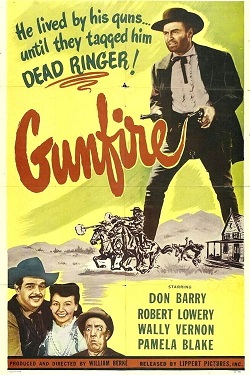
Gunfire (1950, directed by William Berke)


Years after the death of his brother Jesse, Frank James (Don “Red” Barry) has settled down in Colorado and is living a peaceful life as a rancher.  He is even friends with the town’s sheriff, John Kelly (Robert Lowery).  Unfortunately, it’s not always so easy to escape the past, especially when you are one of the few surviving members of one of the Old West’s most notorious gangs.  A former member of the James Gang, Mundy (Claude Stroud), shows up at Frank’s cabin and tries to talk Frank into joining up with him, the Ford brothers (Gaylord Pendleton and Roger Anderson), and their new leader, Bat Fenton (Don “Red” Barry, playing a second role).  When Frank refuses and makes clear that he still wants revenge on the Ford brothers for the murder of Jesse James, the gang goes on a crime spree.  Because he and Fenton look exactly alike, the entire town thinks that Frank is responsible.  Can Frank clear his name and avenge the death of his brother?

There were a lot of poverty row B-westerns produced in the early 1950s and most of them are pretty bad.  However, occasionally you come across a diamond in the rough and that’s the case with Gunfire.  Gunfire tells an interesting story, it has exciting gunfights, and it also features not one but two good performances from Don “Red” Barry!  Barry is equally convincing as both the good Frank and the bad Fenton and the movie uses the double plot as a way to illustrate how difficult it is to escape the sins of the past.  Frank has been “born again” but every time he sees Fenton, he sees not only who he used to be but also who many will always believe him to be.  Gunfire is a good western that shows that you don’t need a huge budget to tell an engaging story.