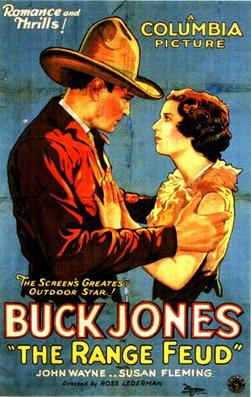
The Range Feud (1931, directed by D. Ross Lederman)


In a frontier town, two ranching families are at war.  The Turners claim that the Waltons have been stealing and reselling their cattle.  Even an attempt to hold a peace meeting at the local church just leads to more fighting.  Complicating things is that young Clint Turner (John Wayne) is in love with Judy Walton (Susan Fleming).  When someone shoots John Walton (Edward LeSaint) through the window of his office, Clint is the number one suspect.  Not helping is that Clint had an empty round in his gun.  Clint says that he fired at a coyote but he missed.  Everyone else in town says that its time to hang Clint without a trial.

Only Sheriff Buck Gordon (Buck Jones) stands between the mob and Clint.  Buck was raised by the Turner family and considers Clint to be his brother.  However, Buck still knows that Clint might be guilty but there’s no way that Buck is going to allow mob justice to rule his town!

The Range Feud was one of the many B-programmers that were released in the 30s.  Running less than 60 minutes, it is a briskly paced western that features a theme that was present in many westerns, the battle between mob justice and the law.  The townspeople who are eager to hang Clint without a trial represent the old ways of doing things while Buck represents the new way, in which everyone is innocent until proven guilty and entitled to a fair trial.

Buck Jones was one of the best of the early western heroes.  He played tough-but-fair men who could definitely handle themselves in a fight but who preferred to try to reason their way out of conflict.  Buck Jones served in a Calvary unit, worked as a cowboy, and started in the film business as a stunt man.  He had an authenticity that set him apart from others who merely pretended to be cowboys.  That authenticity serves him well in The Range Feud.  He may feel bad about having to arrest his stepbrother but any character played by Buck Jones can be guaranteed to follow the law.  In real life, Buck Jones died a hero.  In 1942, Buck Jones was at the Cocoanut Grove nightclub in Boston when a fire broke out.  Though Jones initially was able to get out of the nightclub, he subsequently reentered to help other people get out.  Severely burned, he died of his injuries two days later.

Of course, the main reason that people will track down this film is for a chance to see the young John Wayne playing a key  supporting role as Clint Turner.  It’s always a little bit strange to see Wayne playing a young man.  He’s one of those actors who you always assume was always in his 40s.  Wayne is likable as the free-spirited Clint, though it is again strange to see Wayne playing someone other than an authority figure.  For once, it’s Wayne who ends up in jail and who is dependent on someone else to save him.

The Range Feud is an entertaining and fast-moving western.  Fans of the genre and of Buck Jones and John Wayne will appreciate it.

Badlands of Dakota (1941, directed by Alfred E. Green)


This B-western takes place in the legendry frontier town of Deadwood.  It’s a town that’s patrolled by General George Custer (Addison Richards) and which is home to Wild Bill Hickok (Richard Dix) and Calamity Jane (Frances Farmer).  When outlaw Jack McCall (Lon Chaney, Jr.) and his gang start disguising themselves as Sioux and start robbing stagecoaches, young homesteader Jim Holliday (Robert Stack) is appointed town marshal.  Unfortunately, Jim’s older brother, Bob (Broderick Crawford), has gotten involved with McCall and his gang.  Bob has also never forgiven Jim for marrying Anne (Ann Rutherford), the woman that Bob loved.  Jim struggles to get the town to take him seriously.  When Jim tries to put out a fire that’s threatening to burn down several businesses, the citizens laugh at him and shoot a hole in the water hose.  No one said that the people of Deadwood were smart.  Ann wants to leave town but McCall and his gang are growing more brazen in their attacks and when one of Jim’ mentors is murdered, Jim has no choice but to get justice and revenge.  Meanwhile, the real Sioux grow tired of being blamed every time a stagecoach is robbed and they launch their own attack on the town.

Though the plot may be predictable, Badlands of Dakota is memorable for the cast that was assembled to bring its familiar story to life.  Along with those already mentioned, the cast also includes Andy Devine as a saloon owner, Hugh Hubert as the town drunk, Fuzzy Knight as the town’s stagecoach driver, and the folk band, The Jesters, as the town’s entertainment.  They all do their part to bring the town of Deadwood to life.  Frances Farmer steals the film with her tough and unsentimental portrayal of Calamity Jane and Lon Chaney, Jr. is an effectively hard-edged villain.  This was one of Robert Stack’s first films and he’s appropriately stiff and upright as Jim.  Jim is the only honest man in Deadwood, which also means that Jim is fairly boring when compared to everyone else around him.  It’s also difficult to accept him as being Broderick Crawford’s younger brother, though Crawford does a good job of portraying the personal betrayal that Bob feels when he discovers that Jim has married Anne.

Not surprisingly, Badlands of Dakota plays havoc with history.  This is especially true when it comes to Addison Richards’s sober and reasonable portrayal of a middle-aged General Custer.  (The real-life General Custer died when he was only 36 and could reportedly be slightly erratic.  Not to mention, Custer died the same year that Deadwood was founded so it’s doubtful that he ever visited the city, much less had a personal friendship with Wild Bill Hickok and Calamity Jane.)  Still, there’s a lot here to entertain fans of B-westerns.  Along with all of the familiar faces in the cast, there’s also a sequence with an out-of-control stage coach that makes good use of rear projection and the film’s final gun battle is exciting and well-directed.  It’s a quick 76 minutes, full of all the action and bad history that a western fan could hope for.

Film Review: The Bubble (dir by Judd Apatow)


Meh.

The Bubble is the latest film from Judd Apatow.  Taking place during the first year of the COVID pandemic, it follows a small group of actors as they attempt to make the sixth installment of the Cliff Beasts franchise.  The spoiled, pampered, and pretentious actors find themselves isolated, not allowed to go anywhere other than the set or the hotel.  The film becomes a disaster as the actors are driven mad by all the rules and the inconvenience that comes along with trying to make a film in the middle of the global pandemic.  When the studio hires a security team to keep anyone from escaping, things get only dumber.

Even by the standards of what we’ve come to expect from Judd Apatow, The Bubble is a notably messy and self-indulgent film.  It’s a bit of a shame really because there’s much about the Pandemic that not only deserves to be satirized but also needs to be satirized.  For much of society, satire will be an important step on the road back to sanity.  Unfortunately, the humor in The Bubble often falls flat because Apatow doesn’t seem to really be sure what his main target is.  Is he targeting COVID hysteria?  Is he targeting the pampered rich people who treated the pandemic like a two-year vacation while people who actually lived paycheck-to-paycheck were risking their health just so they could pay their bills?  Is he targeting bad action movies or pretentious indie directors or actors who think that the world revolves around them?  When Maude Apatow shows up as a TikTok star who has been given a role because she has 2,000,000 followers, is Apatow aiming at the shallowness of social media or is he poking fun at the older generation that can’t understand the kids and their wild and wacky ways?  Apatow seems to be going after everything and everyone but, at the same time, he also expects us to care about these characters when they start demanding to be allowed to leave the set.

The film’s action doesn’t really follow any sort of real storyline.  Instead, it feels like a collection of skits, all piled on top of each other and all dragging on for a bit too long.  Though The Bubble is shorter than the average Apatow film, it’s still over two hours long.  After the first hour, the film suddenly becomes obsessed with random dance scenes.  Usually, I love random dance scenes but, in this case, there’s really no humor or point to them beyond saying, “Wow, these people suck at dancing.”  It’s funny the first time but, by the fourth time, it starts to feel a bit lazy.  The film is like the improv student who, instead of building on the situation and working with his scene partners, just shouts out whatever pops into his head and begs the audience for a laugh.  The film does end on what would be a clever touch if not for the fact that it’s all pretty much lifted from the final scenes of Tropic Thunder.

Lest anyone think that I’m totally trashing the film, I did chuckle a few times.  There’s a recurring bit with Kate McKinnon’s studio exec constantly being at either the beach or on safari.  That made me laugh.  And Keegan-Michael Key, as an actor who has written a spiritual guide, delivers the majority of his lines with just the right amount of self-importance.  For the most part, though, The Bubble falls flat.  This is not the Netflix film to watch this weekend.

Lisa Marie’s Way Too Early Oscar Predictions For March


Now that the awards for last year’s films have been given out and everyone has already started to forget who won, we can start to concentrate on the next batch of Oscar contenders….

Oh, stop yelling.  It’s not that early!

Well, actually, it is way too early.  I mean, we’re still not really sure what is even going to be released this year.  Due to all the COVID delays, we went into 2021 knowing which films we could look forward to, mostly because all of those films were originally supposed to be released in 2020.  Compared to 2021, we’re going into 2022 blind.  The majority of the films that we do know about don’t really sound like Oscar contenders, either.

So, really, the only solution to how to predict the Oscar nominees when you know nothing is to guess.  The films and actors listed below are not there because I have any inside information.  Instead, they are there as a result of some wishful thinking and some educated guesses.  Killers of the Flower Moon was directed by Martin Scorsese, so of course it’s there.  The Fabelmans is there because a lot of people feel that the Academy didn’t show Spielberg and West Side Story enough love this year and I think the fact that the film is autobiographical will make it irresistible to same voters who nominated BelfastNapoleon is there because there might be some lingering guilt over how both Ridley Scott and The Last Duel were utterly ignored this year.  Rustin is there because it’s an Obama production and Hollywood loves the Obamas.  Chris Rock is listed as a supporting actor nominee because it would be the perfect conclusion to the saga of the Oscar Slap.  David Lynch is listed because …. well, I like David Lynch.  Personally, it’s doubtful that Tom Hanks will be able to pull off two nominations in one year but if anyone could do it, it’s Tom!

In other words, don’t take any of these predictions too seriously.  As of now, there are no definite contenders.  These are just some guesses.

Be sure to check out my even more random predictions for February as well!

Best Picture

Babylon

The Fabelmans

Killers of the Flower Moon

Napoleon

Rustin

She Said

TAR

Thirteen Lives

Till

The Woman King

Best Director

Damien Chazelle for Babylon

Chinonye Chukwu for Till

Martin Scorsese for Killers of the Flower Moon

Ridley Scott for Napoleon

Steven Spielberg for The Fabelmans

Best Actor

Colman Domingo in Rustin

Brendan Fraser in The Whale

Tom Hanks in A Man Called Otto

Joaquin Phoenix in The Whale

Brad Pitt in Babylon

Best Actress

Naomi Ackie for I Wanna Dance With Somebody

Cate Blanchett in TAR

Viola Davis in The Woman King

Danielle Deadwyler in Till

Michelle Williams in The Fabelmans

Best Supporting Actor

John Boyega in The Woman King

Leonardo DiCaprio in Killers of the Flower Moon

Tom Hanks in Elvis

David Lynch in The Fabelmans

Chris Rock in Rustin

Best Supporting Actress

Laura Dern in The Son

Sally Field in Spoiler Alert

Greta Gerwig in White Noise

Lily Gladstone in Killers of the Flower Moon

Li Jun Li in Babylon

Film Review: Windfall (dir by Charlie McDowell)


I really hate home invasion movies.

Seriously, it’s always the same thing.  Some mysterious stranger breaks into an empty house and hangs out for a few days, trying on clothes and smoking cigars and drinking whatever’s available in the refrigerator.  Eventually, the couple who own the house comes home.  They get held hostage.  The stranger wastes a lot of time trying to be intimidating.  The husband always tries too hard to take control of the situation.  The wife tries to keep everyone calm.  The stranger is poor.  The husband is rich.  The stranger and the wife form a connection.  Secrets are revealed.  Blah blah blah.

Don’t get me wrong.  There have been a few good home invasion movies.  There are some directors who can pull it off and make a film compelling despite telling an overly familiar story.  Ruggero Deodato brought some life to the genre, with a little help from David Hess and Giovanni Lombardo Radice, in The House At The Edge of the Park.  For the most part, though, the home invasion genre has led to some of the stagiest and most dramatically inert films ever made.

Consider Windfall, which premiered on Netflix earlier this month.  Starring Jason Segel, Lily Collins, and Jesse Plemons, the film has a talented cast.  It’s directed by Charlie McDowell, who previously made a very intriguing  film called The One I Love.  Like Windfall, The One I Love was largely confined to one location but, unlike Windfall, McDowell still managed to use that location to craft an intelligent and compelling film that never felt stagey.  The house in which Windfall takes place is lovely to look at.  The film has many of the ingredients to be a success but it doesn’t have a particularly clever or even interesting script and, as such, it falls flat.

Segel, Collins, and Plemons play three characters who aren’t actually given names.  Segel plays the home invader, who is credited as being “Nobody.”  Plemons is the CEO, a billionaire who is responsible for putting people out of work and who makes his employee signs NDAs.  Collins in the Wife, who is secretly taking birth control pills.  Segel may be a criminal but he’s not a very good criminal, as becomes clear as he continually finds himself being manipulated by his hostages.  Plemons is selfish and never stop talking down to Segel, even when the latter is pointing a gun at him.  Collins claims that she works very hard at running a charity that her husband set up but it’s obvious that she and and her husband have a strained relationship, even before Segel shows up.  There’s a few heavy-handed attempts at social relevance, with Segel and Plemons debating whether or not Plemons deserves to be a billionaire.  The film ends with a twist that Godard or Bunuel could have pulled off but here, it just falls flat.  The action is just too predictable and dramatically inert for Windfall to be anything more than a movie about three talented performers acting up a storm while trying to bring three boring characters to life.

Windfall is a very much a film of its time, both in its focus on inequality and it’s minimalist style.  Like Malcolm and Marie, it’s the type of one-location, small crew film production that was popular at the height of the COVID pandemic and the CEO and his wife heading to their vacation home to hide out from the world will undoubtedly remind some viewers of the wealthy people who were able to isolate themselves during the early part of the pandemic.  So, the film has some historical value if not much dramatic value.  In the end, Windfall serves as a reminder that, when combined with Malcolm and Marie, Netflix has pretty much cornered the market on pretentious, one-location films.

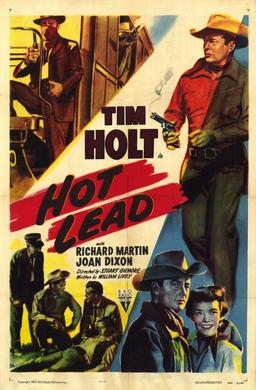
Hot Lead (1951, directed by Stuart Gilmore)


In this B-western programmer, Dave Collins (Ross Elliott) has just been released from prison.  Because he knows how to operate a telegraph, outlaw Turk Thorne (John Dehner) tries to force Dave to get a job at a local telegraph office so that Turk can use his skills to rob a train.

Despite wanting to go straight, Dave also doesn’t want to get full of hot lead.  He rides into town and gets a job at the ranch owned by Gail Martin (Joan Dixon).  He is befriended by Gail’s two ranchhands, serious cowboy Tim Holt (played, believe it or not, by Tim Holt) and his comedy relief sidekick, Chito Rafferty (Richard Martin).  Tim and Chito want revenge on Turk for killing one of their friends during a previous train robbery.  Working with Dave, they set a trap for Turk and his gang.  Meanwhile, Dave falls in love with Gail.

Hot Lead was one of the last of the 46 B-westerns that Tim Holt made for RKO Pictures.  Holt started out playing the type of prototypical happy, go-lucky cowboys who were popular in the 1930s.  At that time, he was unique as one of the few western stars to not play a continuing character who was named after him.  While the studios promoted other western stars as essentially playing themselves, Tim Holt was promoted as being a serious actor.  Holt’s films were popular with audiences but his career was put on hold while he served in World War II.  Post-war, Holt played characters who were far more world-weary than his earlier cowboys and he also started to play characters who were specifically named “Tim Holt.”

Even though most of Holt’s later films were uneven in quality, Hot Lead is one of the better examples of the genre.  Whether happy or serious, Tim Holt was always a convincing cowboy and he brings his natural gravitas to the role, playing his character as being the type of serious and no-nonsense cowboy that anyone would want in their corner.  John Dehner was always a good villain and Ross Elliott is equally good as the man struggling not to go back to his old ways.  The action scenes and the gunfights are well-directed and the story even carries an important message about giving people second chances.  Not bad for a B-western!

A Few Random Thoughts On The Oscars


Let’s just be honest about this.

No matter what else you or I might have to say about the Academy Awards, the only thing that anyone is going to remember about this year’s ceremony is Will Smith walking up on stage and slapping Chris Rock.  That’s it.  That’s what these awards are going to be known for.  Whenever this ceremony is written about in the future, the accompanying picture won’t be of the cast and crew of CODA.  Instead, it’ll be Will Smith slapping Chris Rock.

The Slap, itself, was unpleasant to watch.  Will Smith sitting back down in his chair and continuing to shout at Chris Rock was unpleasant to watch.  It left me feeling awkward and uncomfortable and I was just watching it on TV.  I can only guess what it was like the celebrities sitting in the auditorium.  You know that they were probably terrified that something unexpected would happen with the vote for Best Actor.  At that moment, there was probably a lot of worry about what would happen if Andrew Garfield pulled off an upset.

Will Smith, however, did win Best Actor.  After making a few “fierce protector” excuses, he did, eventually, get around to apologizing to the Academy and “my fellow nominees.”  He also did a lot of God talk and I’m not sure if it’s a good idea to mention God twenty minutes after slapping someone on national TV.  He mentioned that Denzel Washington had apparently taken him aside and warned him that the Devil would come for him at the height of his success.  Which …. I mean, okay.  The thing is, Will Smith is 53 years old and he’s been a star longer than I’ve been alive.  By this point, the Devil should have moved on to someone else.

A few notes on the rest of the show:

It was good to see the show taking place in a theater, as opposed to a train station.  Just by using an actual theater, this year’s Oscar ceremony was a significant improvement over the previous year’s.

The hosts were pretty boring.  There was nothing gained by having three of them.  Amy Schumer needs to fire whoever picked out her first outfit.  If Schumer picked it out herself, she needs to hire someone to pick out her outfits.  Regina Hall looked lost.  Wanda Sykes was okay but that museum segment bogged down the whole show.

CODA is a likable film and it’s obvious that the audience appreciated its heartwarming approach more than the emotionally detached style of The Power of the Dog.  The fact that this tiny little indie film managed to defeat the expensive Netflix slate was gratifying in a David vs. Goliath sort of way.  CODA, if we’re going to be honest, really does feel more like a made-for-TV movie than a feature film but I think that, emotionally and mentally, people were just ready for a positive movie that wouldn’t leave them feeling disturbed or depressed.  After two years straight of pandemic panic, voters were perhaps not inclined to honor a film that ends with its main character dying on anthrax poisoning.

Dune swept the technical awards and ended the night with the most Oscars.  Dune II is probably going to win Best Picture.

Troy Kostur’s acceptance speech was definitely the most moving part of the night.  It’s a bit of a shame that it’s going to be forever overshadowed by The Slap.

Politically, it was pretty much a typical Oscar ceremony.  At this point, I think anyone who cares enough to be offended by Hollywood’s liberalism has probably already stopped watching the Oscars.

As the Academy promised, the cut categories (i.e., the Oscars there were awarded before the start of the live show) were edited into and shown during the show.  They were awkwardly inserted, so that we would see the people in the auditorium reacting to a speech that was given two hours earlier.  It just came across as weird and fake and, whenever the hosts did anything, I found myself thinking, “They cut categories for this.”  Even a brilliant hosting trio would have suffered as a result.  In this case, you had Amy Schumer dressed like Spider-Man on live TV while the winner for Best Film Editing had to make due with edited highlights of his speech.

What’s hilarious is that, even with all of ABC’s new measures, this year’s Oscar run longer than the previous two years.  The total show clocked in at nearly 220 minutes.  For comparison, that’s 20 minutes longer than The Godfather, Part II.  Will Smith’s acceptance speech alone ran for seven minutes.  Of course, would you want to be the person tasked to tell Will Smith to wrap it up?

It was hard to tell but I guess Army of the Dead won the Twitter Poll and Zack Snyder’s Justice League won the Oscar Cheer Moment thing.  Even from just watching on TV, it was obvious how annoyed everyone in the auditorium was with them.  Personally, I have to respect the ability of the Snyder fandom to game the system.

The interpretive dance that went along with the In Memoriam segment was distracting and annoying.  If I’m ever included in a memoriam segment, I’m hoping there will be no gospel music and no interpretive dancing.

The Godfather tribute was nice but I wish they had gotten Sofia Coppola to do the introduction instead of Sean “Whatever” Combs.

In the end, the Oscars weren’t as much of a train wreck as I thought they would be but it was still a fairly unfortunate ceremony.  The category cutting didn’t sit well and I doubt I’ll ever be comfortable with that.  (It’s something that I hope will be abandoned in the future.)  This ceremony will always be known for The Slap and probably not much else.  I would say that I would hope the Academy and ABC would learn from this but the only thing they care about is ratings.  If the ratings are good, ABC will take the credit.  If the rating are bad, the Academy will get the blame.  Who knows what next year will bring?

Speaking of next year, that’s what I am now concentrating on!  There’s a lot of good movies coming out over the next few months and a whole new Oscar race to prepare for!  Let’s get to it!

Here Are The Oscar Winners


Best Picture — CODA

Best Director — Jane Campion, The Power of the Dog

Best Actor — Will Smith, King Richard

Best Actress — Jessica Chastain, The Eyes of Tammy Faye

Best Supporting Actor — Troy Kostur, CODA

Best Supporting Actress — Ariana DeBose, West Side Story

Best Adapted Screenplay — CODA

Best Original Screenplay — Belfast

Best International Film — Drive My Car

Best Documentary Feature — Summer of Soul

Best Animated Film — Encanto

Best Cinematography — Dune

Best Costume Design — Cruella

Best Film Editing — Dune

Best Makeup and Hairstyling — Eyes of Tammy Faye

Best Production Design — Dune

Best Sound — Dune

Best Visual Effects — Dune

Best Original Score — Dune

Best Original Song — No Time To Die

Best Animated Short Film — The Windshield Wiper

Best Live Action Short Film — The Long Goodbye

Best Documentary Short Film — The Queen of Basketball

6 Directors Who I Hope Win An Oscar In The Next Ten Years: 2022 Edition


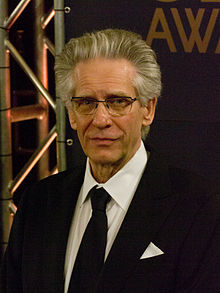
David Cronenberg

The master of the Canadian independent film, David Cronenberg, has never been nominated for an Oscar.  He’s been honored by the Canadian equivalent of the Oscars but the Academy itself has never seen fit to nominate him.

Some of that is because Cronenberg’s early films were all of the horror genre and that’s usually the kiss of death when it comes to the Oscars.  (Though that has started  to change in recent years….)  But, even as Cronenberg moved more into the “mainstream,” the Academy still seemed hesitant to embrace him.  After Map of the Stars, it was rumored that Cronenberg had retired from filmmaking and it seemed like the Academy’s only hope would be to eventually give him an honorary award, as they did for David Lynch last year.

Well, it turns out that the rumors of Cronenberg’s retirement were premature.  He’s got a film coming out later this year.  Now, I realize that David Cronenberg is about 80 years old and, in another ten years, he’ll be at an age when most people are very much retired.  That said, I hope he does have a few more films in him and I would love to see David Cronenberg win his first Oscar between now and 2032!  Seriously, I think his acceptance speech would be killer.  If nothing else, he deserves it for being such a good spot about appearing in Jason X.

Here are five other directors that I would like to see win their first Oscar within the next ten years:

2. Wes Anderson

He was previously nominated for Grand Budapest Hotel.  That this year’s French Dispatch was both praised and criticized as being “the most Wes Anderson film that Wes Anderson has ever made” is a sign of why he sometimes struggles with the Academy.  Anderson is one of those directors who people either love or hate.  You either respond to his trademark quirkiness or you sit there with a permanent frown on your face.  My hope is that enough people will love him that he’ll pick up his first directing Oscar in the next ten years.

3. Fran Kranz

Mass was one of the best and, in its low-key way, bravest films of 2021 and I can’t wait to see what Kranz is going to do next.  Somehow, it seems appropriate that the stoner from The Cabin In The Woods just might be our next great director.

4. Emma Seligman

Shiva Baby was one of the best films of 2021, with director Emma Seligman deftly mixing comedy, horror, drama, and even a little romance with the surest of hands.  Much as with Fran Kranz, I can’t wait to see what she does next.

5. David Lowery

Like Wes Anderson and Richard Linklater, David Lowery is a Texas filmmaker who has emerged as one of the best independent voices working today.  A Ghost Story and The Green Knight both deserved a bit more Oscar consideration than they were given.

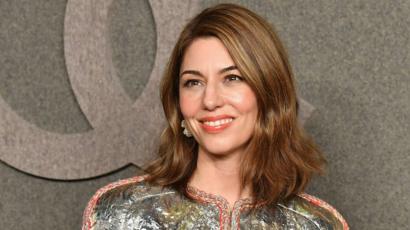
6. Sofia Coppola

Get with it, Academy!