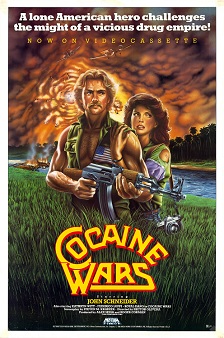
Cocaine Wars (1985, directed by Hector Olivera)


In 1980s Bolivia, the most powerful drug lord is Gonzalo Reyes (Federico Luppi).  Working with General Lujan (Rodolfo Ranni), Reyes runs his own concentration camp, where people are forced to process the cocaine that is then sold in the United States.  Reyes’s pilot is an American named Cliff Adams (John Schneider).  Reyes eventually gives Cliff a very important assignment.  He wants Cliff to assassinate Marcelo Villalba (John Vitali), a crusading journalist who is running for president of the country.

What Reyes and Lugan don’t know but soon learn is that Cliff is actually a Miami-based DEA agent who has been working deep undercover.  Despite his assignment and the fact that even the U.S. government seems to consider Villalba to be expendable, Cliff refuses to carry out the assassination.  Soon, he and his girlfriend (Kathryn Witt) and their friend Bailey (Royal Dano) are being pursued by Reyes and Lujan.  Cliff’s girlfriend is also a reporter and she has compiled a story that, if it is published, will blow the lid off of Reyes and Lujan’s partndership.

Produced by Roger Corman and filmed in Argentina, Cocaine Wars is very much a product of its time.  In the 1980s, America was all about the War on Drugs, especially the War on Cocaine.  However, some of the world’s biggest drug lords were working with the tactic approval of some of America’s most important allies in South and Central America.  For as long as it was convenient and strategically useful, the American government would look the other way.  It was only when the situation became internationally embarrassing, as in the case of Panama’s General Manuel Noriega, that the U.S. would actually step in.  This was certainly the case in Bolivia, where drug lords were so essential to overthrowing the government that the subsequent coup was referred to as being “the cocaine coup.”  General Lujan is a stand-in for a large number of Bolivian military men who continually overthrew the country’s democratically-elected leaders.  By including several Germans among Reyes’s organization, Cocaine Wars also acknowledges the role that Nazi war criminal Klaus Barbie played in not only propping up a series of Bolivian strongmen and drug organizations but also teaching the Bolivian secret police how to torture information out of political prisoners.  While Cocaine Wars is not primarily a political film, it is still notable as an early example of a film that pointed out why the War on Drugs was destined for failure.

As for the film itself, it is a standard low-budget action film.  There aren’t any huge surprises to be found but, at 82 minutes, it moves quickly and it has enough action to satisfy fans of the genre.  John Schneider may not have been Sylvester Stallone, Arnold Schwarzengger, or even Chuck Norris but that works to the movie’s advantage.  Unlike those bigger-than-life heroes, Schneider does not come across as being indestructible and that adds a little more suspense to the inevitable gunfights and torture scenes.  Schneider is a likable and effective action lead, even if you never do forget that you’re essentially watching a TV actor taking a stab at the big screen.
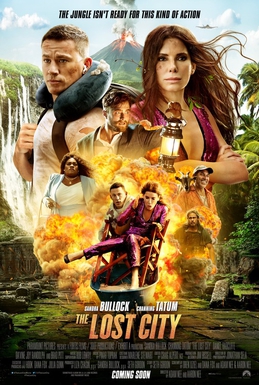
Film Review: The Lost City (dir by Adam and Aaron Nee)


Last month, when I finally watched The Lost City, I had two thoughts.

First off, I thought it was a perfectly charming little movie, a well-made and unpretentious film that went out of its way to entertain its audience and which, for the most part succeeded.  The film, which features Sandra Bullock as Loretta Sage, a reluctant writer of sex-filled romance/adventure novels, and Channing Tatum as Alan Caprison, an earnest but not terrible bright cover model, strikes just the right balance of adventure and comedy.  Bullock and Tatum are charming together.  Brad Pitt has a fun cameo as an ultra-macho wilderness guide who is hired to help track down Bullock after she’s kidnapped by a wealthy businessman who wants her to help him track down the fabled crown of fire.  Daniel Radcliffe gives a nicely eccentric performance as the villain and, for once in his post-Potter career, actually seems to be having fun with a role.  The jungle scenery is lovely to look at.  Bullock’s purple sequin jumpsuit is to die for.  Tatum shows off his physique.  The jokes come fast, the action is exciting, and we get to watch two people fall in love.  What more could one ask for?

My other thought is that The Lost City is a film that Sandra Bullock could have made at any point of her  career.  There’s never been a time when Bullock wouldn’t have been convincing in the role of Loretta Sage.  It’s easy to imagine The Lost City coming out in the aughts, starring Sandra Bullock as Loretta and Brendan Fraser as Alan.  Or perhaps even in the 90s, with Bullock and Matthew McConaughey as Alan.  Much as Top Gun: Maverick does for Tom Cruise, The Lost City serves to remind us that Sandra Bullock is one of the last true film stars, someone who can effortlessly move from genre to genre without losing any of their onscreen charisma in the process.  For audiences who have just spent the last two years being told that the world was collapsing and that nothing would ever be the same again, there is something undoubtedly comforting about films like Top Gun: Maverick and The Lost City.  They are a reminder that yes, it is permissible, possible, and even necessary to just have a good time.

And have no doubt about it, The Lost City is definitely a good time.  From the opening scene (which literally takes us into one of Loretta’s novels) to Loretta’s disastrous book tour to the eventual journey through the jungle, The Lost City is an entertaining film.  It’s not a film that asks for much from the audience.  There’s no complicated backstory.  It’s not necessary to have seen 10 earlier movies and a miniseries to understand everyone’s motivations.  There’s no bad CGI to challenge the audience’s willingness to buy into the story.  The film gets the job done in a relatively brisk 112 minutes and, at a time when even comedies are regularly running over two hours, it’s hard not to appreciate the efficiency with which The Lost City tells its story.  There is a mid-credits scene but it’s actually kind of funny.  For once, the promise of a sequel feels likes something for which to look forward.

If you missed The Lost City in theaters, it can currently be viewed on Paramount Plus.

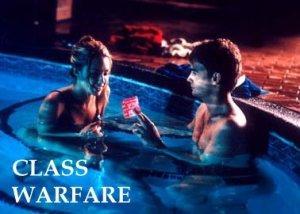
Class Warfare (2001, directed by Richard Shepard)


Kristen Marshall (Lindsey McKeon) is a rich high school girl with a problem.  She’s not rich anymore!  Her parents have lost all of their money due to a shady business deal and now, Kristen might not even be able to afford to go to Harvard!  Even the fact that she’s the senior class president and drives an expensive car might not be enough to convince those Boston brahmins to give her a scholarship.  Looking to get away from all of her problems, Kristen and her boyfriend, Jason (Wade Carpenter), decide to spend the weekend at their friend Graham’s (Dave McGowan) lakehouse.  Kristen, however, is upset to discover that Graham has also invited Richard Ashbury (Robin Dunne).

Richard is a high school activist, a self-professed Socialist who spends his time putting up flyers for a food and clothing drive.  Kristen first met Richard when she accidentally hits him with her car.  (Kristen was in a hurry and she didn’t notice Richard riding by on his bicycle.)  Though Richard was uninjured, Kristen’s car was slightly dented and Richard told her that he was sure that her family would be able to pay for it.  Now, Kristen is stuck spending the weekend with him and, to make things even worse, Richard looks at a newspaper and discovers that he has got a winning lottery ticket.  As soon as the weekend ends, he’ll turn in the ticket and get $25 million dollars!  Meanwhile, Kristen is having nightmares about her guidance counselor denying her application for a college loan while Richard lights a cigar with a hundred dollar bill!

Eager to that get that ticket for herself, Kristen first tries to seduce Richard.  When that doesn’t work, Kristen orders Jason to kill him.

Class Warfare definitely has a made-for-TV look about it but, when taken on its own terms, it’s not bad.  Lindsey McKeon is an effective villain and the other actors are all credible in their roles, even if it’s obvious that most of them haven’t been in high school for a good couple of years.  The movie’s class warfare theme was sometimes simplistic but the film still did a good job of ratcheting up the stakes as one mistake led to another.  Nowadays, people take the lottery for granted but Class Warfare does capture that moment when people really did feel like their lives could be changed in an instant.

Class Warfare was produced by the USA Network and originally aired on December 24th, 2001.  I guess that was USA’s way of saying, “Merry Christmas!”

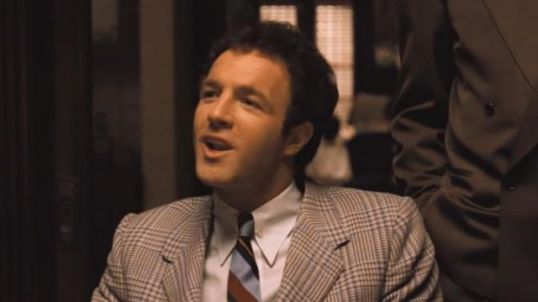
Scenes I Love: James Caan in The Godfather


James Caan has passed away, at the age of 82.  There are a lot of great James Caan performances to choose from and to highlight.  For me, though, he’ll always be Sonny Corleone, the temperamental son of the Don who remains oddly likable, even as he cheats on his wife and threatens to kill every other gangster in New York.  Sonny is a force of chaos, which ultimately leads to his untimely death.  But, at the same time, it also makes him someone who you definitely fighting for you instead of against you.

The scene below is mostly cited for Al Pacino’s quiet intensity as he reveals that he’s truly become a member of the family.  While Pacino’s great, Caan’s reaction is just as important.

In the scene below, Sonny discovers that Carol has been beating up Connie so Sonny beats up Carlo.  Carlo really deserved it.  Now this scene is often cited for featuring one shot where it’s clear that Caan didn’t actually hit Gianni Russo.  That’s fair.  But still, Caan actually did make contact enough times that Russo ended up with a broken rib.  Look past that one shot and you’ll see that, in this scene, Caan clearly shows why Sonny was such a feared figure.  Even more importantly, this scene shows how important his family was to Sonny.  Who doesn’t want someone who would beat someone up for them?

And finally, in this scene, Sonny tells off the FBI.  How can’t you love that?  Apparently, the smashing of the camera was something that Caan improvised on the spot.

That said, there was a lot more to Caan’s career than just The Godfather.  Watch all of his films.  He was one of the greats and perhaps the only celebrity who was actually worth following on twitter. RIP.

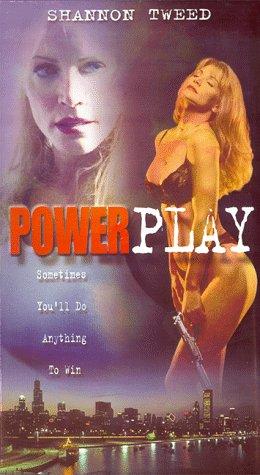
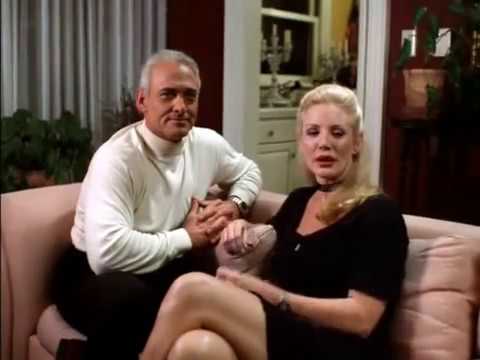
Powerplay (1999, directed by Chris Baugh)


Shannon Tweed plays Jacqueline, a sexy con artist who seduces older men and then, after she poisons them, runs away with all of their money.  After her latest target, Benjamin Alcott (Bryan Kent), ends up floating dead in his swimming pool, Jacqueline heads off to find her next target.  Ben’s estranged daughter, Candice (Danielle Ciardi), is upset to learn that Ben only left her his library of book while leaving all of his money to Jacqueline.  Along with her sleazy boyfriend, Steve (Jim Richer), Candice tracks Jacqueline down and tries to con the con artist.

Shannon Tweed is top-billed in Powerplay but she’s not in much of the movie.  Both onscreen and off, this was clearly a take the money and run job for Tweed.  Still, a little bit of Tweed is better than no Tweed at all, especially where a film like Powerplay is concerned.  Of all the actresses who regularly appeared in late night Cinemax in the 90s, Tweed was definitely the most talented and she brings some needed energy to her scenes.  Tweed’s main strength as a star was always that she could be appealing and sexy even while she was smirking about killing someone and Powerplay makes good use of that ability.

The majority of the film, though, follows Candice and Steve as they try to track Jacqueline down.  In a nice twist, Candice is just as greedy, voracious, and cold-hearted as Jacqueline and Danielle Ciardi (who bore a probably not coincidental resemblance to Neve Campbell in Wild Things) does a good job of playing her.   This was Ciardi’s film debut and, according to the imdb, her only starring role.  That is too bad because it seems like she had the talent to do much more.  Unfortunately, Jim Richer is far less effective in the role of Steve.  In fact, all of the male performances in Powerplay are lousy and are not helped by an overly convoluted script that features a few plot twists that are incoherent even by the standards of the typical direct-to-video neonoir.  Powerplay ends with multiple cons and double-crosses but none of them feel earned.  There’s a difference between something like Stephen Frears’s The Grifters, where the con is obvious once you know what to look for, and Powerplay, where the con feels like a last minute addition to the script.

But who am I kidding?  This film wasn’t made for an audience that’s going to be watching for the plot.  They’re going to be watching because Shannon Tweed takes a shower while the man she poisoned dies nearby and because Candice is written and portrayed as almost being a nymphomaniac.  (Candice has a creative way of handling things when a hotel employee knock on the door of a room that she’s not supposed to be in.)  Powerplay has enough sex and nudity that it was undoubtedly popular when it showed up on late night Cinemax in 1999.  But it doesn’t have enough of a story to be memorable for any reason beyond that.

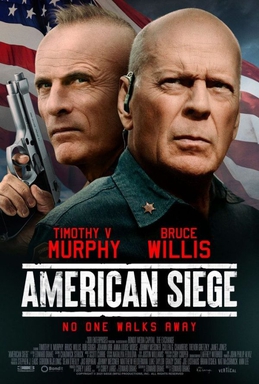
Film Review: American Siege (dir by Edward Drake)


For a few months, I’ve been going back and forth on whether or not I wanted to review American Siege.

On the one hand, I try to review every film that I see, regardless of how bad (or good) it might be.  I love movies.  I love talking about them.  I love writing about them.  I love sharing my opinions about them and hearing and reading the opinions of others.  That goes for all films, even really bad ones like American Siege.

On the other hand, American Siege is also one of the films that Bruce Willis made shortly before announcing his retirement from acting.  Since his retirement was announced, there have been a lot of stories that have suggested that Bruce’s condition led to him accepting a lot of roles that he normally would not have even considered and that Willis was not always fully aware of what was happening on the sets of the films in which he appeared.  Regardless of how much of that is true or not, it’s a heart-breaking story and it makes it difficult to watch Willis in a film like American Siege.

In American Siege, Willis plays a sheriff in a small Georgia town.  When a group of loud rednecks take a local pharmacist hostage, Willis and his deputies drive out to the man’s house.  However, Willis is ordered to stand down by the richest man in town, who is played by Timothy V. Murphy.  It turns out that the pharmacist has evidence that links Murphy to an unsolved crime.  The rednecks might be loud and stupid and self-destructive but it turns out that they’re not actually the worst people in town.

American Siege is 90 minutes of people shouting at each other and pointing guns out of windows.  There’s not much of a story to be found and even the unsolved mystery is a bit of a dud.  As was typical of his last few films, Bruce Willis is only on screen for a few minutes and he delivers his lines in a heart-breakingly flat monotone.  The rest of the cast is actually okay, even if they do go bit a overboard with the fake Southern accents.  The rednecks are convincingly redneck-y and Murphy is convincingly condescending as the rich man who has never had to face any consequences for his actions.  But the main reason anyone is going to watch this film is because of Bruce Willis and, sadly, there’s none of the swagger that made Willis in a superstar.

So, why am I reviewing American Siege?  Mostly it’s so I can recommend that, if you are really determined to watch one Bruce Willis’s later films, you skip American Siege and watch Gasoline AlleyGasoline Alley was made by the same director and it also features Bruce Willis but it’s a hundred times better than American Siege and it actually gives Willis a decent role to go out on.

Of course, my ultimate recommendation, as far as all this is concerned, is that you go and rewatch the first three Die Hards.  They’re not just for Christmas!

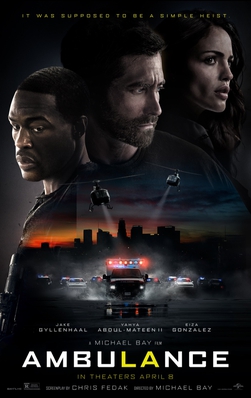
Film Review: Ambulance (dir by Michael Bay)


Ambulance is the ultimate Michael Bay movie.

Obviously, whether or not that’s a good thing for you personally will depend on how you feel about Michael Bay.  As a director, Bay specializes in kinetic thrill rides, the type of films where the camera never stops moving, the characters are attractive but shallow, and every plot development is an excuse for another action sequence.  Michael Bay is hardly the first, only, or last director to put action and spectacle above characterization and a coherent storyline.  However, he might very well be the most shameless about it.  Michael Bay’s approach has not made him a favorite of the critics but it has usually proved successful with audiences.  Personally, I’ve smirked at a lot of scenes in a lot of Michael Bay films.  (I still laugh whenever I remember the slow motion shot of the children playing in front of the faded JFK campaign poster in Armageddon.)  But, in this age of self-important filmmakers, it’s hard not to appreciate a director who just wants to have a good time.

And, make no doubt about it, Ambulance is definitely a good time.  The film’s plot is simple.  Jake Gyllenhaal and Yahya Abdul-Mateen II rob a bank.  When the robbery goes wrong, they hijack an ambulance.  In the back of the ambulance is an EMT played by Eliza Gonzalez, who is desperately trying to keep a wounded cop (Jackson White) from dying.  Gyllenhaal and Abdul-Mateen also want to make sure that the cop doesn’t die because they know that, if they’re captured, the penalty for being a cop killer is considerably worse than the penalty for being a bad bank robber.  With the entire LAPD and the FBI in pursuit, the two men drive the ambulance through Los Angeles, trying to find a way to escape.  Essentially, Michael Bay said, “You know how everyone enjoys a chase scene?  What if we made the chase scene last for 136 minutes?”  And wisely, some people gave him money to do just that.

(Actually, that’s just the way that I like to imagine it.  Ambulance is actually a remake of a Danish film and Michael Bay originally passed on the project.  But, as they put it in The Man Who Shot Liberty Valance, print the legend.)

Jake Gyllenhaal may be top-billed but the star of Ambulance is definitely Michael Bay.  In many ways, there’s not much about Bay’s direction here that’s different from what he’s been doing since The Rock.  The camera moves a lot.  The images are sharp and clear.  The rapid-fire editing captures the chaos of the action scenes, occasionally at the cost of letting the audience know just who exactly is shooting at who.  But what sets apart Ambulance from other Bay films is that Michael Bay finally discovered his greatest collaborator, the drone.  Bay’s camera flies across Los Angeles, zooming over buildings and down streets and essentially making the viewer as much a part of the chase as Gyllenhaal and the cops pursuing him.  Ambulance moves with so much energy and confidence that it doesn’t matter that it’s a bit too long and that Gyllenhaal’s plan often doesn’t make much sense.  Ambulance is a thrill-ride, a film that rewards anyone who is willing to just go with it.  It’s an example of what Lucio Fulci called “pure cinema,” where the story itself is not as important as the way the director puts it all together.  I enjoyed it.  That ambulance barreling through the streets of Los Angeles was the 21st century equivalent of the speeding train that thrilled and terrified audiences during the silent era.

Unfortunately, Ambulance struggled a bit at the box office.  I’m a bit confused as to why, other than it wasn’t a part of a franchise or a sequel (like The Batman, Dr. Strange, and Top Gun: Maverick) and it didn’t have the mix of strong reviews and pop cultural cachet that led audiences to make Everything Everywhere All At Once into a hit.  Along with reviews that were more interested in criticizing Michael Bay in general as opposed to actually considering whether or not the film itslef worked, Ambulance was damaged by the fact that audiences were still getting used to the idea of leaving their homes for a night out.  I get the feeling that a lot of people looked at the commercials for Ambulance and said, “That’s something I can watch at home.”  (Admittedly, that’s what I did.)  It’s a shame that Michael Bay’s ultimate (and, I would say, best) film is also one of the few to be deemed a box office failure.  The film is currently on Peacock.  Try to watch it on the biggest screen you can find.

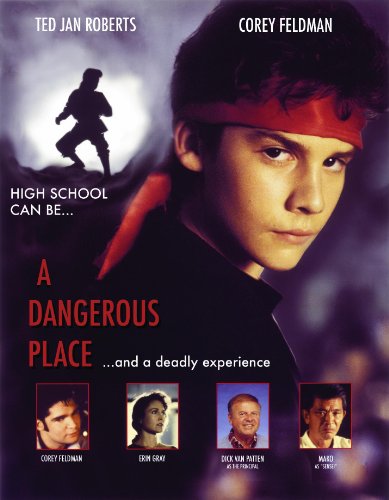
A Dangerous Place (1994, directed by Jerry P. Jacobs)


In A Dangerous Place, a young karate student avenges his brother’s death and Corey Feldman impersonates Christian Slater.

Greg (Dean Cochran) and his younger brother, Ethan (Ted Jan Roberts), are both students of a sensei (Mako) who teaches that sparing an enemy is the best way to make a friend and that true martial artists do not compete in tournaments.  Greg wants more out of karate so he starts hanging out with The Scorpions, a gang led by Taylor (Corey Feldman).  The Scorpions all belong to a dojo owned by Gavin (Marshall R. Teague), who teaches that mercy is a weakness.  When the Scorpions aren’t beating up people at the beach, they’re “scavenging.”  They break into houses and businesses, steal what they can, and claim that homeowners insurance means that they’re actually doing everyone a favor.  When one robbery goes wrong, Greg tries to stop Taylor from killing a homeowner.  Taylor fights back and the end result is Greg falling over a railing and dying.  

The Scorpions leave Greg hanging in the high school gym.  The police think that Greg committed suicide but Ethan knows that his brother would never end his own life.  Ethan knows that the Scorpions are responsible.  He leaves his old dojo and joins Gavin’s dojo.  Ethan now has an in with the Scorpions but, if Gavin and Taylor are going to trust him enough to reveal the truth about what happened to Greg, Ethan is going to have to betray his old sensei and set up a match between the two dojos.  Ethan is going to have to abandon his own peaceful principles about become as bad as the people he is trying to take down.

For a low-budget Karate Kid rip-off, A Dangerous Place is not as bad as it sounds.  Some of the fight scenes are exciting, Mako is a decent stand-in for Pat Morita, and Marshall R. Teague does a passable Martin Kove impersonation as the leader of the bad dojo.  Corey Feldman imitating Christian Slater imitating Jack Nicholson does eventually get old but, since Feldman is playing the bad guy here and we’re not supposed to like him, it actually works to the film’s advantage.  Finally, Dick Van Patten, of all people, has a small role as the high school’s principal.  Mako, Feldman, Van Patten, and karate?  A Dangerous Place is dumb but entertaining.

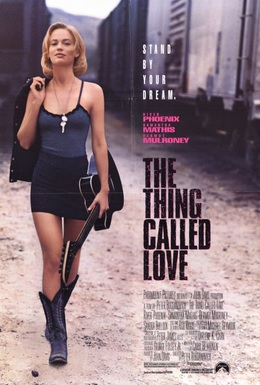
Film Review: The Thing Called Love (dir by Peter Bogdanovich)


First released in 1993 and directed by Peter Bogdanovich, The Thing Called Love takes place in Nashville, the city that, for many people, has come to define Americana.

Of course, for those who actually love movies, it’s difficult to watch any film about Nashville and the country music scene without being reminded of Robert Altman’s American epic, Nashville.  Much like Nashville, The Thing Called Love follows a group of wannabes, stars, writers, and performers.  However, whereas Robert Altman used the city and its residents as a way to paint an acidic portrait of a nation struggling to find its way in an uncertain new world, The Thing Called Love is far less ambitious.

The Thing Called Love centers around Miranda Presley (Samantha Mathis).  Miranda is from New York but she loves country music.  She comes to Nashville to try to sell her songs and become a star.  Instead, she ends up working as a waitress at the “legendary” Bluebird Cafe.  While she waits for her big break, she meets two other aspiring writer/performers, Linda Lu (Sandra Bullock) and Kyle Davidson (Dermot Mulroney).  Kyle falls in love with Miranda but Miranda falls in love with and marries James Wright (River Phoenix, brother of Joaquin).  Unfortunately, while James is talented, he’s also a bit of a jerk.

The Thing Called Love aired on TCM last year and I can still remember checking out the #TCMParty hashtag on twitter while the film was airing.  The majority of the comments were from people who loved TCM and who couldn’t understand why the channel was showing this rather forgettable movie.  The answer, of course, is that the film was directed by Peter Bogdanovich and Bogdanovich was one of the patron saints of TCM.  Along with being responsible for some genuinely good films (Targets, The Last Picture Show, Paper Moon, Saint Jack, Mask, The Cat’s Meow), Bogdanovich was also a very serious student of the history of film.  Up until he passed away in January, Bogdanovich was a familiar and welcome sight on TCM.  Listening to him talk about John Ford, Alfred Hitchcock, and especially Orson Welles was always a delight.

Unfortunately, as Bogdanovich himself often admitted, the majority of his later films failed to reach the heights of his earlier work and that’s certainly the case of The Thing Called Love.  It’s not so much that The Thing Called Love is bad as it’s just really forgettable.  There’s very little about the film that suggests that it was directed by cineaste who was responsible for The Last Picture Show.  Samantha Mathis is likable but a bit bland in the role of Miranda while River Phoenix plays James as being such a jerk that you really don’t care about whether or not he finds success.  From what I’ve read, Phoenix based his performance on watching Bob Dylan in the documentary Don’t Look Back.  Dylan is notably mercurial in that documentary but, it should be noted, that Dylan eventually abandoned that persona once he realized that it was a creative dead end.

To be honest, I think the film would have worked better if Samantha Mathis had switched roles with Sandra Bullock.  This was one of Bullock’s first films and she steals every scene in which she appears, giving an energetic and likable performance as someone who never allows herself a single moment of doubt or despair.  As opposed to the self-loathing Phoenix and the bland Mathis and Mulroney, Sandra Bullock represents the hope and optimism that Nashville is meant to symbolize.  In the end, her performance is the best thing about The Thing Called Love.

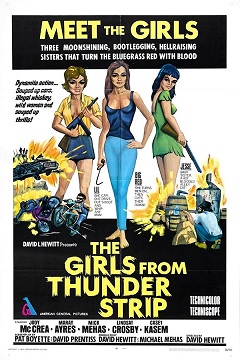
The Girls From Thunder Strip (1970, directed by David L. Hewitt)


This one is pretty bad.

A group of dirty, good-for-nothing bikers roll into a Southern town.  Led by Teach (Gary Kent), the bikers are obsessed with murder and rape, the latter of which opens the film and is treated in a fashion that is meant to be comedic.  When some pointless bullying of a gas station attendant leads to the gang’s only female member getting stabbed to death, the bikers are arrested and thrown in the county jail.

Meanwhile, three sisters (Maray Ayres, Megan Timothy, and Melinda MacHarg) are making their own moonshine and selling it to the local hillbillies.  A federal agent (played by Casey Kasem, the DJ who used to countdown the Top 40 songs in America and who voiced Scooby-Doo’s stoner friend, Shaggy) comes to town and insists that the local sheriff (Jack Starrett) arrest the three sisters.  However, only one of the sisters is taken to jail while the other two escape.  The federal agent manages to accidentally blow up the still but he only ends up with a face full of soot as a result.  That Kasem can survive getting blown up without getting so much of a scratch on him would make sense if the rest of The Girls From Thunder Strip were presented as being a live-action cartoon but it’s not so the entire Kasem storyline feels like it was lifted from another, more light-hearted moonshiner movie.

With the help of the bikers, the incarcerated sister is able to break out of the county jail.  But just because they helped each other, that doesn’t mean that the sisters trust the bikers, especially after the bikers murder a deputy who happened to be a cousin to the bootleggers.  The bikers try to take over the moonshine business while the sisters (and one convenient mountain lion) take on the bikers.

The movie is all over the place.  On the one hand, you’ve got the bikers raping and killing nearly everyone they meet.  On the other hand, you’ve got Casey Kasem, playing a federal agent and pursuing the sisters with all the panache of a cartoon cat chasing a mouse.  The action scenes are lousy.  The characters have no motivation.  With one exception, the actors are terrible and no, that exception is not Casey Kasem.  Instead, the one exception is Jack Starrett, who plays the sheriff.  Starrett, with his trademark gravelly voice, was a director who had sideline playing intimidating authority figures.  In First Blood, he played Galt, the worst member of Brian Dennehy’s police force.  (He was the one who laughed when he ordered the deputies to shave Rambo with a straight razor.  Later he fell out of a helicopter and Rambo was blamed for his death.)  Starrett gives the same performance in The Girls From Thunder Strip that he later gave in First Blood and since the sheriff is not actually given a name, I’ve decided that he and Galt are the same character and Girls From Thunder Strip takes place in the Rambo Cinematic Universe.

Other than providing a look at the early life of Art Galt, there’s not much else to recommend The Girls From Thunder Strip.  Even aficionados of the biker and moonshine genres will want to look elsewhere.